Thursday, September 29, 2005
Scan & Return
How would you like to walk away from the recording counter with your recorded original document stuffed snuggly in your briefcase? A new program at the registry of deeds in Worcester is allowing that to happen with selected documents. Here’s how it works: the document is recorded in the usual manner with the registry clerk entering all applicable indexing data and then collecting the appropriate fee. Once the financial part of the transaction is entered into the cashiering terminal, the computer system assigns that document a book and page number and notes the time of recording. A receipt and a bar code label which is affixed to the document are also produced. At this registry, we then hand the customer the receipt and we keep the original document, scanning it within a few hours. Once the document is scanned, we shoot microfilm from a paper print of the scanned document image, but we hold onto the original document until the microfilm is developed and we view it frame by frame to confirm that good images have been obtained for all documents. Then, we either return documents to those who have pickup boxes or who have provided us with self-addressed, stamped envelopes or we place the document in our unclaimed “no postage” storage area. Either way, it’s a laborious and time consuming process. Worcester’s experimental program has eliminated much of this work. There, immediately after the document is recorded and while the customer is still standing there at the counter, the registry clerk scans the document at a scanner that’s immediately adjacent to the cashiering terminal. The clerk then opens the newly scanned image in the Search program to ensure it was captured adequately, and prints it for backup purposes. If all is in order, the clerk hands the original document back to the customer. There registry doesn’t have to worry about storing or handling that document ever again. Right now, Worcester is experimenting with this process for documents of only a few pages. Handling a multi document, multi mortgage transaction in this way wouldn’t work very well – there’s be too many pages to scan while the customer stood there. But it’s certainly a start and an idea we are looking into.
Wednesday, September 28, 2005
The Red Sox Effect

Many of you may have seen the recent medical study reported in the national press that emergency room visits to Boston hospitals dropped during important Red Sox games. I’m starting to think that the same phenomena holds true for registry of deeds activity. My theory is that when the Red Sox reach a critical point in the season, everyone in the real estate business becomes so focused on baseball, that all conveyancing activity ceases. The next couple of days will allow us to test this hypothesis. When the end of the month falls on a Friday like it does this month, we have historically seen the highest level of recording activity of the year. This time, however, the Red Sox are in a tight pennant race and moving into a three game series with the New York Yankees beginning Friday night. If the registry of deeds is empty this Friday, September 30, the only explanation can be that the Red Sox are to blame.
Tuesday, September 27, 2005
Document Formatting Standards
As we’ve mentioned here before, a new version of the Massachusetts Deed Indexing Standards is in the works. Next week, the Registers of Deeds Association will meet to refine the most recent draft. We expect the new version will go into effect on January 1, 2006, however, the “Document Formatting Standards” section, because it has such far reaching consequences for document preparations, should have a one year grace period. For the first year, therefore, the Document Formatting Standards should be advisory only but will become mandatory on January 1, 2007. Of course, this is just my expectation of what will happen – nothing is definite yet. Here is a preview of the formatting standards that are being proposed – all subject to revision, of course. Documents shall be on white 20-pound paper without watermarks. All document pages and attachments must be on paper that is a minimum size of 8.5 inches by 12 inches or a maximum paper size of 8.5 inches by 14 inches. Printing shall be on one side of page only; no double-sided pages will be accepted. On the first page of a document, the top margin shall be 3 inches; the side and bottom margins shall be 1 inch. On second and subsequent pages of the same document, all margins shall be 1 inch. All documents must be printed or typed in a font size no smaller than 10 point Times New Roman or equivalent. Blanks in an instrument and corrections to an instrument may be made in pen. Signatures shall be in either black or dark blue ink. Names shall be typed, stamped or printed beneath all written signatures.
All documents must display on the first line of print on the first page a single title identifying the recordable event that the instrument represents. Do not use colored markers to highlight text. That’s it. Please send me any comments you may have.
All documents must display on the first line of print on the first page a single title identifying the recordable event that the instrument represents. Do not use colored markers to highlight text. That’s it. Please send me any comments you may have.
Monday, September 26, 2005
Scanning Update

Detail Courthouse Foyer
Update on the "missing image scanning project". In a week we checked approximately one thousand books. That's about two hundred a day. This is an excellent pace in my opinion. Up to this point the results are a little surprising. Of the one thousand books that have been checked, only three are missing in their entirety. Mostly we are finding small two and three page gaps. Some books have as many as seven or eight of these. The plan is to make copies of the missing images from the books themselves…then scan them. You may recall from an earlier post that our electronic images were taken from microfilm…This has made us a little concerned that the missing “electronic images” may also be missing on the microfilm. Since the possibility does exist (although small) that the film is incomplete we intent to microfilm the paper copies after scanning…we’ll sleep better.
Friday, September 23, 2005
Visitors from Tomsk
Today we had the pleasure of having some judges and law professors from Tomsk, Russia visit the registry of deeds. They’ve spent the week in Massachusetts, visiting various courts and government offices. Since hearing about the registry of deeds can get a bit tedious even for listeners who are fluent in English and have some background in American property law, we highlighted some of the unique features of this place, especially our electronic recording system and our website. While they seemed suitably impressed when we recorded a discharge electronically (the image and data was submitted by a remote user), they seemed astounded at the amount we charge to record documents (a justifiable and boundary-less response to our high recording fees). There were also several questions about the risk of fraudulent documents being recorded and what we can (and can’t) do to prevent it. Everyone also crowded around one of our oldest record books to see a 1640 deed from several Indian tribes. The locus was a 50 mile wide swath of what is now northern Massachusetts and southern New Hampshire, extending from the eastward bend in the Merrimack River in Lowell all the way to the Atlantic Coast at what is now Portsmouth, New Hampshire. Oh, and the purchase price for this sale was “a wagon load of winter coats and the love and affection we have for our English king.” A buyer’s market, I suppose. What made this document particularly interesting was the manner in which the tribal chiefs signed it, not with signatures, but with uniquely individual pictographs – small stick figures, each slightly different in appearance, each representing a different chief. Finally, we used the Google Earth program to demonstrate how we plan to link overhead photographs and maps of the property in our district to the documents recorded here at the registry.
Thursday, September 22, 2005
More on National Lumber
Yesterday the Legislative Subcommittee of the Massachusetts Registers of Deeds Association held a meeting in Worcester. We discussed the implications of the National Lumber case at length. While we all disagreed with the decision in the case – it interprets archaic statutes in a way divorced from the reality of the recording business – we are compelled to follow its dictates until the relevant laws can be changed. The Appeals Court, in interpreting sections 14 and 26 of chapter 36 of the Massachusetts General Laws essentially decreed that a document is deemed to be “recorded” when it physically comes into the custody of the registry of deeds. After that, the registry has 24 hours to fully index the document. Until this case, every registry (and every attorney, for that matter) has considered a document to be recorded when the registry enters the document in the index and affixes some recording information (usually date/time of recording and instrument number) to the document. An unwritten rule has evolved that says, if you are concerned about when your document is to be recorded, have a human being bring it to the registry and stand there while it is recorded. Not unreasonably, registries have treated mail as “time non-sensitive” meaning that anyone who mails something to the registry can’t be all that concerned with how quickly the document is recorded. Obviously, the registry has a duty to record documents received by mail within a reasonable amount of time. But what is “reasonable” is a variable concept: mail received on a Wednesday in the middle of the month is recorded much quicker than a document received on the last day of the month when our walk-in business usually doubles. Tony Vigliotti, the Register of Deeds in Worcester, gave some historical context to this situation when he recalled that when he started as register (at a very young age) back in 1978, the registry would record all mail before taking a single customer. That changed because the public wouldn’t stand for it, but if one was to follow the letter of the law and of this decision, that’s exactly how recording should be done. Here in Lowell, our mail arrives at approximately 11:00 a.m. each day. If we were to follow the prescribed steps (without modification) we would have to immediately stop all walk-in customer recording, concentrate all of our efforts on recording that day’s mail, and only begin to record walk-in customers again when the mail was all recorded. Now that would be a big change.
Wednesday, September 21, 2005
mea culpa
This morning will began a “long, long” overdue project… First some background…Way Back When…we had approximately 2 million document images captured from archived microfilm and placed on CD’s. Later, when money became available these images were loaded from the CD’s onto our computer server…of course, this made the images available for viewing both internally and on the Internet. The images were captured using an “automated” scanning system…fast yes, but…no “human eye” was checking to see if an image was missing. Up until this morning we relied upon our computer users (you) to let us know if an image was missing. When someone mentioned a problem …we fixed it (not very scientific or efficient I must admit). Finally, we took the bull by the horns…This morning we assigned an employee to search from book 2705 forward looking for missing images. The process is not as time consuming as you might think…When we bring up a document entry (the indexing information) a flag appears beside the information if an image is connected to it. Fittingly, we call this an “image flag”…Simply put, the missing images are identified by finding the entries without “image flags”…and what makes this even easier is that a complete book can be brought up in one search. The checker simply scans the entire book’s entries looking for missing “image flags”. A book can be checked in about five minutes. A second employee has been assigned the task of "scanning in" the missing documents. We are starting with book 2705 because these later books are bound in plastic covers and can easily be disassembled, scanned then reassembled. A second phase of this project will be to attack the earlier books. As I began... this is a long overdue project…mea culpa, mea culpa, and mea culpa.
Tuesday, September 20, 2005
National Lumber v Lombardi
A disturbing and far-reaching decision by the Massachusetts Appeals Court is the lead story in this week’s Massachusetts Lawyers Weekly. “Registry’s late recording won’t bar lien enforcement” reports on National Lumber v Lombardi, a case about the enforceability of a mechanic’s lien. After filing the applicable notice requirements at the registry, the plaintiff filed suit and then sent an attested copy of the complaint to the registry of deeds with the correct filing fee by Federal Express. The document was received by the registry well within the 30 days required by statute to perfect the lien, but the registry did not actually record the document for nearly five weeks, a delay that put the time of recording outside of the statutory period. (This happened in 2002 when historically high recording volumes caused most registries to fall far behind in the recording of mail). The defendants moved to dismiss the mechanic’s lien on the grounds that the required complaint was not timely filed. The Appeals Court disagreed, stating that the registry of deeds had a duty to record documents received by mail correctly and within 24 hours of receipt. The court further stated that the registry’s failure to do this could not be used to harm the party that had mailed the documents. The court’s remedy seemed to be to deem a document to be “recorded” at the moment it is received by the registry of deeds and not the time it is actually entered into the registry’s computer system and assigned an instrument number and an official time of recording. The implications of this decision for registries and title examiners are enormous. As long as the customer gets the document to the registry, it places the duty of recording it in the right place (registered or recorded) within an impossibly short (given our present staffing levels) period of time. The implications for title examiners are even worse: now you have to be concerned not with the time the registry recorded the document but with the time the registry received the document. Good luck figuring that out. This certainly won’t be the end of our discussion of this case, so check back in the future for more analysis.
Monday, September 19, 2005
E Ink?

According to an article in this morning’s Boston Globe a Cambridge based company has invented electronic paper. E Ink Corp calls its invention “RadioPaper”. It is a flexible display that looks and feels like regular paper, but it has the capability of changing its print. The technology behind “RadioPaper” is far above my understanding, but deals with microcapsules that are white when positively charged and black when negatively charged…letters are formed by sending various charges to the microcapsules. E Ink Corp believes that black print on a white background will always be more comfortable to a reader than a computer screen. The developers also believe that a newspaper “printed” using “E Ink” could be updated many times each day. Imagine this…finish reading “The Adventures of Huckleberry Finn”…electronically change the RadioPaper into Patricia Grasso’s “To Charm A Prince”. The possibilities for this changeable paper are endless…train schedules, restaurant menus, supermarket displays etc…and there certainly is no shortage of investors that see the potential. Since its establishment in 1997 E Ink Corp has raised more than $100 million in venture financing. These investors even include several prominent newspapers. It may be time to rephrase Mark Twain’s famous quote… “Don’t pick a fight with a man that buys E Ink buy the gigabyte.
Friday, September 16, 2005
Who Wants To Record Electronically?
In yesterday’s posting, I indicated that there were two big issues that must be resolved in order to proceed with full-scale electronic recording. The first, discussed at length yesterday, was the apparent inability to bridge the “run down gap” that exists between the time a document is sent and the moment it is recorded. The second issue that must be resolved is who exactly will be allowed to submit electronic documents. Thus far, we’ve worked with ACS, the company that provides us with our computer system. Another arm of ACS (called eRX) is in the electronic recording business, so when we began experimenting with electronic recording, it seemed simple and logical to work with ACS. No one intends for ACS to have a monopoly on electronic recording, so our goal is to open up the process to others to become document submitters. Before doing so, however, we must establish minimum criteria for such entities. Before being permitted to submit documents, a company would have to be licensed by the Commonwealth. Things like bonding, criminal record checks for employees, minimum technical standards for encryption and authentication are just a few. As I said yesterday, the system has worked quite well so far, but to expand beyond our pilot program, so large policy questions must first be resolved.
Thursday, September 15, 2005
Electronic Recording Update I
We recorded our 300th electronically submitted document earlier this week. Electronic recording is still being done on a test basis, but the system seems to work quite well. There are two big issues that must be addressed before this goes into full-scale use in this registry, at least. The first issue is the process of doing an up to the minute run down electronically from a remote location. With the registry website being continuously updated with new recordings, that addresses a big part of that problem. Unfortunately, being able to do “a big part” of your pre-recording rundown really is inadequate for the ordinary, prudent conveyancer. Our recording system has a “look-back” feature that bridges the gap between when you do your final run down and when the document is actually on record. Anytime that a name we enter in the computer has been entered within the preceding hour, a popup box alerts us that the name was recently entered, giving the book and page number of the document where it was located. When the customer is standing across the recording counter, it is easy for the registry clerk to ask “Do you know about this other document? Do you want me to proceed?” The customer can respond immediately. With electronic recording, however, the customer is at some remote location with no effective means of instantaneous communications. We’re not in a position to decide when to proceed or to reject the transaction, so we’re left with an all or nothing approach. Because the popup box appears most often because of bank or mortgage company names, it’s usually innocuous and we’re instructed to proceed. But every so often, it might be an attachment or a mechanic’s lien and the new documents are pulled back. My conclusion is that until we get some kind of gap insurance here in Massachusetts, electronic recording will serve primarily as a substitute for recording documents by mail. This posting has gotten long enough, so tomorrow we’ll continue with more on electronic recording.
Wednesday, September 14, 2005
GOOOGGGLE
Do you like Blogs? Well then there’s good news if you are a Blog-aholic like me…The Internet’s “mega-giant”, GOOOGGGLE is launching a new search site to help users find their favorite Blogs. Blogging has achieved incredible popularity in a very short time. If you can believe it, there are more than 17 million in existence today. They cover subjects from “sports to registry of deeds” …and most anything else between. Yet, not all Blogs will be found by Google’s new search engine. Google intents to index only those Blogs that send automatic updates to readers…in other words, Blogs that use an RSS feed or Really Simple Syndication. This makes Google the only search engine offering complete Blog search and feed capability. According to Jason Goldman, Google’s Product Manager, “we look for sites that update pinging services (that’s, that RSS thing) and then crawl in real time so that we can serve up search results that are as fresh as we can”. Google’s Blog search works essentially like it’s regular search. The results are sorted by date with recent posts appearing at the top of the list. The results appear with a title and small summary. There is also an “advanced search” available allowing users to look for specific titles, authors, languages and more. In some cases links to related Blogs are also presented at the top of the search results. Google’s new service can be found at http://www.search.blogger.com/.
Monday, September 12, 2005
They're Baaack
Statistics…boring, dry…please don’t! Not for me…I find them interesting (so call me strange). Statistics can be very revealing…as an example…I’ll bet if you tell me how many mortgages we recorded in a given year I can tell you how much toner we bought…Back in the old days when we recorded 60/70,000 documents a year I was very good at keeping the Middlesex North statistics…but in 2003 we recorded 148,000 documents…keeping statistics became secondary to doing the work (recording documents) that created the statistics… Of course, I did keep the basics (mortgages, deeds and total documents in a year). Still, these aren't enough to give you a complete picture of the registry… but as everyone knows, the real estate world is ever changing and business has leveled off. This "slight" slow down has created an opportunity for us to return to gathering important statistics. A few years back we displayed charts and graphs on Poster Boards in the courthouse hallways…now (as you would expect) the registry's statistics will be posted on the Internet. We'll collect…number of documents recorded on a quarterly and yearly basis…number of mortgages, homesteads, assignments, discharges and deeds recorded in particular period…and their percentage of the total number of documents recorded... if you think of any statistical information you think might be interesting let us know.
Friday, September 09, 2005
Sheriff DiPaola in Louisiana
Middlesex County Sheriff James DiPaola was on local radio station WCAP (980 AM) this morning, speaking live from Louisiana, where he led a relief column of 19 deputies from his department. DiPaola explained how after seeing on TV the devastation and helplessness of hurricane victims, he decided to do what he could to help out. Within the span of six hours, he had his volunteers ready to roll, fully immunized and mounted up in sheriff’s department vehicles that were stuffed with food, water, tents and other supplies that would allow the expedition to be self-sufficient for at least two weeks. While en route, DiPaola contacted authorities in Louisiana who directed him to a particular parish (their equivalent of our county). The Massachusetts convoy arrived on Sunday morning, just as the local residents were emerging from a church service during which they prayed for assistance. Most welcome, it seems, was the Sheriff’s communications van which provided instant telephone and Internet access for this community that had been completely without communications of any type for five days. (DiPaola had endured considerable abuse locally for his acquisition of this vehicle with grant funds several years ago, so this real world demonstration of its usefulness certainly would justify him saying “I told you so” to his critics). Besides communications support, the deputies from Middlesex County are performing a law enforcement mission, teaming up with local sheriffs to do patrolling and security. It really was a fascinating interview, one that was initiated by the radio station and not the Sheriff. DiPaola and his subordinates deserve enormous credit for this undertaking. Clearly, he demonstrated a level of decisive leadership that was (and still is) so painfully lacking at all echelons of government during this crisis. But, since we’ve been writing about disaster preparedness this past week, perhaps the Sheriff’s ability to mobilize these resources so quickly is even more impressive. To be able to organize, outfit and depart on a cross-country expedition with just six hours of lead time evinces a level of training and readiness that is truly impressive.
Wednesday, September 07, 2005
"You Rang?"

Comedian and American Pop Icon Bob Denver passed away last week. Denver, who is mainly known for his “silly” role as Gilligan will always be Maynard G Krebs to most Baby Boomers and me. “The Dobie Gillis” show aired from 1959-1963 and brought us Maynard… the first beatnik on national TV. In those days Jack Kerouac was the real deal, but Maynard G Krebs was a laugh a minute. As a kid I can remember anxiously waiting for Maynard to appear on screen and without question he stole the show. I thought a short trip down memory lane might be refreshing... so hop in Mr Peabody's "wayback machine".
“Do you remember”…
Maynard G Krebs…the G stood for Walter, his aunt’s name
Zelda loved Dobie and wrinkled her nose at him
Dobie gave a weekly monologue in front of Rodin’s statue “The Thinker”
Maynard collected Aluminum foil and kept it shaped in a ball
Tuesday Weld played the gorgeous Thalia Menninger (Dobie’s true love)
Maynard: “You rang?”
Maynard: “Like, Dob, I’m getting all misty”
Warren Beatty played rich boy Milton Armitage
Maynard loved scary movies…his favorite was “The Monster
That Devoured Cleveland”
Chatsworth Osborne III
Maynard loved to watch the wrecking ball knocking down the Old Endicott Building
Dobie’s mother and father owned a grocery store
Maynard was “hip” he played the bongos and love Jazz
Mumsey
Maynard: “WORK!”
Yup… "WORK!" that’s what I have to get back to…
Tuesday, September 06, 2005
Second Homes
According to an article in the Boston Business Journal, the sale of second-homes will not be effected by the local real estate market slow down… at least that's the opinion of many local realtors. Unless there is a major down turn in the economy, real estate brokers expect second-home sales to remain strong. Keith Bradley of the Real Estate Company said local resort areas are actually underpriced when compared to other parts of the country. Last quarter Massachusetts saw a 5.2% drip in single family home sales…but prices increased on Cape Cod despite the state’s overall slow down. The median price on the Cape increased by 7.8% reaching $388,000. It’s not just Cape Cod…in Vermont’s resort areas the sale of homes are on pace with last year. Many local real estate agents feel that second homes in resort areas in New England are still very coveted. The profile of the average second homebuyer has changed. The empty nesters are no longer flooding this market…rather it is the “40 something” group doing to majority of the buying. Many analysts believe that some investor/buyers are purchasing a second-home rather than investing in the stock market.
Friday, September 02, 2005
Labor Day
We hope everyone enjoys the long weekend. The registry was busy up until about 12:30 p.m. today and then all the customers disappeared, presumably to get an early start and enjoy the beautiful weather. No one was talking about vacation plans, though, because everyone's thoughts are on the victims of Hurricane Katrina and the unbelievable scenes of devastation and deprivation that appear on TV and in the newspapers. But equal time was given to the sky rocketing prices of gasoline. Only days ago, we were predicting that demands for heating oil this winter might drive gas to $3.00 per gallon. Tonight, however, everyone around here is longing for gas at a mere $3.00 per gallon since the price zoomed from $2.50 to $3.25 in little more than the blink of an eye. This is the kind of economic earthquake that could precipitate some real problems with our economy and the housing market. Sorry to be so gloomy at the start of the holiday weekend, but being old enough to remember quite well the effects of fuel shortages in 1973 and 1978, I'm not optimistic about the next six months.
Thursday, September 01, 2005
Katrina and Disaster Preparedness
The scenes of devastation and the resulting chaos from New Orleans and southern Mississippi almost defy belief. Although the odds of such a destructive storm hitting New England are much lower, this is a reminder that we must be prepared for bad things to happen to us as well. We haven’t heard anything about the fate of land records in Louisiana, but there are two stories from registry lore that illustrate the consequences of catastrophic destruction of land records. The first instance was the famous Chicago fire of 1871. All government land records were destroyed, but the Chicago Title Insurance Company prudently loaded all of their records on a boat before the fire consumed their building. By floating the boat down the Chicago River, they saved one copy of all of the city’s real estate ownership records. When we visited the Cook County Registry of Deeds back in 2001 during our quest for a new computer system, I was quite surprised to learn that Chicago Title has its own scanning operation in the basement of the registry and new documents presented for recording must go through the Chicago Title office before they reach the registry of deeds. That arrangement was the price that Cook County paid to get copies of the records that were destroyed by the fire. The other registry horror story was caused by the San Francisco earthquake of 1906 when the building containing the only copy of property ownership records was consumed by fire. In that case, re-establishing ownership of real estate took more than ten years of litigation. While our migration from paper based to electronic records may seem like a less stable way of preserving these records, it is really the opposite. As long as we have electricity and a functioning computer somewhere, we can make multiple copies of all of our document images very quickly and ship copies all over the country and even the world, something that could never happen with 19,000 paper record books. We certainly recognize that electronic storage carries its own risks, but we prefer the flexibility they provide. (Several days ago I inadvertently created some excitement with my blog entry when I mentioned a local service station increase the price of a gallon of gas to $1.69 per gallon – I meant to say $2.69 – but before I could make the correction, I was inundated with calls asking for the whereabouts of the cheap gasoline. Sorry for the confusion).
Wednesday, August 31, 2005
It's A Small World

Tall & Thin…yup, it’s what everyone wants to be…Well, in London “tall & thin” means big bucks…at least when it comes to real estate property. There is a house in London that measures just 5 feet across… that’s only 60 inches wide… Let me put this in perspective…60 inches is the length of the average bath tub…it’s about the width of your car…and it’s only slightly bigger than the length of Rafael Palmiero’s Pinocchio nose…What would you pay for this (excuse the expression) dollhouse? Need more information? According to the listing information it has a “narrow” kitchen, a “narrow” dinning room, three (you guessed it) “narrow” bedrooms, a shower room (what, no tub?) and five levels (I said it’s tall and thin). OK, so back to the real estate question…What would you pay for a 5 foot wide, five level house located in West London?... How about $933, 868 (that’s what I call a fat price for a thin house). The house is being marketed by London’s Winkworth Real Estate company. They describe the house as “unique” (you think?). “Full disclosure”…some sections of the house are wider (well, not that much… 9 feet wide or two of Palmiero’s Pinocchio noses). I figure they call this section the “Great Room”. Want to make an offer? First, you have to meet the physical requirements…Tall & Thin.
Tuesday, August 30, 2005
Katrina and Home Prices
Driving to work early this morning, I saw an employee at a gas station changing the numbers for the cost of gasoline on the big sign out by the street. What was $2.63 per gallon yesterday was $1.69 today. Many are predicting that the devastating hurricane (Katrina) that just struck Mississippi and Louisiana will so disrupt oil refineries and off-shore wells in the Gulf of Mexico that the price of gasoline and heating oil will skyrocket. Many have already been predicting $3.00 per gallon for gasoline by the onset of winter, but the effects of Katrina may accelerate this increase. While there’s no direct link between energy and home prices, it’s extremely likely that a rapid spike in energy costs will have an adverse effect on home prices. Even before this storm, there have been many indicators that the housing market is slowing. Saturday’s Globe business section led with the following headline: “Number of unsold homes surges.” Other stories told of a slow down in single-family home sales but a continued strong market for residential condominiums. While a number of factors undoubtedly contribute to strong condominium sales, foremost among them have to be the affordability of condos when compared to homes. And in a slowdown, the high end feels the effects first. As if on cue, I had to interrupt writing this to wait on a customer at the recording counter. He had two sets of documents to record. One was a single Order of Notice to commence foreclosure proceedings, the other was a full fledged foreclosure with a certificate of entry and a foreclosure deed: a preview of coming attractions?
Monday, August 29, 2005
School Days

Last week I taught a course at the Massachusetts Collectors and Treasurers Association conference at UMass Amherst. The subject was the"Collector/Treasurer and the Registry of Deeds”. Even though the class is not required by the MCTA for certification the course was very well attended. The topic that brought the most questions and discussion was E-Recording. The group asked excellent questions that ranged from determining document authenticity to fee collection. By displaying copies of the Middlesex North computer screens I was able to demonstrate the E-Recording process...step by step. As expected the next most popular topic was the Internet. I was both surprised and encouraged when questions were asked about finding specific entries. It indicated to me that the Internet has become an important tool for professionals. It's interesting when I think about the entire program...I spent the most time talking about technology. I'll bet that wouldn't have been true ten years ago.
Friday, August 26, 2005
Cell Phones and the Registry
The dictionary defines “ubiquitous” as “being everywhere at the same time; constantly encountered.” It’s not a word in my everyday vocabulary, but it works perfectly to describe the role of cell phones in our society. While cell phone use at the registry of could hardly be called ubiquitous, customer use of them has become a major distraction for our employees (me especially) while we are trying to do our jobs. Consequently, we have moved to curtail the use of cell phones within the registry. Our rule is not an arbitrary one – in the midst of entering data on a million dollar sale, we are often distracted by having to listen to one side of a telephonic debate on such pressing issues as what type of pizza to bring home for dinner. And distractions lead to errors. So no more cell phones may be used in the vicinity of the recording counter and other areas of the registry where employees are working. Of course, if there’s a reasonable question unearthed in the midst of the recording process, registry personnel may invite the customer to call the office for clarification.
Wednesday, August 24, 2005
Hotel Keys & ID Theft
Knowing of our interest in all things related to identity theft, a reader forwarded an article that reported on an investigation in California (where state government has taken an extremely aggressive posture towards identity theft) into identity theft at hotels. You know that plastic swipe card you are now given in lieu of a standard room key: well besides the information needed to open the door to your hotel room, it also has in many cases, your name, your home address, your hotel room number, your check in and check out dates and . . . your credit card number and expiration date. That information stays on that plastic room key/card until it is reformatted for the next hotel guest’s use. In the meantime, your information sits there, waiting for someone with a run of the mill magnetic strip reader (many makes and models available at affordable prices on eBay) to siphon your credit card number and head off on a spending spree. The express checkout routine at many hotels urges you to leave your key in the room and merely call the front desk when you depart. That leaves the card available to anyone who gains access to your room after you leave. Even worse, it turns out, is dropping the card in the wooden box at the front desk. From there, an unscrupulous employ can grab a handful of cards and cultivate identity information. The hotels are prohibited from charging you for a card that is not turned in, so this article advises travelers to bring the cards home and snip them up. Then again, you could always stay home.
Monday, August 22, 2005
Equifax
We often get calls from distraught residents of the Southern District of Middlesex County who have blemishes on their credit report courtesy of Equifax. It seems that this giant credit reporting agency has only one address for the registry of deeds for Middlesex County and that's "Lowell Registry of Deeds, PO Box 918, Lowell, MA 01853-0918." Never mind that we stopped using that or any other PO Box eight years ago, Equifax doesn't seem to acknowledge that there's a registry in Cambridge (we hope Register Brune doesn't learn of this). You see, Equifax will take information about liens and encumbrances from Cambridge, but they will only take discharges of those same liens from Lowell. Since neither the lien nor the property are in the Lowell District, it's impossible for us to produce a recorded discharge. Yet Equifax continues to tell consumers who rightly dispute the continued existance of liens to "Call the Registry in Lowell." While there's not much if anything we can do directly for the consumer caught in this trap, we have decided to write to Equifax and request that they start recognizing the distinction between the two registries. I'll put a copy of the letter on our website so that anyone in this predicament will be able to download it and send it along with an explanation. And if Equifax persists in this reckless behavior, we'll have to take more drastic measures.
Friday, August 19, 2005
Bomb Threat Follow-Up
This morning’s Lowell Sun reports that the man who told security guards of the “suspicious men” who allegedly put a package in the mail box outside the courthouse was arrested and charged with disorderly conduct, disruption of court proceedings, threats causing a public inconvenience and falsely reporting a crime. At the time he made the report, the man had a relative upstairs in the criminal courtroom, so he may have been angry with the court system or trying to disrupt that particular proceeding. As I mentioned in Tuesday’s blog entry, 29 years ago a disregarded bomb threat contributed to the serious injury of a courthouse employee when a terrorist bomb exploded on the front steps of this building. That bomb detonated at 6:15 a.m. on June 21, 1976 when the court custodian opened the front door from the inside. During the over night hours leading to the explosion, the “night watchman” within the courthouse received a telephone call warning that the courthouse and other “Suffolk County Courthouses” would be bombed that morning. Since the courthouse was in Middlesex County, not Suffolk County, the watchman ignored the call, assuming it was a prank. If that warning had been taken seriously, the innocent custodian would have avoided the serious injuries he sustained. Back in 1976 on the day after the explosion, two other threats were telephoned in to the courthouse, causing it to be evacuated. They say that history repeats itself – we certainly hope that’s not the case here.
Thursday, August 18, 2005
Homestead Kiosk
We rolled out our newest invention today – a Homestead maker. Every day about a dozen individuals come to the registry’s Customer Service office to fill out a Declaration of Homestead. Up until now, we have provided preprinted forms that contain blank spaces for the customer’s name, address, town, and deed book and page reference. The customer fills these out, dates and signs the document. Then, one of our many notaries will acknowledge the signature and the customer moves over to the recording counter and records the document. Our new invention uses a computer with touch screen technology and a laser printer to produce personalized, fully printed Declarations of Homestead. On screen instructions prompt the customer to use a fingertip with the on-screen keyboard to enter the customer’s name, address, book and page reference. The computer automatically inserts the current date and then prints the completed form. The customer signs the form, we notarize it and record it – a clean, fully typed document. We’re still in an experimental mode with this new device, but if it works the way we hope it does, we might start mass producing them as a type of ATM-like kiosk that can be installed in town halls, libraries and other locations where people congregate.
Wednesday, August 17, 2005
Document Formatting Standards
We’ve been researching document formatting standards on the Internet in anticipation of adopting rules for Massachusetts effective January 1, 2006. Paper size is one area that requires some standardization. The rule will probably allow paper sizes of up to 8.5 inches by 14 inches which would include the great majority of documents now recorded. Some mortgages, however, are 8.5 inches by 22 inches (two pages joined at the top/bottom). When pages like that are recorded, we have to tear them apart. Often, the printed text straddles the fold so when we tear it, the text gets split apart. Another requirement will probably be that the printing be on only one side of the page. Margins are another problem. While it’s understandable that the person drafting a document will try to fit it all on one page, reducing the margins to a fraction of an inch is not the proper way of doing it. Miniscule margins leave us no room to place the bar code label with the recording information on the document, and extremely narrow margins on the sides and bottom might cause the images to be deficient. Many states require 3 inch margins at the top of the document and 1 inch margins on the side and bottom. The 3 inch margin might seem a bit extreme, but a 2 inch margin seems like it might be reasonable. Most states also have a minimum font size, usually 10 point which sounds reasonable. These items - paper size, printing on one side and at least a 10 point font – seem like reasonable standards to impose. We will write more about this in the coming weeks.
Tuesday, August 16, 2005
Bomb Threat

Early yesterday afternoon, a report was received that a suspicious package had been placed in the mailbox on the front steps of the courthouse. Courthouse security personnel called the Lowell Police who assessed the situation and decided it would be prudent to evacuate the building and call in the bomb squad to investigate further. All of the building’s occupants, especially the registry employees, cleared out of the building in an orderly and rapid fashion. The specialists were coming from a distant location, so we decided to formally close the building for the day and to send employees home at about 3:30 P.M. Members of the bomb squad arrived, suited up in their protective gear and thoroughly investigated the area. Fortunately, it was a false alarm and the all clear sounded at about 5:00 P.M. We were able to open for business as usual this morning at our normal time. A few customers did show up to record late yesterday afternoon, but with all the police cars, fire trucks, ambulances and assorted other vehicles parked around the building plus the yellow crime scene tape conspicuously draped across the sidewalks and Gorham Street, no one seemed too upset that they weren’t able to get inside the building. Many commuters were delayed by the traffic tie ups that occurred due to the closure of Gorham Street, but most seemed more curious than upset by the inconvenience. With the recent terrorist activity in London, security and safety are foremost in most peoples’ minds. And with the history of this building – a domestic terrorist group set off a bomb on the front steps back in 1976 – we are always cognizant of suspicious packages and unattended briefcases.
Monday, August 15, 2005
Is the Real Estate Bubble Hissing?
The great debate on whether the real estate bubble is about to burst or at least spring a significant leak continues to be waged in the media. For every person who says that prices will soon plunge (usually an economist) there’s another person who says the contrary (usually a real estate broker). Still, there some indicators that might help predict which way the market is heading. Several of them, unfortunately, are bits of information that are closely held by real estate brokers such as the number of houses on the market for how long. Another indicator is called Price-to-Rent Ratio which shows how much it would cost each month to own a property compared to the cost of renting it. I read, for example, that in a certain condominium complex in San Diego, California, the monthly mortgage payment for a traditionally financed unit in the complex would be $3700, while the monthly rent for a comparable unit in the same complex would only be $2000. When the cost of owning far exceeds the cost of renting, that’s a good indication that prices are inflated. Two other indicators are available here at the registry of deeds website. One is the sales price of houses. By looking at our Sales Reports (see the link on www.lowelldeeds.com) you can compare the sales prices of properties in this registry district over time. Our reports include all of 2003 and 2004 and 2005 to date. The other indicator is market activity which can be traced by the number of properties sold. While there has been a slight reduction in the number of deeds recorded here in Middlesex North during 2005, the drop has not been a staggering one. Here are the number of deeds recorded from January 1 to July 31 for the past five years: In 2005 – 5022; in 2004 – 5234; in 2003 – 5106; in 2002 – 5040; in 2001 – 4739.
Friday, August 12, 2005
New Recording Rules
Our new recording procedures turn one week old today and our customers are beginning to get used to it, although with real estate being as slow as it is these days, not everyone comes in each week, so there is still a lot of learning going on. Here are the highlights of the new rules: (1) staple together all loose pages of each document; (2) put the documents in the order you want them recorded; (3) write the property address on the first page of all deeds, mortgages and discharges; (4) make sure the property is recorded land, not registered land; (5) if the originals are to be returned to your pickup box, write the box number in the lower left corner; (6) if you have a self-addressed stamped envelope for document return, write “ENV” in the lower left corner of the document; (7) only three sets of documents may be recorded at one time (if you have more than three, you can get right back in line); and (8) No cell phone use at the recording counter. Unfortunately, this is just one more set of registry-unique rules that seem to be a departure from the statewide move towards standardization. But, as we’ve stated before, these rules have been necessitated by the lack of preparation of some customers who routinely present themselves at the recording counter with stacks of loose papers with the expectation that we’ll put them in their proper order and grouping.
Thursday, August 11, 2005
Redacting Social Security Numbers
The software I saw demonstrated on Monday (aiIndex) has another very useful application. It can search through scanned document images and located social security numbers. It does this by looking for number combinations and the types of forms most likely to have such numbers. Once it finds a possible social security number, it highlights it so the computer operator can decide whether to redact it (black it out) or not. A registry in another state did a test in which employees looked through a certain number of records to identify all of the instances where social security numbers appeared, then the registry sent the same stack of documents to the designers of aiIndex and let them run their software on it. Well, the computer found 30% more social security numbers than the human beings did when searching the same documents. A very nice feature of this program is that the original page that contains the social security number is saved by the computer in a safe place and the exact location of the "blacked out" part is also stored so that if the change ever has to be undone (if for example, after blacking out entire social security numbers, the law requires only the first five digits to be removed). We haven't yet asked for a cost estimate to obtain this software. I suspect it's pretty high. But if the state legislature demands that we remove social security numbers from our records (there are several bills pending that would require this) we will need a product such as this to make that requirement happen.
Wednesday, August 10, 2005
To Be or Not To Be (not anymore)

The passing of Peter Jennings this week marks the end of a TV era. The “big three” news anchor are gone (Dan Rather, Tom Brokaw and of course Jennings). The days of a Walter Cronkite clone presenting The Evening News have passed. The careers of the above mentioned faded with the passing of time, but many would argue that big network media was on life support anyways…in fact if Hamlet were alive today he might have asked… “To Channel Surf or To Net Surf that is the question“. A recently released Canadian poll reports that Internet Surfing is overtaking TV watching. According to the survey the amount of time spent on the Web has increase by 46% since 2002. When this survey pool is narrowed to people between the ages of 18-34 the Internet overtakes TV. These younger people spend 14.7 hours on the Internet as opposed 11.7 hours of watching TV(watch out Katie Couric). More than a quarter of the survey respondents say they don’t have a favorite website…this means that Internet users are looking at varied sources to get information, especially when it comes to news. People log into specific sites for Health, Political and Sports news and many have a favorite Weather site…The big survey loser is the newspaper. The 18-34 year old set spends only 2.5 hours per week reading newspapers. This is the group that is changing the face of the information world.
Tuesday, August 09, 2005
Artificial Intelligence
Yesterday I travelled to the Registry of Deeds in Worcester to see a presentation on a computer program that would automatically index documents. The developer of this program, called AIindex is Mentis Technology, LLC and their website is http://www.aiindex.com/. The program seems to use a super sophisticated OCR (optical character recognition) technology. For those of you not familiar with OCR, we've been using it at the registry for administrative purposes for seven or eight years. (we've never used it in any way with recorded documents). Here's an example of how we might use it: A consultant gives us a report on paper but not in an electronic format. We want to use large portions of the text of that report in a new document. One solution would be to retype the portions you want. With OCR, you scan the original report, creating an electronic image of the document, then the OCR program "rescans" this electronic image, converting images of individual letters to word processing characters. The earliest versions of OCR software, yielded some pretty bizzare results, with "O" coming out as "Q" or "8" so you had to do quite a bit of editting. But OCR software is much more sophisticated now and AIindex seems like its the state of the art. There are many potential uses for this. In other parts of the country, registries are scanning newly recorded documents and allowing the OCR software to do the indexing. For example, the software would scroll through the document image looking for the words "grant to" followed by something formatted like one or more names. Those names would be placed in the grantee fields in the index. All fields would be populated this way. Then a registry employee would simply verify the data that was entered by comparing the names and addresses in the data fields with those in the document. It's supposed to be a much faster process than typing all of the information as we do now. With our need to get names into the index as soon as the document is recorded, I'm not sure this process would replace recording counter data entry in Massachusetts (the document must be scanned and then the software goes to work which all takes time - although not that much time). Still, the software looks like a fascinating tool that gave me a glimpse into the future. It's so good, that we should probably get it and then figure out how to best use it. But that's not all, this software has another very interesting application, but I'll write about that on Thursday.
Monday, August 08, 2005
Before you...
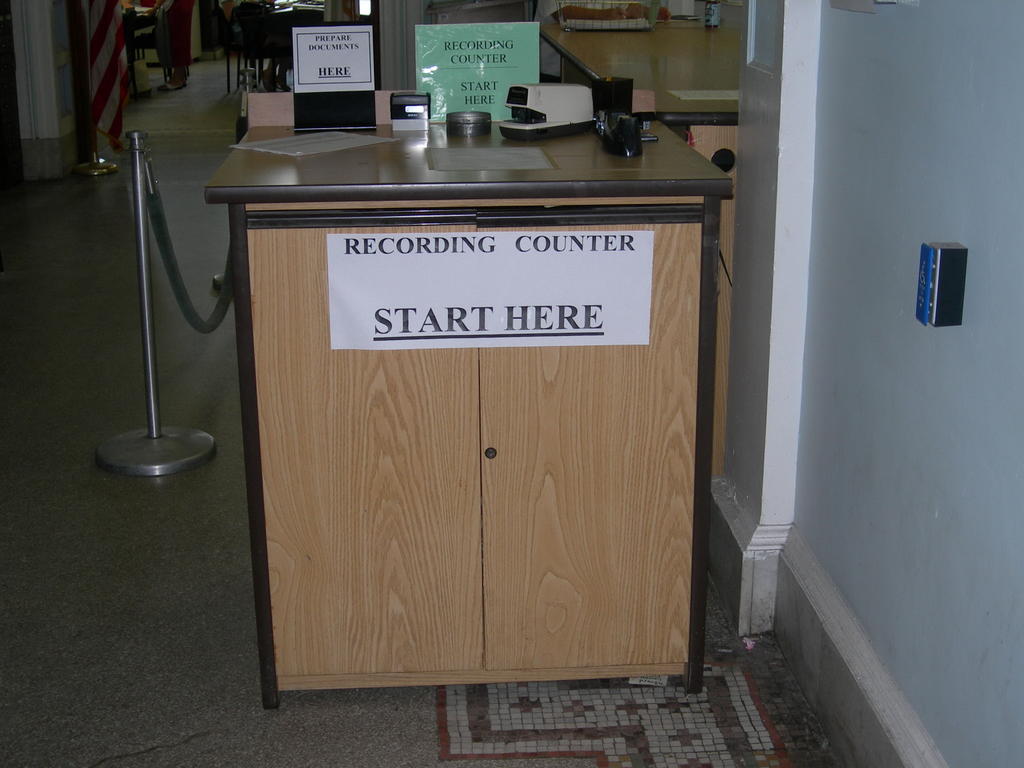
As part of our effort to streamline the recording process, we have moved the start of the recording line. The line now begins at the "checking table" located to the right of the registry’s Recording Counter. Copies of our new “Rules for Recording” have been placed on the wall at the document checking area. We urge you to take one and keep it for future reference. These instructions are pretty much self-explanatory…but if for some reason there is something you do not understand regarding these instructions, go to our Customer Service Office for assistance. Remember... before approaching the recording counter be sure your documents are prepared. It will save time and energy. The new checking table is equip with all that is needed to ready your documents… a stapler, a list of registry boxes, paper clips etc.
Friday, August 05, 2005
Recording Counter Renovations
We spent the day moving cashiering terminals around and cleaning up so much accumulated dust and dirt that our efforts at times resembled an archeological dig more than an IT project. We moved all of our cashiering terminals to one side of our "L" shaped recording counter, leaving the other side free for us to check documents. So when you arrive to record, you approach the broad expanse of recording counter where a registry employee will check over your documents, counting pages, checking for title references and signatures. Only after these checks have been made will customers move to one of the terminals where the recording process should be fast and painless. To help you prepare before you get to the recording counter, we've composed a one-page "Rules for Recording" that provides a check list of what you should do before you get to the recording counter. This form will be available at the registry and on our website on Monday. Unfortunately, this move was motivated by the ever increasing slopiness we have seen in customer document preparation. Now we'll just leave those who don't have their documents prepared standing at the check area and call on the next customer. So if your documents are in good shape when you get to the registry, you should get on record even quicker than before.
Thursday, August 04, 2005
MCLE & Homesteads
Yesterday I traveled to Burlington to attend an MCLE seminar, Preserving and Transferring Your Client’s Principal Residence, primarily to hear the discussion about Declarations of Homestead. The distinguished panel of experts consisted of Alexander Bove, David Correira, Robert Ryan, Leslie Sleeper Madge and Robert Gorfinkle. Much of the program involved Medicaid planning and it was fascinating but also a little frightening given its complexity. Unfortunately, but not unexpectedly, the “should you file a new homestead after refinancing” question was left unanswered. In the 2003 Bankruptcy Court decision, In re Heretakis, 293 BR 82, that court held that Massachusetts law would not consider a mortgage to be a deed that would terminate an existing homestead. Unfortunately, no state appellate court has held likewise (although no such court has held the contrary, either). In the meantime, the panel seemed to suggest that practitioners continue to give explanatory but non-specific answers when confronted with this question, and hope that one of several pending homestead-related bills that clarify this situation be enacted soon. There did seem to be agreement that advising a client to record a new homestead after refinancing “to be safe” was problematic since the new homestead would wipe out the earlier homestead regardless of the legal effect of the mortgage. If the homeowner recorded a homestead in 2001, incurred a debt in 2002, refinanced in 2003 and recorded a new homestead in 2004, the 2004 homestead would terminate the one filed in 2001 and the debt from 2002 would then come before the homestead and be outside of its protection. (I had always understood this to be the case but once when I explained it on the Blog I was chastised by a lawyer who maintained that there would be no “interruption of coverage” in this scenario). One last thing: the panel emphasized that anyone filing for bankruptcy absolutely should file a declaration of homestead before filing the bankruptcy petition, no matter when the debts came into existence.
Wednesday, August 03, 2005
RSS

Technology never ceases to amaze me…just when I thought I had a handle on the World Wide Web (oh yeah, no one uses that term any more)… excuse me the Internet… something new comes along that sends me back to square one (or should I say DOS). This time it's RSS or “Really Simple Syndication” ("Really Simple" who are they kidding...I could use one of those Dummies books right now… “RSS for Dummies”). As I understand it…RSS is a format being used to syndicate news, magazines and blogs. Web publishers distribute headlines, news links and story summaries using RSS. This is big time…major publishers such as the BBC, The New York Times, The Christian Science Monitor and The Wall Street Journal all use RSS. This new ”contain channel”, as it is called, allows the tracking of information updates using something called a “News Aggregator (If I was writing the Dummies book I would define News Aggregator on page one). RSS is also widely used by the Weblog community to share new entries. When a new blog entry is published or a news source is updated it immediately appears on your “newsreader”(just another word for News Aggregator…as defined on page one). There is no need to go hunting newspaper websites for a news story or dealing with “pop up Ads”…RSS sends only the important contains directly to you. The Middlesex North Blog is currently not available in the RSS format… but as you can see…the research has begun to add this feature (and I am already getting a headache). Stay tuned…aspirins please.
Tuesday, August 02, 2005
"Tough Love" at the Recording Counter
We continue to experience problems with documents presented to us for recording. One problem occurs when a customer presents us with a stack of loose pages. This happens frequently and leaves us in a position of sorting through the stack, trying to discern what's a separate document and what's an attachment to a document. With multiple rider mortgages, this is no easy task. Of course, when an assignment or a homestead, the last in the stack, is counted as the last page of the preceding mortgage, the offender is quick to blame us for the oversight. The other problem is with the order of documents. Last Friday, a young man presented me with a stack of pages. I slid them back to him and asked him to staple the pages of the various documents together. He proceeded to staple the MLC, the 6D certificate and the deed all together in one package, then a first mortgage in another and the second mortgage in a third. I asked if that was really how he wanted things recorded (it would have went on record as a 3-page MLC then two mortgages). He called someone on his cell phone and spent a considerable period of time tying up the recording counter sorting through his documents. When he finally gave them back to me, the first three documents were separate, but the mortgage in the lesser amount was in first place and the mortgage in the greater amount was in second place. And that's exactly how they were recorded. At some point, I suspect, someone will realize the order of the mortgages is wrong and call, asking what can be done. Well they have two choices: Leave things as is or rerecord both mortgages in their proper order, paying the $175 per mortgage recording fee - that'll cost $350 dollars to sort that out. That's what I mean by "tough love." For too long, we've been trying very hard to accommodate people, to help sort out documents and put them in the presumed proper order. But the only result our efforts have yielded is more sloppiness on behalf of more lawyers and their agents. So we've decided to tighten up our procedures to try to force the offenders described above to do the bare minimum that is expected from an attorney in the real estate business. For the vast majority of you who are consummate professionals, this should only improve your experience at the recording counter since you shouldn't get stuck in line behind a customer who's trying get his papers ready at the recording terminal rather than back at the office. If our measures, which we will describe here in the near future, have an adverse impact on you, please let us know.
Monday, August 01, 2005
Patiences

Scanning the Miscellaneous Jurisdictions is turning out to be a more difficult job than expected. In their original form most of these documents are legible, but in some cases once scanned the images become difficult to read. In many cases the solution is easy…simply darken light pages using a copy machine... then scan the copy. Sometimes the document has to be copied several times at various exposures to get a quality copy. If (and fortunately this hasn’t happened yet) we cannot create a good image by scanning a copy, we will re-create the document on a word processor...then scan it. There are only about seven hundred Miscellaneous Jurisdictions. It may seem difficult to believe...but over all, the 160,000 Registered Land documents we just finished scanning were in better condition than the Miscellaneous Jurisdictions…It is obvious that the key with this project is being patient.
A New Look for the Blog
There's a new look to the blog. The content is the same and we will continue posting as usual, but we have changed the appearance to make it easier for our readers to navigate around the site. As always, we welcome your comments and suggestions about the content of the blog, but we would also be happy to hear from you about its appearance.
Friday, July 29, 2005
Old Middlesex South Books
We’re well on our way to having all documents in the registry scanned and available on our website. One of the last groups left to be scanned are our oldest documents, those that were recorded before this registry came into existence in 19855. Prior to that year, any documents related to land in the towns that subsequently became the Middlesex North District (Billerica, Carlisle, Chelmsford, Dracut, Dunstable, Lowell, Tewksbury, Tyngsboro, Westford and Wilmington) were re-copied in new books that were divided by town name and then sequentially numbered. The placement of documents within these books was based on what town the relevant property was part of in 1855, not when the document came into existence. For example, a 1776 deed to a parcel at the corner of Andover and High Street was then in Tewksbury, but by 1855 that area had become part of Lowell, so that deed would be placed in one of the Lowell books. To give you a sense of the relative size and volume of real estate activity within the Middlesex North District towns prior to 1855, here are the number of record books containing documents from 1639 to 1855 for each town: Billerica – 21 books; Carlisle – 13 books; Chelmsford – 19 books; Dracut – 16 books; Dunstable – 12 books; Lowell – 91 books; Tewksbury – 16 books; Tyngsboro – 7 books; Westford – 20 books; and Wilmington – 14 books. There are also 16 books in a category called “Doubtful” which presumably includes documents for property of an indeterminate location. There is also Grantor Index (21) and Grantee Index (17) books. The indexes are consolidated, meaning all of the names are grouped alphabetically, and contain dual book entries. One is the book and page number of the original Middlesex South book; the other is the newer, Middlesex North reference (“Lowell book 2, page 450” for example). We are now analyzing how to best convert these documents to digital form and hope to have them available on our website by January 2006. These documents tend to make fascinating reading, so they’ll be valuable from a historical as well as a title examining perspective.
Thursday, July 28, 2005
Lowell Folk Festival

The annual Lowell Folk Festival begins this Friday night and runs through Sunday. All weekend, downtown Lowell will be filled with musical performances, craft demonstrations, and ethnic food stands. The types of music and performers that may be heard include an African/Cuban Ensemble, American Piano Styles, Appalachian Bluegrass, Azerbaijani Music, Blues, Bulgarian Vocals, Cajon Music, a Cape Breton Fiddler, Greek and Near Eastern Music, Irish Music, an Italian-American Brass Bank, Klezmer music, Korean Dance, Drumming and Music, Music of Mali, Mexican Calentiana, Quebecois Music, Rockabilly and a Slovenian Polka band. Craft demonstrations include Abenaki baskets, a blacksmith, a boatbuilder, Byzantine icon painting, duck decoys, hooked rugs, Nantucket lightship baskets, an Oud maker (an Oud is a stringed instrument in the Lute family and is played by Greek, Armenian and Middle Eastern musicians), Penobscot clubs, Portuguese instruments, Portuguese lace, a Puerto Rican Cuatro maker, a steel pan tuner and Ukrainian egg art. Ethnic food will be sold by the African-American Merrimack Valley Branch of the NAACP, the African Cultural Association, the Armenian Relief Society, Iskwelahang Filipino, the Holy Trinity Hellenic Orthodox Church, the Hellenic American School PTA, Jamaican Celebration of Life, Laotian American Community of Massachusetts, the Lao United Church of Christ, the Wat Lao Mixayaram of New England Inc, the Wat Buddhabhavana of Massachusetts, the Lowell Southeast Asian Water Festival, the Lowell Latin Catholic Community of St Patrick’s Parish, the Lowell Polish Cultural Committee and the Portuguese American Veterans Center. As you can plainly see, there is something for everyone, so please come to Lowell this weekend. Detailed information about the festival, a schedule of performances and directions and parking information are available at http://www.lowellfolkfestival.org/
Wednesday, July 27, 2005
National Figures

Once again the national real estate market has set a record for the sale of existing homes. The median sale price in the country rose to $219,900 in June. This is a 6.3% jump, the biggest in history. Housing prices have increased five times the rate of inflation in the country. Incredibly even this is not stopping buyers. Higher family income and lower interest rates are keeping sky-high prices reachable for would-be buyers. These record prices are being fueled by the lowest mortgage rates in fifteen months. The news is the same throughout the country. Prices have increased in all four regions. The West and the Northeast showed the largest gains. In the West the median price went up 17.4% to $317,000 and in the Northeast the median price increased to $250,000 a 13.6% increase from last June. The number of sales also rose in the Northeast by 3.5% but the West (which obviously includes) California out paced even that with a 5.5% increase. The National Association of Realtors is forecasting another increase next year. One thing interesting to note…on a national level yearly housing medians have not dropped since 1950.
Tuesday, July 26, 2005
Condominium Sales
A story in today’s Globe attributed the continued strength of the Massachusetts real estate market to soaring condominium sales. While condo sales are up 24% from the same period last year, sales of single-family homes are slightly down. It’s apparent that buyers at both ends of the market – first time home buyers seeking an affordable place to live and older folks seeking to downsize and cash in on the appreciation of their suburban residences – have made the condominium market very attractive. The story does report, however, that sales of high-end units in Back Bay, Beacon Hill, South Boston and Charlestown are slowing, with less units sold in those areas so far this year as compared to the same period in 2004. This could have significant consequences in Lowell since many of the purchasers of downtown residential condominium units have chosen to live here for economic reasons – a unit in Lowell is affordable while a comparable one closer to Boston is not. With prices in Boston sliding, that dynamic might change. The growth of the condo market here in Lowell is evident from the following statistics: In May and June of 2004, we recorded 742 deeds for the city of Lowell. Of those, 197 (27%) were for condominiums. In May and June of 2005, we recorded 772 deeds, 243 (32%) of which were condominiums. While the number of all deeds recorded for these two months increased by 4% from 2004 to 2005, the number of condominium deeds increased by 23%. Unfortunately, this means that the number of non-condominium deeds decreased by 3%. This transition to a real estate market dominated by condominiums is demonstrated by the number of Master Deeds (the document that creates the condo complex) that have been recorded over the past few years for Lowell. In 2001, there were 7. In 2002, there were 22. In 2003, there were 15. In 2004, there were 41. Up to today in 2005, there have been 25 with many more under construction or in the planning stages. Unfortunately, past experience has shown that when a real estate bubble bursts, condo prices collapse precipitously. If there’s a slow down of the real estate market, this increased dependence on condominiums for housing stock could have dire consequences for the city of Lowell.
Monday, July 25, 2005
Website Woes
Thank you all for your patience with the problems we experienced with our website over this past weekend. As I understand it, a board within the website server which is located in Boston burned out over the weekend. I started receiving emails from customers reporting the problem on Saturday night. In the process, we discovered a flaw in our maintenance procedures: the people who can fix the computer can’t get access to it after hours and the people who can get access to the computer room after hours aren’t the ones who can fix the machine. In the past, the necessary parties have teamed up when confronted with a major outage, but things just didn’t work out this time. On a more optimistic note, we’re formulating plans that will add the rest of our holdings to our computer system which means everything will be available over the Internet, hopefully by the first of the year. All registered land documents have now been scanned and are available electronically. We have just started to experiment with ways of scanning old registered land certificates. Ultimately we want all certificates available electronically, but this must be done carefully and in conjunction with land court. To find the best way of accomplishing this requires some behind the scenes, unofficial, trial and error on our part. As for recorded land, we now have the scanned images of documents recorded in books 1 through 1129 (1855 to 1950) and should have them loaded onto the computer system in early September. Our marginal reference project in which we are entering all pre-computer marginal references in an electronic database is back to book 1100. Once this project is complete, we will switch back to the old grantor and grantee index project in which we’ve made the grantor index from 1950 to 1975 available as an electronic book in the PDF format. We plan to use this same methodology to make all indexes available electronically.
Friday, July 22, 2005
New Courthouse for Lowell
Earlier this week the Lowell Sun reported that the governor formally proposed the construction of a $115 million, 280,000 square-foot judicial center in downtown Lowell, across the street from the Lowell Memorial Auditorium. Plans for such a facility have been discussed for several years, but the actual site has been unclear. While the judicial center is by no means a sure thing, the latest events move it closer to reality. The local legislative delegation has long advocated this proposal, so it should find strong support in the House and the Senate. Presumably the Superior Court and the District Court will find homes in this facility. Hopefully, the additional space will allow for a full-time presence of the Probate Court in the city. While the Juvenile Court should logically be included, that court is in the midst of a long-term lease in a private facility, the former Post Office on Appleton Street. It’s unclear whether that lease could be voided by the state. Of course, the new facility might not even be completed by the time that lease expires. (Plans call for the new court to be occupied in spring 2010). As for the registry of deeds, it’s unclear where we will be located. The state’s master plan does not see courthouses to be the appropriate place for registries of deeds in the future. The primary rationale for that belief is the enormous expense of constructing courthouses. Between security concerns and the legitimate desire to have a formal, imposing setting to lend dignity and respect to court proceedings, judicial facilities are costly to build. A registry of deeds, on the other hand, has needs closer to a library than a court with a much more affordable price tag. And with almost our entire holdings available online and electronic recording about to become a realistic option for many customers, the location and physical structure of the registry are of decreasing importance. So there’s nothing definite, but we’ll certainly keep our readers informed.
Thursday, July 21, 2005
Next!

On Monday we will begin our next scanning project…. The registry has approximately seven hundred unique documents refer to as Miscellaneous Jurisdictions. These are made up of a variety of document types… Judgments, Statements, Petitions etc. They use a numbering system separate from Recorded or Registered Land... it uses both digits and letters…example Misc Jurist 436b. The first phase of the project will involve scanning the “Misc Jurist” into an independent database in “tiff” format. Registry users will be able to view these images using “stand alone” computers that are no connected to the ACS system. During the days of Wang’s proprietary computer system we used a similar system to make images available to the public. If you are a frequent user of the Middlesex North Registry of Deeds you will remember this system… we called it “Image Inquiry”. The Misc Jurist will be made available in much the same way. I know you have hear me say this before…but…these documents are old and many are in bad condition. This means that many will have to be copied before being scanned. Also, when completed the images will be put on CD and copies will be offered to the public.
Wednesday, July 20, 2005
Identity Theft Legislation on Beacon Hill
Today’s Globe reports that a legislative committee is about to report out a bill increasing the penalties for stealing someone’s identity. The full legislature is expected to consider the bill later this summer. One rather controversial provision that has been omitted from this bill deals with “credit freezes.” As I understand it, in a state with a credit freeze law, a consumer can direct credit reporting agencies to freeze that person’s report, preventing the credit agency from issuing a copy of the report to anyone seeking it. Let’s say a wrongdoer applies for a credit card using your name and personal information such as your social security number. Before any company will issue a new credit card, that company will want to see the applicant’s credit report. With a credit freeze in effect, no report may be given and presumably, no new credit card will be issued. When the consumer legitimately wants to obtain a new credit card or a car or home loan, the consumer must request a limited “thaw” of the credit freeze to allow a report to be issued to the new creditor. Sounds like a lot of work which invites the question, who will pay for it. In most states that have such a law, it is the consumer who pays, usually something like $10 to freeze the credit report and $5 each time it has to be thawed. Because there’s a fee involved, not many people utilize this even where it is allowed by law so its effectiveness is questionable. But at least the state legislature is trying to address this problem. All this talk of freezes and thaws seems a little out of place on such a warm, sunny day. On another note, thanks to Assistant Register Tony Accardi for the superb job he did in maintaining the blog while I was vacationing in Canada. It was a great trip although the temperature never made it beyond 33 degrees any day we were there.
Tuesday, July 19, 2005
First Look
Update on the Social Security number project we started last week. A quick review…we assigned an employee to go through record books dated from January 1,1995 to June 30,1995. He is writing down the “book and page” and “document type” of documents that contain a social security number. Today I received a small sample of these to review. As of this morning we have checked 80 record books containing approximately 4,000 documents. We found 375 documents containing Social Security numbers. This is approximately 5 per book or 9% of the documents. As expected the vast majority with SS# are Mass and Federal Tax documents. The list also included a very large number of death certificates. Mortgages and Mass Assistance Liens were also listed, but there were significantly fewer than the other document types. I would like to caution …this is a small sample and the picture may change as more information is collected.
Monday, July 18, 2005
Shorties
We are beginning to replace our older computers…hopeful you will begin to see some new public access terminals in the next week or so. It take a little time to set up both the hardware and the especially the software.
As I mentioned last week we have begun taking inventory of our Registered Land images. Up to this point it appears most of the documents that need to be re-scanned are multiples that we intentional skipped during the back scanning project.
We get between 10 and 20 E-Recordings everyday. Some days a large percentage of these have to be rejected because they out of district. Believe it or not…sometimes we send a “wrong registry” document back to a bank only to receive it again the next day.
Friday we finished quality checking the last of the “plan images”. This was a long, tedious project, but it is behind us now. If you see an image that needs to be re-scanned (plan or any other) please let Customer Service know.
The computer images from 1987 to 1950 were captured from microfilm using an automated system. Some of the older books…especially the 2000 series have problems. If the film had been spliced during its processing it muddled the automated scanner/counter. These books need to be re-scanned. They are very big, seven hundred pages or more. We experimented by making copies using a copy machine, then scanning the copies. This took much too long. The alternate plan (and the better one) is to use our Microdax microfilm scanner. We are going to make hard images then scan them…This should be faster.
As I mentioned last week we have begun taking inventory of our Registered Land images. Up to this point it appears most of the documents that need to be re-scanned are multiples that we intentional skipped during the back scanning project.
We get between 10 and 20 E-Recordings everyday. Some days a large percentage of these have to be rejected because they out of district. Believe it or not…sometimes we send a “wrong registry” document back to a bank only to receive it again the next day.
Friday we finished quality checking the last of the “plan images”. This was a long, tedious project, but it is behind us now. If you see an image that needs to be re-scanned (plan or any other) please let Customer Service know.
The computer images from 1987 to 1950 were captured from microfilm using an automated system. Some of the older books…especially the 2000 series have problems. If the film had been spliced during its processing it muddled the automated scanner/counter. These books need to be re-scanned. They are very big, seven hundred pages or more. We experimented by making copies using a copy machine, then scanning the copies. This took much too long. The alternate plan (and the better one) is to use our Microdax microfilm scanner. We are going to make hard images then scan them…This should be faster.
Friday, July 15, 2005
One Will Get You Two

In the old days…(you know, before technology guided our lives) the saying was “two heads are better than one”. Well, it looks like Sharp TV has just changed that to “two TV pictures are better than one”. Sharp Corporation has developed a liquid crystal display that shows totally different images depending on the angle from which you view it. Look from the left see CSI Miami…look from the right watch CSI New York. Why would someone want this?…As an example, Sharp says one person can be surfing the Internet while another is watching a movie (I can hear that conversation…Left Side: "Wow, what a price on these tickets to Florida"; Right Side: "Duck Rambo duck!”) This two-way viewing angle LCD is going into mass production this month…and will cost twice as much as a regular TV(sounds fair to me…get twice as many pictures…pay twice as many dollars). I can hear the TV Ad now…"it’s two, two sets in one”. There is one problem with the two-picture TV…if you stand in the middle you see parts of both pictures(seriously)…Just imagine, you might see Ray Ramano being thrown off the Survivor Island…Or Dan Rather on Fox News…or Tom Brady throwing to Alex Rodriguez (today that sounds better than letting Schilling do it). I usually like to try and think of ways new advances in technology can be used to improve the registry…In this case I think I’m stumped.
Thursday, July 14, 2005
Back Scanning Project
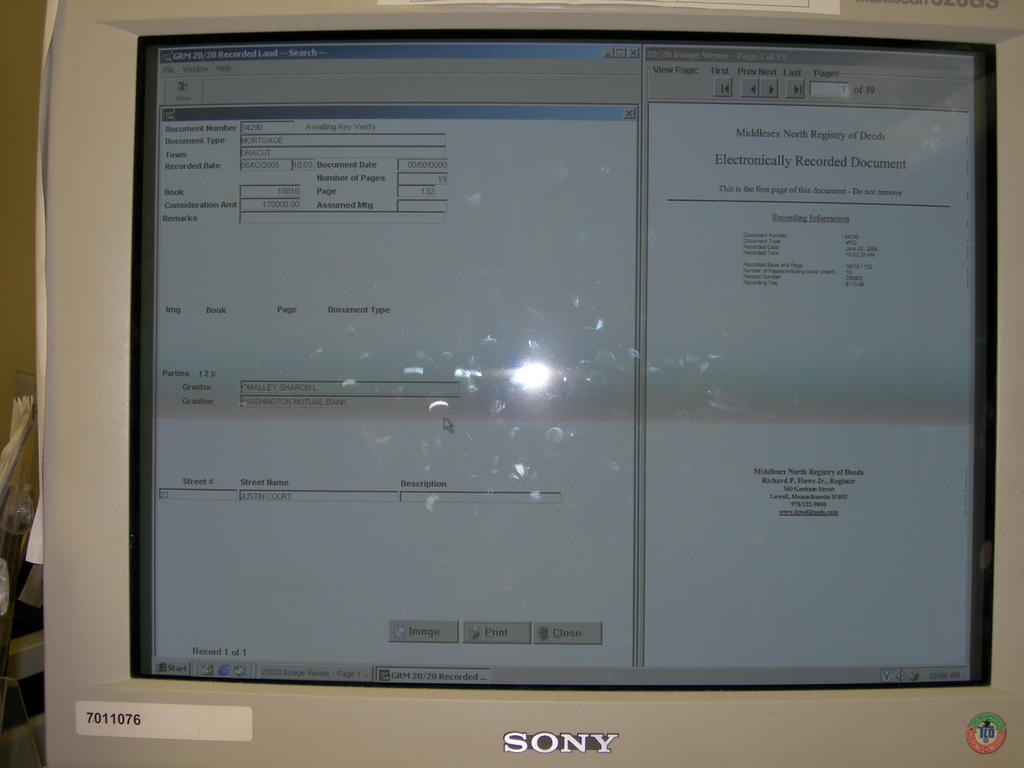
We finished back scanning the remainder of our Registered Land documents two weeks ago. Since we finished the project earlier than expected we reassigned the scanners to do an additional 22,500 documents. These documents, which are available on the old Image Inquiry computer program, are not on the ACS system. All 22,500 documents have been prepared for scanning and the majority of these have actually been scanned. Today we began to review the “list” of these documents looking for gaps. The gaps are actually very easy to find…when we bring up the document entries an image flag appears beside documents that have been scanned. Simply put…the gaps are entries without image flags. Once this portion of the project is completed will we deal with special scanning problems. As an example… we found early tax liens with newspaper pages attached proving public notice. These papers are large and fragile. Although there are only about eight of these… they will take time and much work to re-scan.
Wednesday, July 13, 2005
Podcasting

The world of Podcast is growing daily. It is difficult to pick up a magazine or newspaper without seeing some reference to this new entry in the information world. I recently “googled” the phrase “real estate podcast” just to see what would happen. The results were interesting to say the least. Below are a couple of samples of google hits:
Access Realty World: this is a podcast that features news from the real estate world as well as insider hints and tips. It shares information on how to buy and sell and make profits on Foreclosures
Realize the Realty: this podcast, (well it’s actually a BlogPod), is directed toward homeowners, builders and investors. The show’s blurb brags “Know more about the real estate industry using well-researched information through this blog and podcast.
Rich Buckley Show: (do you think this guy is really named…”rich”???... a real estate podcaster named “rich”… sounds very convenient). Anyway…”Rich” talks about hot trends in California real estate. The program also includes interviews with successful real estate entrepreneurs and discussions on hot button issues.
Podcasts and their topics have expanded greatly in the last six months. You can find podcasts on Politics, Arts, Science, Business, Teen Issues, Computers and just about any other imaginable topic. In fact we have discussed the possiblilty of a "registry of deeds" podcast...so stay tuned.
Tuesday, July 12, 2005
Social Security Number Update
As discussed earlier this month we have decided to take a sample of a small group of documents to determine how many contain social security numbers. The work began this morning. One employee has been assigned the task of reviewing record books from January 1, 1995 to June 30, 1995. This span, books "7353-7540" contains 187 books. The “Book, Page and Document Type” of records that contain social security numbers are being recorded on a spreadsheet to be analyzed later. Since each “page” of a book must be checked it will probably take a considerable amount of time to complete the test sample. It is a tedious process, but we have learned that large projects, which seemed insurmountable in the beginning, are managed with diligence. It is expected that the vast majority of these documents will be Massachusetts and Federal tax documents. This information will help us determine if we are dealing with hundreds or thousands of documents containing Social Security numbers. It is worth repeating that effective July 1, 2005 no document containing a social security number will be accepted for recording.
Monday, July 11, 2005
Peter Pan

Have you heard about Google Earth yet?…Well if you haven’t… you’re in for a treat. Google earth is a new satellite imagery based mapping system. It combines buildings and terrain with mapping capability. Google Earth allows you to “fly” around the world zooming in and out of satellite photos. Let me explained my first experience with Google Earth…When I first logged on I saw a map of the world…I picked a location. In this case it was my home. I typed the street name in the search field and hit enter (Wow…it was like a Disney ride)…The earth began to slowly turn …when the program found my home it zoomed in…closer and closer. Before I knew it I was looking at the roof of my house (now I know how Peter Pan felt)… spin the image left…spin the image right…tilt it… zoom even closer…closer (gee, I’ve got to mow the lawn). Let me see…I wonder were the nearest school is…simple, just check the “find school” option…the Dewing School appears…nearest train station…nearest water-way…it’s all right there. You can even combined multiple layers if you want…restaurants, video stores, grocery stores, gas stations, volcanoes (come on, in Tewksbury, I'd know about it...I think)…it all appears. Of course, the next logical step for digital mapping systems like “Google Earth” is to make the information available on your cell phone or PDA. The benefits would be incredible. You can try Google Earth at “earth.google.com”… It’s cheaper than going to Disney World…In fact it’s FREE.
Friday, July 08, 2005
More on Social Security Numbers
Up until yesterday, the social security number of Porter Goss appeared on his local registry of deeds website in Florida. Who is Porter Goss, you ask? He’s the Director of the CIA. Needless to say, now that the press has reported this situation, the social security number has now been blacked out on the records. According to the Associated Press article reporting this, Florida law already has set a deadline of 2007 for all social security numbers to be blacked out from online land records. I understand that there are a number of proposals pending in the Massachusetts legislature to deal with social security numbers in online records. Here in Lowell, we are going to do a sampling of a small group of our existing records to determine how many of them contain social security numbers. This will take some time to allow us to obtain a large enough sample (probably a six month period) and we will identify how many are attributable to federal tax documents, how many to Massachusetts tax documents and how many to other types of documents. Once we get this survey done, we will post the results here on the blog.
Thursday, July 07, 2005
Sales & Foreclosure Reports
I have to apologize for the delay in posting the May sales and foreclosure reports. That just happened yesterday. The reports had been prepared for some time but June turned into such a busy month with meetings, projects and our traditional end-of-June spike in recording activity that I just never loaded them onto the website. As the month dragged on, more and more of you sent emails checking on the status of the reports, so I know you make use of them. If it’s any consolation, the June sales and foreclosure reports went online earlier today and I’ll make an extra effort to post future reports in a timely manner. It’s unfortunate that our computer system is very limited in its ability to perform sophisticated analysis of sales data because the information in our computer has value that far exceeds its traditional use in examining titles. There are ways for us to export the data into other computer applications such as Crystal Reports, but we have no in-house experts on that software and it doesn’t lend itself to self-teaching. We’ll do what we can with what we have. As the summer progresses, we will try to give you more information on sales data and statistics and maybe you will have some ideas on how we can best use or information.
Wednesday, July 06, 2005
Historical Perspective
Yesterday I “revisited” a bar graph I created a number of months ago comparing document totals for the past twenty-five years. No question… 2003 was a record breaker. That year the registry recorded 146,956 documents. As I considered these yearly totals I thought it might be interesting to list some significant registry events with the yearly total:
1986- The Wang computer system wasn’t installed in the registry until September of 1987. This means that in 1986 (the highpoint of the 80’s real estate boom) employees recorded 82,575 documents “by hand”.
1994- The first imaging system was installed in the registry in 1994. 71,427 documents were recorded that year. Interesting fact…with the new imaging system computer responsibilities and document flow were not completely establish in 1994 so the MIS director scanned all documents himself.
1995- Register Howe took office. The registry recorded 60,681 documents that year, less than half of what was recorded in 2003(146,956).
1997- The Massachusetts legislature abolished Middlesex County. That year 70,128 documents were recorded. That July Middlesex North was placed in the office of the Secretary of State.
1999-Thank you Y2K…because of the dreaded “Y2K” bug the Wang computer system was convert to work on a window’s based system called “lightspeed”…and new servers with large memory capacity were installed in the registry. This made it possible for us to scan and store 55 years of images. While "teams" of computer experts upgraded our system, the staff recorded 89,506 documents.
2001- The ACS computer system was installed. That year began the incredible rise in documents... 2001-97,180... 2002-115,890... and finally 2003 a historic 146,6956. The ACS system provided us advantages that allowed us to handled 2003 in stride.
1986- The Wang computer system wasn’t installed in the registry until September of 1987. This means that in 1986 (the highpoint of the 80’s real estate boom) employees recorded 82,575 documents “by hand”.
1994- The first imaging system was installed in the registry in 1994. 71,427 documents were recorded that year. Interesting fact…with the new imaging system computer responsibilities and document flow were not completely establish in 1994 so the MIS director scanned all documents himself.
1995- Register Howe took office. The registry recorded 60,681 documents that year, less than half of what was recorded in 2003(146,956).
1997- The Massachusetts legislature abolished Middlesex County. That year 70,128 documents were recorded. That July Middlesex North was placed in the office of the Secretary of State.
1999-Thank you Y2K…because of the dreaded “Y2K” bug the Wang computer system was convert to work on a window’s based system called “lightspeed”…and new servers with large memory capacity were installed in the registry. This made it possible for us to scan and store 55 years of images. While "teams" of computer experts upgraded our system, the staff recorded 89,506 documents.
2001- The ACS computer system was installed. That year began the incredible rise in documents... 2001-97,180... 2002-115,890... and finally 2003 a historic 146,6956. The ACS system provided us advantages that allowed us to handled 2003 in stride.
Tuesday, July 05, 2005
Quality Control and Quill Pens
Sometimes it seems that quality control at law offices is going the way of the quill pen. I’m not talking about the content of the documents as much as I am the organization of the documents. Time and again, customers will present themselves at our recording counter and thrust a stack of pages at us with the expectation that we will sort out what pages go with what document, the order in which the documents should be recorded, and even whether the document is recorded land or registered land. Worst of all is the attitude displayed when we ask these customers to put the papers in the proper order and groupings. Surly describes the response of many. While we certainly try to be as helpful as possible, it is not the registry’s responsibility to ensure that registered land goes to the land court section, that the homestead that is stapled to the back of the mortgage be dislodged and recorded separately or that the first mortgage be recorded first and the second mortgage second. We have tried to address this by instituting a rule that all documents should be fastened with either staples or paperclips prior to approaching the recording counter, but all this has done is caused some of these customers to staple entire packages of documents – an MLC, a deed, a mortgage and a homestead – together into a single group. I’m not quite sure how to handle this and would welcome any suggestions. Maybe we will require all multi-page documents to be stapled before reaching the recording counter. Requiring a cover sheet that lists the documents and their order, similar to that in use at the Middlesex South satellite office, might be another option. As always, when you discuss something like this, there’s a risk that the many people that do it right will somehow be hit with the broad brush of criticism. That’s certainly not my intent. We have many customers who are role models of professionalism. But the number who don’t know what they are doing and who are unwilling to acknowledge that they don’t know what they’re doing is rising at a frightening rate.
Friday, July 01, 2005
June Wrap Up
First, some history: June 30 has always been the busiest day of the year at this registry and yesterday was no exception (which is why we didn’t have time to write a blog entry). Often when we cite statistics, we only refer to recorded land documents, primarily because their numbers are the easiest for us to analyze and count, but our total recordings also include registered land documents and documents recorded at the Middlesex South satellite office. So you can get a sense of the proportions involved, yesterday we recorded 716 recorded land documents, 38 registered land documents and 456 Middlesex South documents. As busy as it seemed yesterday, it was actually our slowest June 30 since 1998. Here are some recording totals for other June 30ths: 2005 – 716; 2004 – 756; 2003 – 922; 2002 – 856; 2001 – 826; 2000 – 882; 1999 – 720; and 1998 – 661. This June was a busy month in other ways. We started receiving electronic recordings on a regular basis; the microfilm of documents in books 1 through 1128 are now being scanned off site and will be added to our computer system in website by the end of the summer; almost all registered land have now been scanned; and our marginal reference project – we’re entering into the computer all marginal references made in all (pre-computer) record books – is now back to book 1291. New projects on the horizon include linking our computer system to the Mass GIS mapping site; scanning all registered land certificates, and reformatting this blog so that it includes a subject index that will allow readers to easily and quickly find all entries about a particular topic. That’s it for now. Have an enjoyable Fourth of July.
Subscribe to:
Posts (Atom)

 Posts
Posts