Wednesday, July 27, 2011

Bagged and Tagged

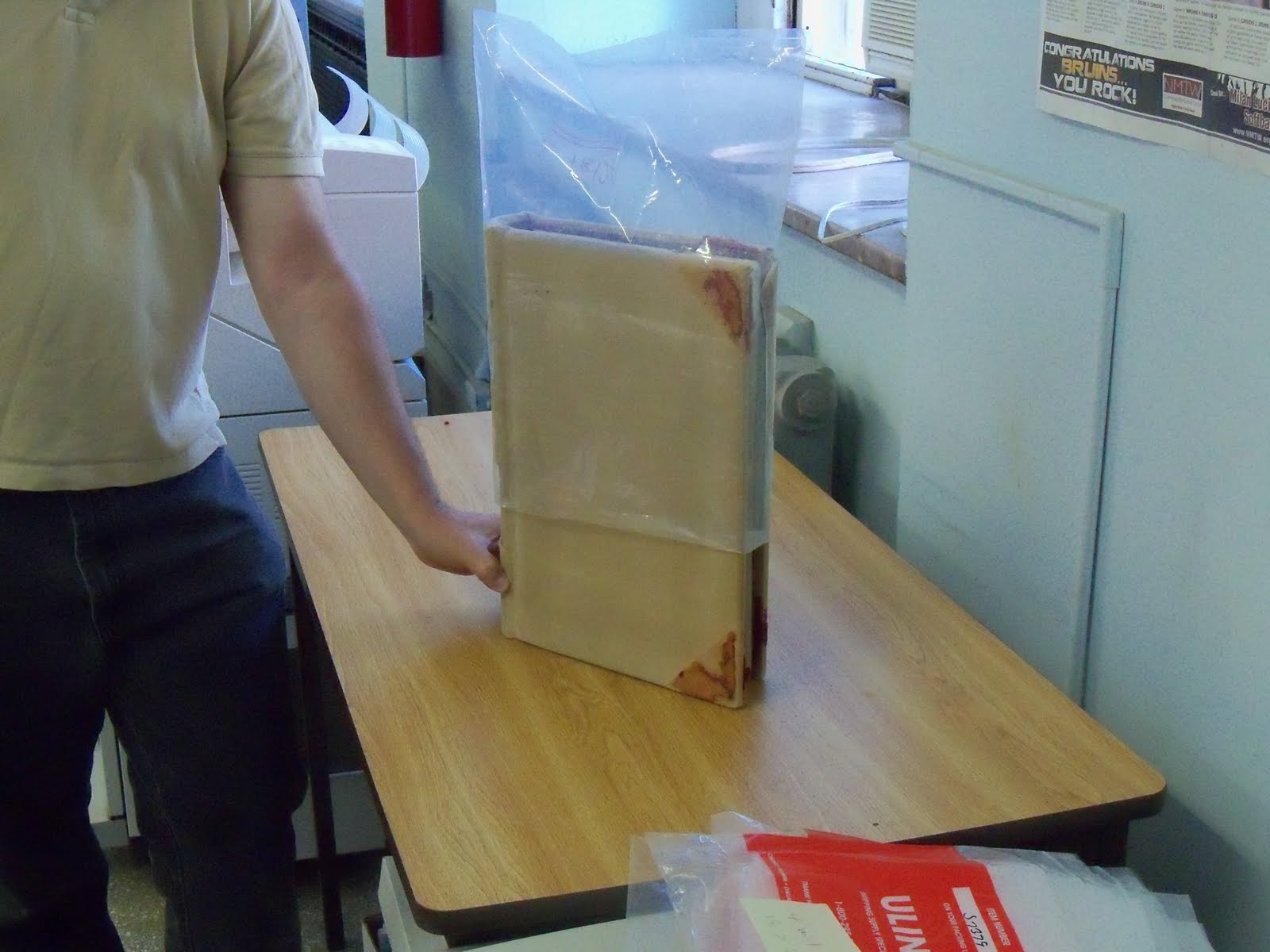
Several years ago we took our Records Books out of circulation and switched over completely to digital images. In order to make all of the images available to the public electronically we cut the pages of the record books from he binding and scanned them. After scanning, we stored the books in the basement of the building. We used two heavy elastics. One around the loose pages and the second to secure the matching binding to book insides. This method of storage worked well for a time, but recently some of the elastic have begun to dry-out and break.

Rather than just replace the elastics, we decided to move to a more permanent means of securing the books. We decided on plastic bags. Last week we ordered several thousand inexpensive 4 mil plastic bags that snugly wrap around the book firmly holding the binder and loose pages in place. The bags measure 14"X22".


Tuesday, July 26, 2011

Attorney General to meet with Registers of Deeds

The Globe this morning reports that Attorney General Martha Coakley will meet with the Massachusetts Registers of Deeds Association to discuss "MERS, the filing of false or misleading documents with registries, and other matters." The meeting is supposed to occur on August 11.

At a meeting last month, the Registers Association voted to ask Coakley for such a meeting to obtain guidance on the two issues raised by Essex South Register John O'Brien - MERS and robosigners - which I recently wrote about here and here.

Monday, July 25, 2011

Thoreau Spends A Night In Jail


The summer after I graduated from high school I worked at Walden Pond for what was then Middlesex County. A bunch of us city kids traveled by car together to the rural, wooded Concord MA. We had never seen so many trees, at least not together.

We had various duties throughout the work period. I remember one time digging a ditch for a water main for a couple of weeks and another time clearing a path in the woods for future paving.

On one particular day I remember walking by an area marked off with small granite pillars and heavy chains.

The marked off area piqued my curiosity so I questioned the County boss.


Me: What's that.
Boss: That? that's where that guy Theruss lived.
Me: Who?
Boss: Theruss or whatever his name is. Supposedly, he moved from a nice house in Concord Center to a shack in Walden Woods. Wow.
Me: What did he do that for?
Boss: I don't know. He was nuts. I think he was the world's first hippie.
Me: (holding the chains) So this is where his shack sat?
Boss: Yeah supposedly, although Tommy (another County boss) tells me when he was a kid he remembers a hotdog stand here.

Did you ever have one of those moments when the stars align just a certain way and something/someone, for no rational reason, draws you? Well, for some unexplainable reason I became obsessed with the guy that lived in a shack in Walden Woods. I wanted/needed to know more.

With a little research the first thing I discovered was the man's name was Thoreau and not Theruss. And Theruss didn't move to the woods because he was a nut, he moved to the woods "to live deliberately, to front only the essential facts of life, and see if I could not learn what it had to teach, and not, when I came to die, discover that I had not lived" (Walden).

Once I entered college, my obsession with Thoreau continued to grow. I read everything I could about and by Thoreau. But of all the things I read the most powerful to me was his essay titled Civil Disobedience. In Civil Disobedience Thoreau advocates peaceful resistance to a perceived injustice, an axiom followed by Gandhi and Martin Luther King just to name two.

And Thoreau practiced what he preached.

On July 23, 1846 Henry David Thoreau spent a night in the Concord jail for not paying his poll tax as a protest to slavery. It is said that on the night of Thoreau's incarceration Ralph Waldo Emerson went to visit Thoreau and as he looked through the cell's bars at his friend asked, "Henry what are you doing in there", to which Thoreau replied, "Ralph what are you doing out there". I guess that says it all about Thoreau.

During my college years I occasionally skipped class (hey, everyone did it) and drove to Walden Pond, sometimes with friends, sometimes alone. We/I would soak up nature and reflect on how the world's first hippie changed the world.

Friday, July 22, 2011

Twitter Hits the Big-Time


Twitter has hit the big-time!

Just how big, is the big-time?
Big enough to lure the President of the United States and six of his possible challengers.

Earlier this week six presidential candidates engaged in a kind of mini-debate forum...using Twitter. Republicans Michele Bachman, Herman Cain, Newt Gingrich, Gary Johnson Thadeus McCotter and Rick Santorum went at it, trading tweat for tweat.

The battle lasted 90 minutes with 140 character jabs and jives going back and forth. Sure using Twitter like this is new, but the candidates seemed to have no problem using "Twitterspeak"...Check this out from Rep Michele Bachman... Obama failed. With ur help we can return the people's voice to the WH, restore fiscal sanity & make Obama a 1 term president.

For techie observers this Twitter forum was a perfect example of how social media is changing the world, in all areas. But as you would expect with any technology experiment, reports say there were down-sides to the event. Twitter allowed little interaction between the candidates and made it a little difficult to keep track of who was tweating what.

But heck, six presidential candidates is still hitting the big-time.

And President Obama is into Twitter too.
Last week the President conducted a first ever Town Hall Meeting using Twitter. Fellow tweaters flooded questions into the president. And he tweated answers right back at em. His staff considered the event very successful.

Twitter has hit the big-time and it is here to stay. I've believed in the potential of Twitter right from the beginning. When people knocked Twitter saying "I'm not interested in reading tweats about what someone ate for dinner", I would reply..."Neither am I. It is not the tool (Twitter) that's the problem. You can use a hammer to pound and make noise or you can build a house with it.

Looks like Twitter started building a subdivision last week.

Thursday, July 21, 2011

Where Should I Meet My Attorney?

Recently many people have visited us that are unfamiliar with the lay out of the Registry of Deeds. They are here to close loans or purchase homes. More often than not these people ask where they should go to meet their attorney. Our Customer Service Department directs them to our closing room. The Closing Room is located in the rear of the building. After a visitor enters the courthouse and passes through the metal detector he/she should walk straight for about 100 feet and the Closing Ares is located on the right-hand side of the hallway. The room is equipped with tables and chairs for public use. AND it even has an Air Conditioner.


Wednesday, July 20, 2011

July 20, 1969 man Lands on the Moon

It was forty two years ago today that man first landed on the moon. I remember it well. It was a hot night in Massachusetts. I was 18 years old and preparing for college in September. My father worked the night shift in a warehouse in Boston, so my mother and I watched the historic event on our black and white Zenith TV in our project home.

I found this video of the original lunar landing on YouTube. The posters description speaks volumes:


The video of the very first moon landing of the Apollo 11 mission in 1969! Neil Armstrong was the first man to set foot on the moon with his now legendary words "One small step for man, a giant leap for mankind." This is a truly amazing video and it was in 1969!!! If you think about it, you have orders of magnitude more processing power in your mobile phone than they did in the whole space craft!! Incredible!


Tuesday, July 19, 2011

Li-Fi


This morning in its Technology section The New York Times published an articles about "Li-Fi".
You know, I can't keep up with this stuff.

Do you mean you are unfamiliar with Li-Fi?
There it is again, Li-Fi. You see, I told you I can't keep up with this stuff. Am I supposed to know what Li-Fi is/does? I hope not, because I've never heard of it.

According to the New York Times article, Li-Fi is going to make us forget Wi-Fi.
Hey, wait a minute I just figured out what Wi-Fi is/does never mind Li-Fi.

Li-Fi technology transmits "high-speed data streams wirelessly"... and cheaply.
Cheap!? I like cheap. You've got my attention...go on.

The article states data transfer by light is nothing new.
OK, so what's the big deal with Li-Fi then?

The big deal is LED versus incandescent light.
The only LED I've ever heard of is my HDTV or is that LCD?

LED stands for "light-emitting diodes" and they are the heart of Li-Fi.
Oh, I'm starting to get it now.

You are?
Yeah, incandescent bulbs can transmit data but they do it poorly, so the old technology stinks and LED technology is much better.

Yes, you are right.
And I would guess the difference between the two is "LED lights can be more finely controlled than traditional incandescent bulbs which makes light-based technology more practical and economical".

Right again.
See, I told you I was getting it. Li-Fi transmits data at a high speed cheaply using LED lights.

By George I think you've got it.
Who's George?

Monday, July 18, 2011

Japan wins World Cup

We'll take a break from mortgages and real estate statistics to write about yesterday's World Cup soccer final which was won by Japan on penalty kicks. While certainly not a soccer fan, I still found yesterday's game fascinating to watch. For the first 30 minutes, the US had numerous scoring chances but repeatedly failed to put the ball into the net. It was not until more than 60 minutes had elapsed that the Americans finally scored. But the US revision to defensive tactics failed. With just a few minutes left, Japan took advantage of some sloppy defensive ball handling in front of the US net and scored the tying goal.

Midway through the 30 minute overtime, the US scored to pull ahead, 2-1. With goals in soccer so rare, I (and most others I suspect) felt that the game was over at that point. Not so the Japanese players. With just a few minutes left, they again tied the score after a post-corner kick scramble in front of the US net. Overtime ended with the game tied. The outcome would be decided by penalty kicks. The TV camera that pried its way into the Japanese pre-kick huddle showed their coach smiling serenely - a bad omen for the US, I thought. Penalty kicks are supposed to be sure things with a rare save often being determinative. But the US shooters didn't rise to the occasion, almost as if they knew they lost the game by giving up that tying score. The Japanese players drilled home more balls than the Americans, and won an amazing victory. If it hadn't been the US team opposite them, we all would have been cheering for the Japanese.

Friday, July 15, 2011

More on robo-signers

Yesterday I wrote about a Globe article that featured my colleague, John O'Brien, the Register of Deeds of Essex South, and his efforts against MERS and robo-signers. Yesterday I addressed MERS; today it will be robo-signers.

The issue is that several large national lenders or the servicing contractors who worked for them, would take corporate votes authorizing a particular employee to sign certain foreclosure-related documents for the bank (as we'll collectively call the lenders and their servicing companies). With the collapse of the real estate market, however, there were too many documents from places too far away for that authorized person to sign in a timely fashion. Instead of the bank formally adding more people to the list of those who can sign on the bank's behalf, the bank left its employees to fend for themselves. Many took to signing the name of the one authorized employee to any documents that passed the non-authorized employee's desk. In all of these cases, a notary public acknowledged the signatures, affirming that the authorized signer, who very well could have been in another time zone, "personally appeared and acknowledged the foregoing to be his free act and deed." These documents were then presented for recording and were recorded at registries of deeds across the country.

Register O'Brien has obtained the services of a forensic document examiner who has identified several dozen names whose signatures on real estate documents were made by different people. O'Brien believes these documents are forgeries and is now refusing to record any documents signed by the previously identified "robo-signers" unless they are accompanied by affidavits attesting to the accuracy of the signatures and acknowledgements. Instead of signing such affidavits, the banks have re-executed at least 14 documents in this category with other authorized employees signing for the bank.

In general, registries do not determine the authenticity of documents. If, on its face, a document has been signed and acknowledged, it's recorded. Claims of forgery or fraud are then directed to the Superior Court for a judicial determination. Common sense, however, tells me that this rule is not absolute. If I no with absolute certitude that a document is a forgery, I believe I would be justified in rejecting it.

The question then becomes "what is absolute certitude of forgery?" and I'm not sure what the answer is. I am sure that it requires a very high standard of proof because registries should not be recording documents based on a mere suspicion or hunch that they are forgeries. O'Brien has the opinion of an expert witness, which is undoubtedly strong evidence that someone other than the person name signed that person's signature. But this case gets more complicated because it implicates various aspects of the law of agency. I haven't studied that in any depth for twenty-five years, but I do recall that in addition to actual authority to bind a principal (as the case of the person authorized to sign on behalf of the corporation) there are also things like implied authority and ratification. I'm not suggesting that either of those documents do apply here, only that they might. Consequently, there are many unanswered questions about this issue. As I suggested yesterday, a court case that resolves this would be beneficial to everyone.

Thursday, July 14, 2011

Globe features Register John O'Brien of Salem

Today's Globe business section has a major story on Essex South Register of Deeds John O'Brien and his efforts against MERS and "robo-signers." Because of articles such as this, there is increasing interest in this topic, so it seemed appropriate to address it here.

As I understand it, there are two separate issues. The first is Register O'Brien's assertion that MERS - Mortgage Electronic Registration System Inc - owes the Commonwealth millions of dollars in recording fees for mortgage assignments that were never recorded. With the second issue - robo-signers - O'Brien contends that employees of a number of major national entities or their related mortgage servicers signed the names of other employees to documents that were (and still are) presented for recording. O'Brien maintains that these signatures are fraudulent which would make the documents legally void and for that reason, he is refusing to record them. In the interest of space, today I'll address the MERS issue. Tomorrow we'll deal with robo-signers.

MERS first came to my attention in 1999. During the real estate crash of the early 1990s, many banks failed and it became difficult if not impossible for homeowners to obtain the legal documents necessary to establish that mortgages had been assigned or discharged. The purpose of MERS was to have a single entity that would hold the mortgage, almost as a trustee for the financial entity that held the underlying promissory note. With MERS, consumers would have a single point of contact for legal documents related to their mortgages. Now this arrangement does run counter to a fundamental principle of Massachusetts real estate law - that being that the mortgage always follows the note - but from 1999 until the commencement of this most recent housing collapse, everyone seemed to think MERS was a pretty good idea and no one complained about it.

At some point after the current real estate collapse, Register O'Brien (probably among others) contended that whenever a promissory note was transferred from one party to another, MERS should have recorded a corresponding assignment of that mortgage and paid the $75 recording fee. His estimate of the amount of fees owed, I believe, is based on the number of MERS mortgages recorded but not assigned.

Because, as I mentioned earlier, the MERS arrangement does ignore the Massachusetts "the mortgage follows the note" rule, it would be very useful to have a court decide whether O'Brien's interpretation of this arrangement is correct. The reason I say a court decision would be useful is that the pro-MERS side does have some arguments that the MERS system was valid legally. For example, there is no legal requirement that any document be recorded at the registry of deeds. When you buy a house, you do not have to record the deed you receive. It would be stupid not to, since by recording it you receive all the protection of the recording statute, but the law doesn't require that you record to convey title. The same is true for an assignment of mortgage. The Supreme Judicial Court of Massachusetts implied as much in the Ibanez case not too long ago. That case involved "missing" assignments. The court held in that case that a lender could prove the fact of an assignment through a variety of means in addition to the traditional way of recording a document.

This is not to say that MERS did not have to record the assignments. Perhaps it did; but with the arguments against it, I think it inevitable that the question would have to be resolved by the SJC or the Legislature. By bringing this issue into the public eye, Register O'Brien is speeding the resolution of this very important issue.

Wednesday, July 13, 2011

Google+ Captures the Headlines


Everyday I look at the Technology section of Google News...it is very helpful if you like keeping up with what happening in the computer world. This morning I found my visit to Google News especially interesting. Here are some of the headlines I saw today:


Google+ Will Let Users Conceal Gender


Google+ Faces Thorny Online Identity Issue


Can Google+ Be a Facebook Killer
Why

Google+ Won't Kill Twitter


and then there are theses...

Study: Google+ Population Explodes to 10 Million

Google+ Already Ran Out of Disk Space


Social Networking Privacy-Beyond the Google+ Hype


and...

Google+: The Verdict So Far

Google+ Offers Chance For A Social Reboot


I think you are getting my point...Google's new social networking site, Google+ is the big, or should I say the big, big news in today's Technology world. Right now, the media is obviously in love with Google+.

I think if I was Facebook founder Mark Zuckerberg I'd be a little worried. But maybe this headline in the Google News Technology section says it best:

Mark Zuckerberg Shuts Google+ Account, No Longer Most Popular User

Mmmmmm, I wonder why.

Tuesday, July 12, 2011

The Federal Debt Limit and the housing market

I'm not an economist, but the more I try to learn about economics by reading the work of those who are, the more I realize it is a field with wildly different interpretations of the facts and prescriptions for solving the country's problems. When I read that a failure by the Federal government to increase the nation's debt limit by August 2 will be disastrous to our economy, I'm not sure whether to believe it. Are these the same people who were oblivious to the housing bubble back in 2004-2007? If so, they don't have a lot of credibility with me.

Still, common sense tells me that a failure to reach a deal on this - presumably some combination of cuts and revenue increases - will be a bad thing. There won't be enough money to pay all of the country's bills and so payments of the money that is available will have to be prioritized. What gets paid first: interest to bond holders or combat pay to a GI in Afghanistan? Where do folks relying on social security fit? It's all unknown at this point.

When a household has trouble paying its bills, its credit rating deteriorates and it costs more to borrow money in the future. I assume the same thing will hold true for the US. To attract money we will have to pay higher rates of interest. That, in turn, will have a collateral effect on the housing market. If interest rates on US obligations rise, so will mortgage rates. With the housing market as bad as it is already, a spike in the cost of borrowing would be an enormous setback.

Monday, July 11, 2011

Plan Printer Fixed


A Xerox repairman just left the registry of deeds. He seems to have fixed the Plan Printer problem described below...we hope.

Plan Plotter Not Printing Scale Size


Unfortunately, for the past two months we have been experiencing some major problems with our Xerox Plan Plotter. This is truly unusual. This 6204 wide format printer is our second Xerox Plotter and for the most part both of these machines have been very reliable.

Here is the problem(s)...for some reason and only occasionally, when scale plans are order the 24"X36" paper roll gets jammed in the tray (fax size and 18"x24" print fine). And there is more...this paper jam causes the plotter to loose its link with the computer server that holds our plans.
Usually clearing the jam and re-establishing the link by rebooting the the computer solves the problem... for awhile. Yes, this easy to do and keeps us running.

But today, the problem reached a crisis level...a customer sent a 24"X36" plan to print and the plotter jammed. We cleared the jam as usual, then a second 24"x36" was sent to print, another jam. This occurred numerous times this morning.

We called the Xerox Maintenance Department. Someone is scheduled to come out sometime this afternoon to check the plotter.

So unfortunately, at this time the public CAN print fax size and 18x24 plans but can NOT print 24"x36" plans.

Sorry for the inconvenience.

Friday, July 08, 2011

Lowell Superior Courthouse Wonderful Example of Arts & Craft Styles

I must admit, sometimes I feel guilty. Working in the Lowell Superior Courthouse everyday I often take for granted the beauty of the construction and finish work in this historic building. Today, I want to specifically mention the remarkable wood trim that adorns this 110 year old building.

Pictured at the bottom of this page is a judge's bench on the first floor of the addition. Built in 1895, this woodwork is a classic example of the Arts & Crafts movement that dominated this period.

The Arts & Crafts movement was a reaction to the ornate style of the Victorian Age and the mass production of the Industrial Age...Mainly built with Quarter Sawn Oak, the beauty of Arts & Crafts woodwork is in its simplicity of design and construction.

Example of a Quarter Sawn Oak Panel. The distinct patterns are called Medullary Rays. You can find examples of these throughout the courthouse.

Finally, don't be like me... the next time you visit us, be sure to enjoy the building's craftsmanship...

Click to enlarge photo

Thursday, July 07, 2011

Deeds and the release of homestead rights

Increasingly deeds presented for recording contain waivers or releases of homestead. Some are embedded in the text of the deed; others accompany as an attachment. I believe this new trend is a result of the automatic homestead contained in the major revision to our homestead law that occurred back in March. In cases where two spouses jointly own a home and both sign the deed conveying the property, no issue of lingering homestead rights should arise. But where the property is owned by only one spouse, the other would be granted rights in the property by the automatic homestead. When it comes time to sell the property, only the title-holding spouse would normally sign the deed. In such a case, it would seem that the non-titled spouse's homestead rights would continue uninterrupted. To put an end to those rights, attorneys increasingly are having the non-titled spouse sign something that clearly relinquishes any such homestead rights. To me, this is a bit of a throwback to the age of dower, that ancient practice that protected the property rights of the wife in the event of the earlier death of the husband. If you look at almost any deed from the 19th century, you will see that the non-titled spouse "releases rights of dower." I see this new homestead-releasing practice as being much like that practice. Here at Middlesex North, we're treating this kind of release of homestead as a basic part of the deed and are not deeming it to create a "multiple document." I suspect at some other registries, the multiple document rule will be invoked and the fee for such deeds will become $125 for the deed and $75 for the release of the homestead for a total recording fee of $200.

Wednesday, July 06, 2011

3D Not For Me

I don't like 3D TVs...not yet anyway.

I find the need to put glasses on to see the 3rd dimension uncomfortable, cumbersome, awkward, annoying, irritating, vexing and down right ridiculous.
I truly can't understand why in this day and age "they" can't figure out how to make 3D TV that works without glasses.

Here is how the brain digests 3D... "3D glasses work by providing a separate image to each eye. The brain then combines the two images into a single image with 3D characteristics. The 3D process fools your brain into thinking it is seeing a 3D image, so it creates one for you". (about.com)

Yeah but, about.com forgot to add the glasses are uncomfortable, cumbersome, awkward, annoying, irritating, vexing and down right ridiculous.

There are actually two types of 3D glasses, Passive and Active.
Passive glasses are less expensive than Active, but the resolution is far inferior to Active glasses and they are uncomfortable, cumbersome, awkward, annoying, irritating, vexing and down right ridiculous.

Active glasses create a great picture but are expensive and uncomfortable, cumbersome, awkward, annoying, irritating, vexing and down right ridiculous, too.

I remember when I was a kid I went to the Strand Theater in Malden to see my first 3D movie. It was called 13 Ghosts. It was 1960 and I was nine years old. When I walked in to the movie theater I was handed a pair of "3D glasses so I could see the ghosts. I found the glasses uncomfortable, cumbersome, awkward, annoying, irritating, vexing and down right ridiculous.

Now, 41 years later it is time for the 3D world to change.

Tuesday, July 05, 2011

Mid-Year Statistics

With the arrival of July, we're half done calendar year 2011 so we have statistics for the month of June and for the first half of the year:

For the month of June 2011, deeds were down 17% from June 2010 (597 to 494); mortgages were down 20% (1105 to 883); foreclosure deeds were down 30% (60 to 42); and orders of notice were up 7% (60 to 64). While the decline in deeds and mortgages is unfortunate, it is consistent with the percentage decrease we've seen in April and May and may be more a consequence of a mini-boom in real estate last spring created by the Federal first-time home buyer tax credit than any current weakness. The rise in orders of notice is disappointing, but the first few weeks of this June saw a much higher rate of increase, so a difference of +4 is not too bad.

For the first half of 2011, deeds were down 11% (2698 in 2010 vs 2399 in 2011); mortgages were down 3% (5374 v 5210); foreclosure deeds were down 41% (345 vs 202) and orders of notice were down 40% (655 vs 393). The slight declines in deeds and mortgages is a function of the robust market in the early months of 2011 which were tempered by declines in the spring, with the same being true for orders of notice and foreclosure deeds.

Friday, July 01, 2011

July 4th Quiz

OK, its that time of year again, the 4th of July, my favorite holiday. Below is our annual July 4 quiz...give it a try.

1. In what Massachusetts town were the first shots fired during the battle on April 19, 1775?
a) Cambridge b) Concord c) Boston d) Lexington

2. Where was the battle fought during which the British surrendered to the Americans ending the War for Independence?
a) Yorktown b) Saratoga c) Trenton d) Dorchester

3. In what state were the words to the Star Spangled Banner written?
a) Virginia b) Maryland c) North Carolina d) New York

4. What is the name of the oldest US Navy Ship
a) The Liberty b) The Constitution c) The Seaward d) The Pequod

5. Which of the following was not one of the original 13 American colonies
a) New Jersey b) South Carolina c) Vermont d) New York

6. Who was the President of the Continental Congress that passed the Declaration of Independence?
a) John Hancock b) John Adams c) Richard Henry Lee d) Ben Franklin

7. How many members are there of the US House of Representatives?
a) 50 b) 355 c) 435 d) 500

8. Who becomes President if the President and Vice President become incapacitated?
a) Senate President b) Secretary of State c) Supreme Courthouse Justice d) Speaker of the House

9. The original signed Declaration of Independence is located in what city today?
a) Washington DC b) New York c) Philadelphia d) Boston

10. Which of the following people did not sign the Declaration of Independence?
a) Ben Franklin b) George Washington c) John Adams d) Thomas Jefferson

Scroll Down for Answers


Quiz Answers

1.d)Lexington; 2. a)Yorktown; 3. b)Maryland 4. b)The Constitution 5. c)Vermont 6. a)John Hancock 7. c)435 8. d)Speaker 9.a) Washington DC 10. b)Washington

Thursday, June 30, 2011

Google+


Remember?
I think it was about two weeks ago. Remember? I told you how Google fired its CEO Eric Schmidt.
Remember?
And I wrote Schmidt got fired because he underestimated the negative impact Facebook’s popularity would have on Google Ad revenue.
Remember? and Remember?
I told you Google’s new CEO (who is also one of the company’s founders) Larry Page was going to shift the company more toward Social Networking, so it could try to recapture revenue it lost to Facebook.
Remember? Do you?
Sure you do.

Well, just yesterday Google announced it was going into the Social Networking business...for the second time. I say the second time, because Google’s first social networking site called Buzz was a failure (I liked it).

Google calls its new service, Google+.

Google+ is very, very much like Facebook...you can upload photos, send messages, makes comments, select friends etc.

But there is one major difference between Facebook and Google+...

The difference is in Friend Management...With Google+, users easily share information with a specific, close circle of friends. Friends the user thinks would be most interested in seeing a photo or read a message. This circle might be immediate family members or people with a common hobby or sports team. “Once users sign up, they have a profile page with security settings that let them share or hide personal information, such as education or job descriptions. Contacts are suggested based on user e-mail accounts. Google’s idea is to easily allow users to create “close” circles of friends with common interests for sharing”. (Bloomberg)

In the beginning Google+ will only be available to a limited number of users. In fact participation in Google+ is by invitation only.

The question is how does Google pry loyal users from Facebook. Users that are accustomed to the layout and mechanics of a familiar, immensely popular social networking site.

But one thing is for sure...Google needs to try something. Recently, for the first time ever Facebook surpassed google for the most number of hits per day.

Wednesday, June 29, 2011

Wifi @ the Registry of Deeds

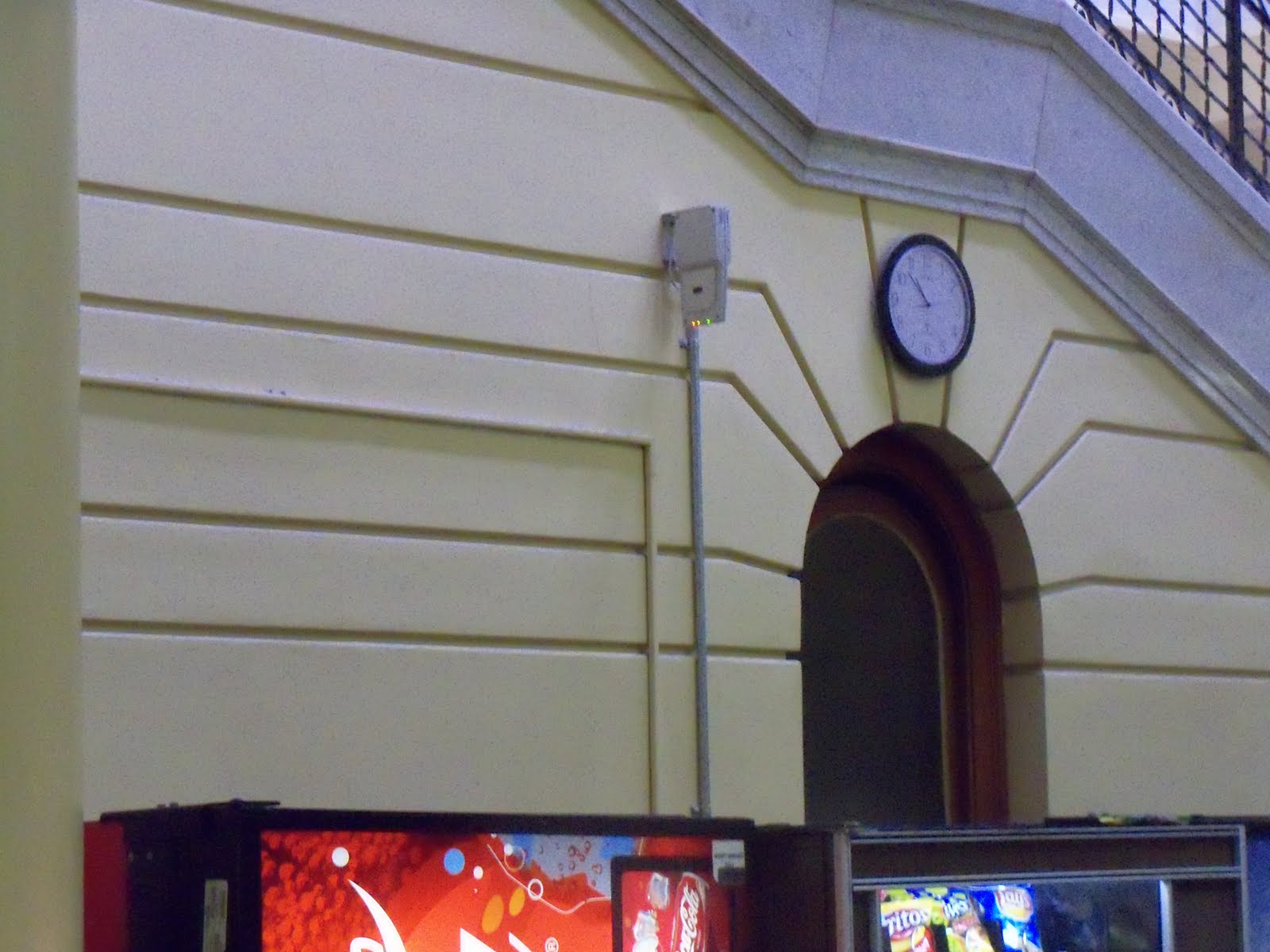
The Middlesex North Registry of Deeds is Wifi ready. We strategically installed six
hotspots around the registry that allow guess users to connect to our wireless signal from anywhere in the registry.

The hotspots are located in...The Recording Counter; Customer Service; Outside the Research Room; Outside the Register’s office; In the Courthouse Foyer and one in the Basement (this was installed with the basement was opened to the public).

If you want to use the registry’s Wifi come to Customer Service and we will give you the User ID and Password.


Tuesday, June 28, 2011

End-of-June recording stats

Historically, June 30 has always been one of the busiest days of the year at the registry of deeds. I believe that two factors contributed to that: for some businesses and for state and municipal governments, it is the end of the fiscal year and some funds must be spent during the FY; the second factor is that many "spring sales" are consummated on that date. Once the snow melts, people start aggressively shopping for homes and, given the lead time needed for a typical sale, the end of June is about when a closing would take place for an April or May purchase and sale agreement. Related to that is the end of school. Families with children might tend to defer moving into a new house might wait until school is out to physically move to a new home or new community.

But as I said, this is the case historically because it certainly has not been the case in the past few years since the real estate bubble burst and it doesn't seem like it will be the case this year. Our recordings-to-date for June when compared to the same period last year, paint a bleak picture. From June 1 thru June 27 of 2011, 373 deeds were recorded while at the same time in 2010, there were 499. That's a drop of 25%. The same holds true for mortgages. They went from 900 in June 2010 to 689 in June 2011, a drop of 23%. We hope that things pick up this week, but there is unfortunately no indication right now of that happening by the end of the week.

Monday, June 27, 2011

Foursquare?


Foursquare is the hottest thing in social networking right now.
I know what you're thinking...What the heck is Foursquare?

First, investors are clamoring to give Foursquare founders, Dennis Crowley and Naveen Selvadurai money (not me). In fact, in June the company raised $20 million in venture financing.
That's not back for a company most people have never heard of.

Today the four year old company is valued at $600 million...(wow, I keep telling myself I've got to invent some techie thing).

OK, so that's the money part of Foursquare, but what is it?

Check out this statement directly from the company's website: Foursquare is a location-based mobile platform that makes cities easier to use and more interesting to explore. By “checking in” via a smartphone app or SMS, users share their location with friends while collecting points and virtual badges.

Huh?

OK, this is how I understand Foursquare works. Lets say you go to a restaurant, once you are there, you "check in"using a Foursquare App that locates your position through the phones GPS system. This allows your friends to know where you are, and join you if they want. Foursquare can even ping your friends and let them know immediately you are in the restaurant.
Now...While at the restaurant you are not sure what to eat, simply check what your Foursquare friends think is the best thing on the menu. And Foursquare gives "badges" and "points" to people who repeatedly "check in" at the same restaurant or "check in" at many venues in one day. You can watch your points and your friends points build up. Of course, all of these "location finders" can be limited by privacy settings within Foursquare itself.

So that's Foursquare...as I understand it.

Still don't get it? Me neither...

But, today 10 million people are registered Foursquare users... so someone is getting it.

Friday, June 24, 2011

Massachusetts Deeds Indexing Standards - some background

During the 1990s registries of deeds across the country increasingly converted their index creation, storage and presentation to computers that ran various land management software applications. As registry users became comfortable with this new technology, they began demanding that land data be entered into these computers in a standard way. Early on, Virginia, North Carolina and Georgia all adopted deed indexing standards and vendors of land management applications whose territories were nationwide carried these standards to other jurisdictions including Massachusetts.

Guided by the work of other states, the Massachusetts Registers of Deeds Association set out to draft standards for the Commonwealth. The first version of the standards went into effect on January 1, 2000. Since then, there have been several updates.

From time to time in the coming weeks, I'll do occasional blog posts giving some of the history and background of various aspects of the standards.

Thursday, June 23, 2011

Robo-Signing and the Salem Registry of Deeds

Essex South Register of Deeds John O'Brien has done some great work rooting out flawed or fraudulent documents created as part of the "robo-signing" practice by some major national lenders. In this context, robo-signing refers to the practice of any number of employees of the lender (or its subsidiary corporate agent) signing an authorized individual's name to a document without any apparent legal authority to execute such a signature. A woman named Linda Green has become the poster child of this practice. She was the authorized signatory for one company, yet dozens of other employees scattered around the country routinely signed her name to documents that often recited that Green was signing based on her "personal knowledge of the facts stated therein." Register O'Brien is in possession of about 20 variants of Green's signature on documents already recorded in Essex South.

Believing that these documents bear fraudulent signatures and are therefor void, O'Brien has instructed his staff to refuse to record any document purportedly executed by Linda Green or any one of two dozen other individuals whose names have been identified as robo-signers. O'Brien returns the original document to the sender with a proposed affidavit whereby the sender would certify under the penalties of perjury that the document proffered for recording contained a valid signature. Thus far, no affidavits have been sent back, only re-executed documents signed by other authorized individuals.

This matter was discussed at length at the Registers of Deeds Association meeting held earlier this week in Worcester. Although the group took no position on the issue, there was a valuable discussion. My own view is that this registry will not (for now) reject any documents for robo-signing reasons. While I don't doubt that some documents were signed by individuals other than the one purportedly signing, I also believe the law of agency is complex, particularly in the areas of actual and implied authority and of ratification. This causes me to question my ability to make an ironclad determination of fraud and its legal consequences, and without such a determination, I believe it important to err on the side of recording the document and let those who rely upon it in the future do so for whatever value they ascribe to it. In the meantime, I commend John O'Brien for tackling this issue so aggressively. Robo-signing fraud carries with it huge implications to home ownership, title insurance, and many other areas of real estate law. By pushing this issue, O'Brien sets himself up as a test case that would ultimately result in legislative or judicial clarification of the consequences of robo-signing, an outcome that would be beneficial to us all.

Wednesday, June 22, 2011

iPad 2 for Her


My wife's birthday is coming right up (no need to sing) and I've got a great idea for a gift...a new iPad 2. I think I'll, I mean she'll love it. I, ah, she can use it to browse the Internet, watch movies, take pictures and answer my, her email.
Its funny though, when I decided to buy a tablet for my, I mean her...I never even considered anything other than the Apple iPad.
And, apparently I'm not the only one that thinks this way... the iPad totally, dominates the tablet market.
How totally? In the 3rd quarter of 2010 Apple's iPad represented 93% of all tablet sales. I'd say that's "totally" dominating the market, won't you?
Since the iPad spectacular release, experts have been predicting Apple would eventually lose ground to other tablets, like Motorola's Xoom, Blackberry's Playbook and Acer's Iconia....but it hasn't. People are iPad crazy...like me, I mean my wife.
According to analyst Rodman and Renshaw, iPad sales projections for the June quarter range from 8 million to 11 million. That's a lot of iPads.
So isn't it obvious why I decided to buy myself, I mean my wife an iPad.
Happy Birthday Dear.

Tuesday, June 21, 2011

Electronic Recording Update

I attended a meeting of the Massachusetts Registers of Deeds Association today in Worcester. Electronic recording was one of the topics of discussion. We've been recording electronically recorded documents in Lowell since 2005 and now 23% of our daily document intake is handled electronically.

(For those unfamiliar with this method, the customer scans the original document and uploads it to a secure website along with data about the document. The customer then transmits this electronic package of data and document image to the registry where it is quickly recorded. All fees are paid through electronic bank transfers).

The other registries of deeds in Massachusetts currently doing electronic recording besides Lowell are Plymouth, Hamden, Middlesex South and Norfolk. All report excellent results with widespread acceptance of the technology by members of the local conveyancing bar.

As more registries deploy electronic recording, the volume of recordings submitted to those offices already using the technology is bound to increase.

Monday, June 20, 2011

Orders of Notice increasing

I checked the number of Orders of Notice (the document that starts the foreclosure process) that were recorded so far this month and compared it to the same time last year. In the first three weeks of June 2011, we have recorded 43 Orders of Notice district-wide. For the same time in 2010, we only recorded 24. That's a 79% increase. The troubled properties are scattered throughout the district. Lowell has 21 of the 43 while Billerica has 6 and Dracut has 5. The mortgages being foreclosed are also of variable duration although most came near the end of the housing bubble (of the 43, 9 were from 2005, 10 from 2006 and 10 from 2007) while only a total of 7 of the 43 were from 2008 or more recently.

A dramatic rise in foreclosures is certainly not good news, so we'll keep close watch on this category in the coming weeks.

Friday, June 17, 2011

June 17, 1775: Battle of Bunker Hill

On this day in 1775, British troops stormed colonial fortifications on Breed's Hill in Charleston, Massachusetts, seeking to expel the local militia from that strategic high ground that overlooked the city of Boston. The colonial troops were dug in and well led and so the first two British assaults failed with heavy casualties. The third British assault captured the hilltop but only after the colonists had expended all of their ammunition. The unwounded militia fled across Charlestown Neck and reformed in Cambridge. Given the length of the engagement and the high casualties received, the British did not pursue but withdrew into Boston where they remained until March of 1776 when they departed Boston for good (on Evacuation Day!).

While the confrontation at Lexington and Concord in April 1775 had resulted in casualties on both sides, many in England and in the southern colonies dismissed that engagement as an unfortunate and unintended mistake, believing that reconciliation was still possible. But after Bunker Hill, with its high casualties, attitudes hardened in favor of a protracted war and any hope of a rapidly negotiated peace ended.

Thursday, June 16, 2011

Bruins win Stanley Cup

Last night the Boston Bruins won their first Stanley Cup in 39 years by defeating the Vancouver Canucks, 4-0, in game seven of the finals. The Bruins victory was a rarity in several respects: only twice before has a visiting hockey team won a game seven (last night's game was played in Vancouver) and never before had a hockey team won three game sevens en route to a Stanley Cup victory. In this series, the home team had won each of the first six games so that also weighed against Boston. But Boston seemed to have more energy, to be better conditioned. When the third period began, I thought to myself, here comes the desperate all-out attack by Vancouver but the Canucks never gained any momentum and so the Bruins prevailed. Nationally, much of the media attention today is focused on the post-game rioting in Vancouver and not the game itself. Here in Boston, however, it's all about the Bruins and their great accomplishment.

Wednesday, June 15, 2011

Speak and Search


Google is looking for a faster way to search...so it is turning to a system that allows people to search using voice activation. In other words... you speak and google goes.

Now I love Google, not just as a search engine but as a company, too. I like the company's business philosophy and approach to "open" information. Google provides the public so many services and it provides them for free. There is Google Chat, Google Docs, Google Books, Google Buzz, Wiki's etc...

But honestly, I don't know about this voice thing.

Unfortunately, I have not come across any voice activating computer software that is 100% reliable. And I have tried a few. On my iPhone I've used Say Where and Dragon Software, both are very good, but not perfect. With Dragon Software I find myself speaking like this... "I-like-this-new-Dragon-software", slowly and deliberately.

Google tried voice activated search before. And of course, I had to give it a try. I kept it for several months, but ultimately didn't think it was very good, so I deleted it from my phone.

But now, according to Alan Eustace, senior vice president of knowledge at Google, this software is a smarter. "Google demonstrated that the search engine understands the difference between Worcester, Mass and Wooster College, words that sound the same but are spelled differently (New York Times).

If Google's new software truly is as smart as Google believes...perhaps it will change search forever.

Tuesday, June 14, 2011

Mid-Month stats for June

Well almost mid-month. Comparing documents recorded from June 1 through June 13, 2011 with documents recorded during the same period in 2010, we gain further evidence that "malaise" is an appropriate word to use to describe the local housing market. The number of deeds recorded during that thirteen day period dropped 14% from 194 in 2010 to 166 in 2011. Mortgages were down about the same - 16% - sliding from 353 to 296. There was good news with foreclosure deeds because they were also down from 28 to 13, a decline of 54%. Orders on notice were up substantially, however, rising from 17 to 29, a jump of 70%. If this document type continues to be up through the balance of the month, it would be the clearest signal yet that we are facing a new wave of foreclosures with their auctions hitting late in the summer or early in the fall.

Monday, June 13, 2011

Chair Lift @ Lowell Superior Courthouse Removed

Late last week contractors removed the handicapped chair lift at the Lowell Superior Courthouse. The lift has been in place making the upper floors of the courthouse accessible for the 17 years I have been here and longer. It is no longer needed now that the new elevator is operational.

This morning is the first time I got a good look at the 120 year old marble staircase without the lift. Although marred by the holes needed to mount the lift, its beauty is still obvious.

Below are pictures showing the mounting holes on both the side of the staircase and the floor, as well as the stunning marble staircase side and striking wood and metal handrail.

Click image to enlarge


Friday, June 10, 2011

Mortgage robo-signers & Sarah Palin

My colleague in Salem, John O'Brien (the register of deeds for Essex South) is conducting an on-going investigation of so-called "robo-signers" from large national lenders. These gigantic mortgage granting entities invest certain employees with the authority to sign on behalf of the corporation. When the wave of mortgage foreclosures became a flood, it became more and more difficult for these designated signers to keep pace with all the paperwork that needed their signatures. Rather than authorize additional employees to sign, other employees began forging the signatures of the designated individuals. One such designated individual had the name "Linda Green."

If you were to walk into John O'Brien's office, he has a poster-sized printout on an easel. It bears the signature of Linda Green - and nine other distinctly different variants of the very same signature. Clearly other people were signing as Linda Green.

While I try to sort out all the legal consequences of these forged signatures, John O'Brien continues to find them in the unlikeliest of places - including in the chain of title of the Arizona mansion recently purchased by Sarah Palin. Here's O'Brien's press release on this matter:

Massachusetts Register of Deeds John O'Brien and Forensic Mortgage Fraud Examiner Marie McDonnell find former Vice-Presidential candidate Sarah Palin is victim of potential mortgage fraud; expert says chain of title to new Arizona home clouded by robo-signers.

In what is an ironic twist of fate today Register of Deeds John O'Brien and nationally renowned mortgage fraud examiner Marie McDonnell, President of McDonnell Property Analytics, Inc., announce that former Alaska Governor and Vice-Presidential nominee Sarah Palin is an unwitting victim of mortgage fraud and has purchased a home in Arizona that contains flaws in the chain of title.

Register O'Brien said, “If fundamental property principles still matter in this country, Sarah Palin may have legal issues that could affect the ownership of her home. Through no fault of her own, Sarah Palin has become a victim like thousands of others across the country that have the same problem with their chain of title. I feel bad for Governor Palin and all the homeowners who have been victimized by this scheme, it just goes to show you that no one is immune from this type of fraud and irresponsible behavior that these banks participated in.”

Marie McDonnell added, “Sarah Palin’s chain of title has been swept up into the eye of the ‘perfect storm’ where robo-signer Linda Green’s fraudulent Deed of Release on behalf of Wells Fargo Bank, N.A. is eclipsed by robo-signer Deborah Brignac’s fraudulent foreclosure documents. Brignac, a Vice President of California Reconveyance Company (a subsidiary of JPMorgan Chase Bank), assigned the homeowner’s Deed of Trust to JPMorgan Chase Bank in her capacity as a Vice President of Mortgage Electronic Registration Systems, Inc. (“MERS”); in the same breath, Brignac executed a document appointing California Reconveyance Company (her real employer) as Substitute Trustee in her alleged capacity as a Vice President of JPMorgan Chase.”

Sound confusing? McDonnell explained, “This is a shell game where Brignac purports to be Vice President of three (3) different entities so that she can manufacture the paperwork necessary for JPMorgan Chase Bank to hijack the mortgage and then foreclose on the property. This is an excellent example of how MERS is being used by its Members to perpetrate a fraud. I have laid out a timeline that illustrates the defects in Sara Palin’s chain of title which shows that it is seriously, if not fatally impaired.” McDonnell whose firm performed the extensive forensic analysis.

O'Brien, who recently announced that he found 6047 fraudulent Linda Green documents recorded in the Essex Southern District Registry of Deeds which had 22 different variations of a Linda Green signature has been the National Leader in blowing the whistle on banks such as Bank of America, J.P. Morgan Chase, Wells Fargo for their business practices. O’Brien said “These banks have participated in a national epidemic of fraud that has clouded or damaged the chain of title of hundreds of thousands of American homeowners all across the country”. O’Brien further said “Sadly, Sarah Palin’s misfortune will however, hopefully shine the national spotlight on this issue. Given her position in the country, I am sure that she will use her influence to stand up for homeowners and their property rights”.

Thursday, June 09, 2011

Robosigning - the good kind

The term "robosigning" was much in the news during the past year. It was used to describe the practice by employees at several large national lenders of signing foreclosure-related affidavits, purportedly based on "personal knowledge" of the person signing, when in fact the person signing was in a remote office, with no personal knowledge of the facts stated in the affidavit.

A story in today's Herald informs us that Robosigning has now emerged in a different (and more acceptable) context. Citizens Bank is experimenting at some of its Massachusetts branches with a type of electro-mechanical device that allows a customer sitting in one place who is communicating with a bank employee at a distant location via teleconferencing, to apply a "wet" signature to a document at that distant location through the use of technology. When it comes time to sign, the customer uses a stylus and an electronic pad to sign, but that signature is automatically imprinted on the underlying document which is physically at that remote location.

I'm reminded of a past trip to Monticello, the estate of Thomas Jefferson. Our third president had devised a mechanical copying machine which consisted of one pen for him to grip that was attached to an arm and another pen attached to a parallel arm that would automatically mimic the writing motions of the person gripping the first pen. By this device, Jefferson would automatically produce an exact copy of all his written correspondence. Like so much of today's technology, people who came long before us came up with the idea; we just have the means of better executing those ideas. In this case, folks applying for bank loans can use the same technological concept as was employed by Jefferson centuries ago.

Wednesday, June 08, 2011

Lowell Superior Courthouse Elevator Dedicated to Denise Lawrence

Several weeks ago a plaque was installed at the Middlesex Superior Courthouse in Lowell (home of the Registry of Deeds) dedicating the new elevator. The plaque pictured below reads as follows:

Dedicated to the memory of
Denise Lawrence
(1962-2008)

A determined advocate for people with
disabilities, who successfully advocated
for access improvements
at the Lowell Superior Court


A dedication ceremony is being scheduled for the near future.

Tuesday, June 07, 2011

The iCloud

Yesterday when I wrote about Apple's World Wide Developer's Conference I really didn't anticipate the new iCloud would be steal the show. Cloud networking is really nothing new. Google has been involved with it for a number of years. But Apple knows how to sell a produce like no one else...hence the iCloud will be huge.
In case you missed it...iCloud will integrate all of your music, photos, videos, Apps, documents etc seamlessly with all of your Apple devices. Example: Lets say I'm walking down the street and Barack Obama calls to me, "hey, Tony how are you doing". I go over to the Commander-in-Chief and take a picture of him with my "iPhone". When I go home and tell my wife I met the Prez and she doesn't believe me, I pull out my "iPad" and show her the picture. Pretty cool.

Here is Steve Jobs explaining the iCloud

Monday, June 06, 2011

Apple's WWDC @ 1:00 Today


Today is a big day for techies...today Apple CEO Steve Jobs will give the keynote speech at the Apple's Worldwide Developers Conference or WWDC as it is known. The word is Apple executives think some today's announcements are going to create much discussion in the technology world.


Here are some of the rumored innovations Jobs is expected to talk about today (most deal with the iPhone and iPad):

  • The introduction of Widgets to the iPhone and iPad
  • Automatic music streaming
  • A remote storage service called, what else...iCloud
  • A simply yet comprehensive Twitter integration
  • A better voice recognition system
If you are interested you can follow the goings on at WWDC by following this link.

Friday, June 03, 2011

May recording statistics (official)

This past Tuesday (May 31) I put up a preliminary report on recording stats for May 2011. Tuesday turned out to be a busy day, however, so the stats I posted in the morning understate the actual figures which are as follows:

For the entire district, the number of deeds recorded in May 2011 (424) were down 19% from May 2010 (525). The number of mortgages recorded were down 15% (743 in May 2011 to 874 in May 2010). The number of foreclosure deeds were down 23% (a good thing! - 44 in May 2011 v 57 in May 2010). The number of orders of notice were down 8% (71 in May 2011 v 77 in May 2010)

Thursday, June 02, 2011

The day after the tornado

Yesterday afternoon the Springfield area was pummeled by a tornado. Four people were killed and more than 200 buildings were destroyed or seriously damaged. MassLive.com, the website of the Springfield Republican newspaper has extensive coverage.

The weather here in Greater Lowell turned ominous but dangerous conditions never materialized. It all began for us at 8:30 in the morning when an otherwise pleasant morning saw a 15-minute cloudburst with much lightning. The rest of the day was partly cloudy but a persistent wind strongly suggested the coming storm. By 4:30 pm, the sky was dark and threatening. Once I got home fifteen minutes later, I remained glued to the television for the next few hours, following the storms as they sped from west to east across the state. Fortunately, we dodged the worst of it.

Wednesday, June 01, 2011

Eric Schmidt's Infamous Mistake


I first heard of Eric Schmidt several years ago when I listen to him during a panel discussion on technology. I was impressed...He was clever, bright and the CEO of of the biggest search engine in the world, Google.

But in an interview conducted last week Schmidt admitted he "screwed up" (those are his words, not mine). The powerful, effective CEO totally under estimated Facebook.

When Facebook was just a budding upstart with a meager 20 million users Schmidt examined whether Facebook might someday pose advertising competition for the search engine giant. He concluded no.

Today Facebook has 500 million users and is attracting online advertisers like honey does bees. Five years ago many of these online advertisers would have given their money to Google, Schmidt's company.

How bad was Schmidt's "screw up" (those are his words not mine)...so bad that it essential led to his firing. Schmdit has been replaced by Google founder Larry Page.

Since taking management control of Google, Page is making a huge effort to turn more of the companies attention to social networking. A move executives hope will correct Schmidt's gaffe and help Google regain the upper hand in the online advertising world.

But don't feel bad for poor, unemployed Eric Schmidt...his estimated wealth is $7 billion. Not bad for a guy that "scre... , well, you know.