Tuesday, May 29, 2012

Will There Be Ink?

     Did you ever have an experience when a non-related sight, sound, event changed or clarified a concept you'd been kicking around in your head?
       It happened to me over the Memorial Day weekend. I was taking a walk with my wife (she wants me to lose weight) in an area located across from a beach. I passed a small cottage with three people sitting on a street level deck very close to the sidewalk, so close I could have touch them. I saw two young girls and one young man. I speculated all three were in their early twenties.
      Now here is the thing that struck me....the first girl was reading an electronic book on a Kindle, the young man was reading the news on his laptop computer and it looked like the second girl was scanning a magazine on her iPad.
     Something about this scene hit me...ten years ago these three would have been reading a paperback book, a printed newspaper, and a paper magazines...but not today. Today their information was all being delivered by an electronic device. I thought to myself... this is the next generation. Sand or no sand, they "want" to get there information electronically.
      I wondered... can ink and paper survive the new generation?  

Friday, May 25, 2012

Two Hundred and Nine years ago today, May 25 Ralph Waldo Emerson was born in Boston Massachusetts.At the young age of 14 Emerson began his studies at Harvard University. At of thirty-one he moved to Concord, Mass leaving his mother's home in Newton.

In 1836 he met and became friends with Henry David Thoreau. Together they became major leaders of the Transcendental Movement, a philosophy that stressed self-reliance, individualism and a connection with Nature.

Often Emerson is given undeserved criticism when compared to Thoreau. Some label him a talker not a doer. This is unfair. Ralph Waldo Emerson was unquestionable a genius. No, he didn't send two years living in the woods, like Thoreau, but he lectured and wrote extensively. During the 1850's he gave as many as 80 lectures a year.

When Emerson died in 1882 he was buried in Sleepy Hollow Cemetery in Concord in an area known as Author's Ridge. Renowned authors Louisa May Alcott, Nathaniel Hawthorne and Henry David Thoreau are also buried on Author's Ridge.

Thursday, May 24, 2012

Finding "Our" Southern Middlesex Plans on the Internet

Over the past couple of days I've had several people ask me how to find "our" Southern Middlesex Plans on the Internet. First, let me explain why I called these plans "our" Southern Middlesex Plans. The Middlesex North Registry of Deeds didn't opened until July of 1855. All plans for any of our ten towns before that day were recorded at the Middlesex South Registry of Deeds in Cambridge...hence, we called them "our" Southern Middlesex Plans.

Anyway... here is how to find "our" Southern Middlesex Plans on the Internet:

Log into masslandrecords.com, select "Search Criteria", under the "Plan" section select "Unindexed Property", enter the book and page of the plan you want to view. OK, here comes a curve ball, all of "our" Southern Middlesex plan books are labeled with a prefix of "90". This means if you want to see Southern Middlesex Plan Book "2" you enter 902 for the plan book number.  After you enter the appropriate information hit "Search" and the indexing information will pop up, select "View Image"...that's it.
 
Here are some pictures to help...yes, I know they are kind of small, but click on them and they will enlarge.  

Wednesday, May 23, 2012

A Talking Car

Back in the olden days when I was a kid, there was a TV show called My Mother the Car. The plot of the show revolved around Attorney David Crabtree who purchased a unique 1928 Porter touring car. The car was unique because it just happened to be the reincarnation of  Crabtree's mother. And of course, the car talked to its son, the esquire, through the radio. It was without doubt one of the stupidest shows I've ever watched, "once".

Call me a little strange, but for some reason that stupid show popped into my head yesterday. "How ridiculous", I thought, "a car that talks to you.Foolish!"
 
Call me strange, again...but I check Google News every morning and especially enjoy the technology section. Can you believe this morning,  I read this headline in the Los Angeles Times "New Service Turns Your Car Into A Talking Personal Assistant".

Come on, are you kidding!

Hey, this time I'll call myself strange. Think about it, the day after I had some stupid, 45 year old, TV show that featured a talking car, terrorizing my brain...a headline appears in a major newspaper stating... talking-cars are just on the horizon.

It's true...

The smart technology behind the innovation was developed by Dragon, the voice recognition software. The company calls it...Dragon Drive. Truthfully, I've already seen some of the features of Dragon Drive operational in newer cars, but some I've never seen, and they look pretty cool...check them out.
     

Tuesday, May 22, 2012

Let's Play... "What's His Invention"


 Let's play a game. I call it "What's His Invention". Here is how it works...I'll give you ten facts about either the invention or the inventor and you see if you can guess the invention.

Sounds like fun.

First, a little introduction...Yesterday, Eugene Polley passed away at the age of 96. Polley was an engineer by trade. Before his death he lived "in a junk-cluttered house, played pool for pocket change and liked a smooth gin and tonic (Chicago Tribune). For one of the most widely used invention in the world Polley received a meager $1,000. 


Now back to the game...Are you ready to play "What's His Invention"?

OK, here we go:

1. Eugene Polley invented a device that changed the world.

2. Polley's invention forever changed the relationship between between men and women.

3. The sale of AAA batteries increased hugely because of Polley's invention.

4. Polley's invention is often lost under couch pillows.

5.  The advertising world is still in havoc because of Polley's device.

6. Polley's invention gave a new meaning to the word "surfing".

7. What Polley gave to the world might be responsible for more weight gain than most fast-food restaurants.

8. Many people call Polley's device "the clicker".

9. Eugene Polley began his career working for Zenith Corporation.

10.  In 1997 the National Academy of Television honored Eugene Polley with an Emmy Award .

So...We know the inventor is Eugene Polley but, the question is... "What's His Invention?"

Scroll down for the answer...


Answer: The Wireless TV Remote Control

Monday, May 21, 2012

Instruments of Redemption from city of Lowell

Ever since the city of Lowell held it's first in recent memory tax lien auction back on April 26, 2012, it seems that quite a few home owners have arrived here at the registry of deeds with Instruments of Redemption in their hands, seeking to record them.  The Instrument of Redemption is the document generated after the back taxes have been paid.  It must be recorded to clear the record of the initial taking.  Some of the citizens who arrive here are surprised/disappointed that they have to pay a $75 recording fee to the registry of deeds after having paid substantial sums to the city for back taxes but most realize that's the way the system works.

I assumed there had been an uptick in the number of instruments of redemption from Lowell being recorded but that was not the case.  From April 1, 2012 until today, there were 41.  From April 1, 2011 until May 21, 2011 there were 41 - the exact same number.  Maybe the ones recorded last year arrived by mail or at least less noticeably than the ones from this year. 

Whatever the case, the city is planning to try the tax lien auction again during the third week in August since the first attempt yielded no bids and made no sales.  Tax takings for FY2011 are scheduled to be completed and recorded by the end of June, so those properties will also be included in the August auction.  For more information about this tax lien auction, contact the city of Lowell Tax Title Division.

Friday, May 18, 2012

Electronic Recording statistics

When we first logged on our computers this morning we had 145 electronic recording payloads waiting for us to process.  Most were assignments sent overnight by major lenders but through the day more and more sales and refinancings handled by local attorneys came in electronically.  This prompted me to look at our 2012 statistics for electronic recording.

In January, we recorded 4911 documents of which 1472 were recorded electronically (30%).  In February, there was a total of 5065 documents of which 1664 were electronic (33%).  In March there were 5297 total documents with 1551 received electronically (29%) and in April there were 5544 documents with 1964 electronic (35%).  For the first four months of 2012, there was a total of 20817 documents recorded with 6651 submitted electronically.  That means 32% of our documents for the year were recorded electronically.  This is up from 25% for 2011.

Thursday, May 17, 2012

Jurors and Social Media

As someone who recently served on a jury and who also is a regular user of social media, I read with great interest a report in the May 7, 2012 edition of Massachusetts Lawyers Weekly on the decision of the Massachusetts Appeals Court in the case of Commonwealth v Werner (full opinion here).  After the defendant had been convicted of larceny over $250, defense counsel discovered that one of the trial jurors had posted something about the trial on Facebook during the trial.  This prompted a motion for a new trial which was denied which denial was the basis for the appeal.

The Appeals Court upheld the trial judge's denial of the motion for a new trial mostly on the grounds that there was no evidence that the Facebook postings put any extraneous information before the jury.  The Appeals Court went on, however, to urge trial judges in their instructions to juries to be much more explicit in directing jurors to refrain from any digital discussion or comment about their jury service at least until such service was completed.  "More explicit instructions about the use of social media and the Internet may therefore be required . . . Jurors must separate and insulate their jury service from their digital lives." 

From my prior career as an attorney who handled a lot of criminal matters, I'm very familiar with the problem underlying this case.  While a trial is a search for the truth, it is a search for the truth within the very strict confines of the adversarial system and the rules of evidence.  Not every piece of information should be available to jurors.  Jurors must base their verdict only on those facts that have been subject to cross examination by the opposing party and that are also allowed by the rules of evidence.  If the jury is exposed to any information that reaches it without first going through this process, a mistrial must be declared.  In the past, scenarios that resulted in new trials involved jurors conducting experiments on their own outside of court or third parties either purposefully or inadvertently passing information to jurors.  Now that everyone with a smart phone or an iPad has access to "all the world's information" at their fingertips, the chances of extraneous information reaching jurors is greatly magnified.

Wednesday, May 16, 2012

Mid-Month Statistics

With May half over we can look at the recording statistics for the first two weeks of the month and compare them to the same period last year.  The trends are optimistic:

The number of deeds recorded was up 33%, from 163 in the first two weeks of May 2011 to 216 in the first two weeks of May 2012.

The number of mortgages recorded was up 71%, from 327 in the first two weeks of May 2011 to 559 in the first two weeks of May 2012.

There was no percentage change in the number of foreclosure deeds - 16 for both time periods - or orders of notice - 28 in 2011 and 27 in 2012.

The big jump in mortgages is very good news.  That suggests more people are refinancing and since it's unlikely that they are doing that to extract equity from their homes, it's more likely that they are going to better rates and reduced monthly payments which is good news for the economy since any money saved by the household on mortgage payments will undoubtedly be spent on something else.

Tuesday, May 15, 2012

More from Registry Technology Meeting

Last night I wrote about yesterday's meeting of the Registry of Deeds Technology Advisory Committee.  Here are a few additional items that were discussed:

CERS - That stands for "Commonwealth Electronic Recording System" which is the state-created and operated electronic recording portal now in operation in Worcester.  The plan is to install it registry by registry rather than all at once.  The Suffolk Registry is the next to get it.  One of the features of this system tries to address what we see as one of the most common errors: customers sending documents to the incorrect registry.  This happens most often in counties with multiple registry districts since some customers only dig deep enough to find the correct county but not the correct district.  This new system requires the customer to select the town in which the property is located which then directs the recording to the proper registry.  Besides the underlying recording fee, this system also imposes a $5 "convenience charge" which is similar in amount to what the third party vendors like Simplifile and ACS charge their customers.  The $5 fee for the state portal goes to a company called "HP Convenience Pay Inc" which administers the system and pays the credit card fee to the issuing bank.

Abolition of Registered Land - Middlesex South Register of Deeds Gene Brune said that one of his wishes was to end Registered Land, at least on a going forward basis if not in its entirety.  His reasoning is that registered land accounts for only 15% of the land in his registry district but that the Middlesex South Registered Land Department is staffed with 50% of his employees.  The representative from the Real Estate Bar Association of Massachusetts (REBA) who is a member of the Technology Committee said that REBA fully agrees that registered land should be reduced, starting most likely with commercial properties, but that the organizations efforts to date to do this have met with "tremendous push back" from the Land Court and so there is little hope of it happening any time soon.

Online Information - The representative of the Mass Association of Realtors (also a tech committee member) explained that 90% of home buyers begin the purchasing process online and for that reason the more information we can put on registry of deeds websites, the better.  He said that good Q&A pages are especially helpful and that some brokers print what is already on registry websites and distribute the information as handouts to customers.  

Monday, May 14, 2012

Registry of Deeds Technology Fund

Back in 2003, the state legislature created a Technology Fund to be used by the state's registries of deeds to fund new technological initiatives.  The Fund is financed through a $5 surcharge on documents recorded at each registry.  Today most of the state's registers of deeds met at the Secretary of State's office to discuss how the money is being used at the registries.

The biggest single expenditure - about one-third of the total - pays for the hardware and software of the MassLandRecords website and for the computer and communications infrastructure that connects each registry to the internet and to each other.  These costs clearly benefit each office although they would be deemed "indirect costs" since they are not directly controlled by the individual registry.

As for direct expenditures by individual registries of deeds, the most common use was for back scanning of documents and indexes.  Many offices have opted to scan their paper-based index books and to put them on MassLandRecords in an electronic book format rather than in a searchable database.  (This is the approach that we've taken at Middlesex North).  Simultaneously, the registries are also working on adding older indexes to the searchable database as well.

Electronic recording was another common expenditure.  The Worcester Registry finally has the "state portal" operational for electronic recording.  Rather than use intermediary companies such as Simplifile and ERX to provide electronic recording services between customers and registries, the "state portal" allows customers to file directly with the registry.  Now that this system is functional in Worcester, the Suffolk Registry of Deeds should be the next to try it.  Other registries that have implemented (either recently or as in the case of Lowell, quite a few years ago) electronic recording using the third party system include Fall River, Middlesex South, Taunton, Fitchburg, Norfolk, Plymouth, Springfield and Lowell.

Friday, May 11, 2012

Globe Op-Ed on Foreclosures

Attorney General Martha Coakley has an op-ed in today's Globe about new moves intended to curtail the ongoing foreclosure crisis.  Coakley writes of a statutorily mandated loan modification procedure now under consideration in the legislature and of HomeCorps, and initiative in her office, financed in part by the proceeds of the mortgage industry settlement.  HomeCoprs, according to the Op-Ed and the AG's own webpage, will provide borrowers in financial difficulty with a state-employed advocate who will help represent their interests in the loan modification process.

As Attorney General Coakley correctly observes in her Globe column, the piecemeal approach to loan modification used during the past five years has only served to prolong the foreclosure crisis.  Until there is a more comprehensive, enforceable approach that provides for principal reduction in place, there is little hope for a rapid end to the foreclosure-driven real estate slump that continues to this today.  

Thursday, May 10, 2012

Jury Duty in Concord

We'll take a detour from real estate and technology today to mention my experience yesterday when I was called for jury duty at the Concord District Court.  Before becoming register of deeds I used to make frequent trips to that court to represent clients in probate proceedings, usually divorces.  It was always a busy session with no lack of cases which made it all the more surprising when I learned yesterday that the probate session had been closed for some time due to an insufficient number of employees left at the registry of probate after budget cuts to staff a full time satellite session like the one that had existed in Concord.

The District Court is open for business and the court when compared to the much older facilities in Lowell still seemed to be in good shape.  The loudspeaker system in the courtroom was broken, however, which made it difficult to hear some of the witnesses.  Everyone on the courthouse staff - security guards, court officers, clerks and the judge - all were professional and prompt in all their interactions with jurors.

I ended up in seat three on the jury and remained there through empanelment.  The case involved possession of illegal drugs but while there was some evidence of drugs (residue of cocaine) there wasn't any evidence linking the defendant to the drugs and so the judge granted the defense attorney's motion for a required finding of not guilty at the close of the prosecution's case.  That brought the trial to an immediate conclusion and our services as jurors were no longer needed.

In the orientation video that everyone watches (which is new since I last was called for jury duty three years ago), the narrator quotes John Adams as saying that voting and serving on juries are the heart and lungs of a democracy.  As inconvenient as it may be to drop out of your daily routine to participate in jury duty, it is an important service.  After my experience yesterday, I can also attest that it is a rewarding experience as well. 

Wednesday, May 09, 2012

The Next Big Thing...Maybe


I am just finishing up a book titled "The New New Thing" by Michael Lewis. One of its major themes is that once something hits big in the technology world there is another thing that quickly follows behind. That is "the new new thing".
     Last week the New York Times listed technology starts up that might become "the next Big Thing".

Here is a list of four:

Square: Square was developed by one of the founders of Twitter. It is an App with an attachment that allows vendors to turn a cell phone into a credit card reader.

Airtime: Actually, I was a little hesitant to write about Airtime since little is known about it right now except that it is being developed by the two guys that started Napster the music sharing site...this time Sean Parker and Sean Fanning are developing a movie sharing site.

Quora: Got a question...Quora's got the answer. It is kind of a wiki. A member asks a question and other members answer it. Behind this start up are Adam D'Angelo and Charlie Cheevers two of the original Facebook employees. 

Dropbox: Dropbox has been around for a while now, but it is still a start up. Dropbox is a kind of cloud storage for files, photos and music. Can you believe it already has 50 million users.

Tuesday, May 08, 2012

MassLandRecords "basket" function

The MassLandRecords website which contains all of our digital document images permits users to view images, to print them and to download them.  The earlier version of MLR downloaded the documents as single page TIF images.  The downloads on the new version, done through the "basket" function, came to your computer as PDF files. While PDFs are probably more portable and are certainly easier to view for many people.  However, TIF images offered customers more flexibility - some would paste them into Word documents, for example - than was the case with PDFs.  To accommodate such innovations, we recently modified the website to permit downloads in either PDF or TIF format.  Once you open your basket after adding a document to it, you now click on either PDF or TIF to begin the download with the file coming to you in whichever format you chose.

Monday, May 07, 2012

Instagram

Last month Facebook purchased Instagram, a popular photo sharing site. The price? a staggering $1 billion! A few years ago I read an article in the New York Times about Instagram. The App sounded interesting so I downloaded it (for free naturally). Days went by, weeks went by, then months went by and I never used it, not even once, so I deleted it off my iPhone. Then I read that Facebook paid $1 billion for the App and I asked myself, "what am I missing". 

Well, Instagram is move than just another photo-sharing site. You can also manipulate color tones of pictures you and your friends have taken. The video below is a good demonstration of Instagram and what you can do with it.   

Friday, May 04, 2012

Median sales prices

I recently ran a report seeking the median sales price of deeds recorded in various communities in this registry district for 2010, 2011 and the first four months of 2012.  I limited the query to deeds with consideration greater than $75,000 but less than $750,000.  Here are the results:


Lowell – The median sales price on a deed recorded for property in Lowell during 2010 was $180,000 (N (number of deeds) = 962).  The median price of those recorded during 2011 was $170,000 (N = 904), a decline of 6%.  The median price of those recorded during the first four months of 2012 was $169,900 (N = 265) which represents no change from the 2011 median.

Billerica - The median sales price on a deed recorded for property in Billerica during 2010 was $300,000 (N = 387).  The median price of those recorded during 2011 was $285,000 (N = 334), a decline of 5%.  The median price of those recorded during the first four months of 2012 was $243,000 (N = 116) which represents a decline of 15% from the 2011 median.

Chelmsford - The median sales price on a deed recorded for property in Chelmsford during 2010 was $290,000 (N = 372).  The median price of those recorded during 2011 was $275,250 (N = 406), a decline of 5%.  The median price of those recorded during the first four months of 2012 was $279,000 (N = 98) which represents a decline of 1% from the 2011 median.

Dracut - The median sales price on a deed recorded for property in Dracut during 2010 was $237,000 (N = 345).  The median price of those recorded during 2011 was $214,800 (N = 327), a decline of 9%.  The median price of those recorded during the first four months of 2012 was $210,000 (N = 97) which represents a decline of 2% from the 2011 median.

Tewksbury - The median sales price on a deed recorded for property in Tewksbury during 2010 was $289,000 (N = 333).  The median price of those recorded during 2011 was $280,000 (N = 313), a decline of 7%.  The median price of those recorded during the first four months of 2012 was $235,000 (N = 112) which represents a decline of 16% from the 2011 median.

Tyngsborough - The median sales price on a deed recorded for property in Tyngsborough during 2010 was $262,000 (N = 152).  The median price of those recorded during 2011 was $262,000 (N = 151), representing no change.  The median price of those recorded during the first four months of 2012 was $215,000 (N = 33) each represents a decline of 18% from the 2011 median.

Westford - The median sales price on a deed recorded for property in Westford during 2010 was $338.250 (N = 358).  The median price of those recorded during 2011 was $360,000 (N = 294), a decline of 8%.  The median price of those recorded during the first four months of 2012 was $361,000 (N = 81) which represents no change from the 2011 median.

Thursday, May 03, 2012

Gone! or Will Be


It is hard to think of  a part of our daily lives that has not been changed by the digital world.  Today we own devices that weren't even imagined twenty years ago...and even more interestingly there so many things we no longer need or use. 


Yesterday several local news outlets ran a story that originated in Britain on the online publication The Telegraph. The article listed "things" the digital revolution has made obsolete or will make obsolete in the near future.

Here is a sampling (BTW I added a few my own)...

Postcards
Handwritten letters
Music CD's
Fax Machines
Rolodex
The Yellow Pages
Pay-phones
Paper Maps for directions
Book-bond encyclopedias
Printed photographs
Personal Pagers
Typewriter
Copy Machine


Wednesday, May 02, 2012

My visit to the Northeast Assn of Realtors

This morning I was joined by Kevin Harvey, the assistant register of deeds of Essex South as the guest speakers of the quarterly meeting of the Northeast Association of Realtors at the organization's headquarters at 6 Lyberty Way in Westford.  Kevin, who was appearing on behalf of his boss, Essex South Register of Deeds John O'Brien, who is perhaps the nation's most recognized critic of MERS which stands for Mortgage Electronic Registration Systems Inc.  Kevin gave a detailed and very interesting account of how concerns about MERS were first brought to Register O'Brien by a constituent.  The deeper O'Brien dug, the more questions arose.  He has not stopped digging.  Along the way, he also latched onto the issue of robo-signers (the practice by employees of some major lenders signing the names of other employees to legal documents), an abusive practice that was highlighted on Sixty Minutes.

My own view of MERS and robo-signers is more nuanced.  MERS has been in existence since the mid-1990s and as long as everything was going well with real estate, no one worried about it.  Only after the market collapsed in 2007 did people start questioning the legality of MERS.  I know that MERS was involved in some shabby practices, but so was almost every national lender doing business during the housing boom.  There's nothing unique to MERS that should cause that entity to be singled out.  But that's just my opinion and as I told the realtors, if the law in this and other areas was black and white, the Supreme Court wouldn't decided cases on 5 to 4 votes.

The topic that was of greatest interest to the assembled realtors was the continuing effects of the Massachusetts Supreme Judicial Court's decision in the Ibanez case.  There, the SJC held that in order to foreclose a mortgage, the foreclosing entity must first have ownership of the mortgage by some type of assignment.  Without an effective assignment in existence before the foreclosure, the foreclosure would be void and all subsequent owners would have defective titles.  Since this would make such properties unmarketable until the defect is cleared, realtors have a practical reason for distinguishing between good foreclosures and defective foreclosures.  Why put a lot of effort into a sale that's likely to fall through just prior to closing because of a void foreclosure in the recent past?  Unless some curative legislation is enacted, a substantial number of properties will fall into this category.

In conclusion, it was a pleasure speaking with this assembled group of realtors.

Tuesday, May 01, 2012

Not MY Google

Did you hear what Google did (allegedly)? I mean, I'm having a really hard time believing this is true, but then again, I still insist on getting a chocolate bunny every Easter.

Have you ever used Google's Street View? I'll bet you have. It is great. Street View is a pictorial log of most of the United States. Believe it or not Google had cars drive up and down most streets in the US taking panoramic pictures of the buildings, trees and most everything else in their path.

Actually, Street View is available in about 50 countries throughout the world. I mainly use it when I'm looking for directions to a destination I've never gone to before.

OK, Street View is great, but did you here what Google "supposedly" did while taking these 360 degree images? Wow...I'm in semi-disbelief (is there such a mental state as semi-disbelief?). But then again, I went to the dentist last week and found $2.00 under my pillow that night.

While the "Google-mobiles" were driving around the US capturing every nook and cranny they were also collecting something else, or that's what some think anyway.

I still can't believe it...I really can't. MY Google do something like this? Never! If this is true, I'll sell you that bridge I bought last year in Brooklyn for a buck.

According to the Federal Communications Commission, at the same time as they took pictures, the Google-mobiles also collected personal information from unsecured wireless networks as it cruised the highways and byways of the America.

Come on! Are you kidding me?   

Google officials claim the "supposed" spy software was "supposedly" installed without their knowledge or authorization by an "alleged", "supposed" Google engineer, who was "acting on his own"...but the FCC doesn't agree. 

According to EPIC, "a public interest research center in Washington D.C"., the FCC's report on the personal data collection by Google "indicates that Google intentionally intercepted payload data for business purposes and that many supervisors and engineers within the company reviewed the code and the design documents associated with the project".

Yicks! Google, say it isn't so!  I just DO NOT BELIEVE IT...but then again, I think its awful that Celtics' guard Rajon Rondo was suspended because he "accidentally" tripped into that NBA referee the other night.

Monday, April 30, 2012

April statistics

At closing time today I grabbed the April recording statistics.  The three columns below are (1) document type; (2) the number of those documents recorded in April 2011; and (3) the number of those documents recorded in April 2012.  First, for the entire district:

Deeds - 405 - 458
Mortgages - 752 - 1162
Foreclosure Deeds - 37 - 37
Orders of Notice - 115 - 44
Total docs - 4744 - 5544

These number are for Lowell only:

Deeds - 131 - 125
Mortgages - 169 - 200
Foreclosure Deeds - 19 - 23
Orders of Notice - 57 - 16
Total docs - 1392 - 1154

Friday, April 27, 2012

Results of city of Lowell tax lien auction

Yesterday morning the city of Lowell held an auction of nearly 300 tax title properties in the city council chambers at Lowell City Hall.  Ten individuals pre-qualified as bidders (pre-qualification was required to participate) and a total of more than 30 people showed up for the event.

There is no set way to hold one of these auctions and the city took what might best be called a macro approach, offering all of the properties in a single bundle with a minimum bid price of $6mil.  When there were no takers for that, three different sub-bundles were offered, each with a minimum bid of $1.7mil or higher.  There were no bidders for any of them.  The auction ended within 5 minutes of its opening.

The good news is that the city took in more than $800,000 in back taxes from people whose properties were initially on the list.  As for the failure to sell, that might just be an example of the city being a responsible seller.  If everything sold right off the bat, we'd be left asking whether the minimum bid amount had been set too low.  And a benefit of bundling the properties is that buyers would have to take the bad properties with the good and not just cherry-pick the best of the lot which would have been the case if the properties had been sold individually. 

The city has given every indication that this was not a one-time thing but that another auction will be held in the coming months.  Learning from the experience of this event, perhaps the bundles will be made smaller, or at least the mixture of properties will be tweaked to find the right balance between something that makes financial sense for the buyer yet keeps the city from selling off assets at a steep discount.  Besides, if the city fails to hold a subsequent option, the tax delinquents who grew comfortable allowing their properties to linger on the tax title list will also grow comfortable in the face of tax lien auctions if nothing is every sold.

Thursday, April 26, 2012

Google Drive

Last year amid a wave of fanfare Apple introduced iCloud to the world. iCloud is a common sharing/storage area for photos, document etc. Truthfully, when Steve Jobs introduced iCloud's the only thing special about it was...it was an Apple product. Cloud networking had been around for a while before iCloud...and I guess the same can be said for Google's newest release, "Google Drive".

Google Drive is, well...why don't I let google explain...
Store everything safely and access it anywhere (especially while on the go). All your stuff is just... there. You can access your stuff from anywhere—on the web, in your home, at the office, while running errands and from all of your devices. 

Hey, that sounds like cloud networking to me. Google is boosting that Google Drive is even equipped with OCR (optical character recognition), so you can scan a newspaper article and then later search it using a keyword.

Right now, google is giving away 5GB of free storage, which is plenty for someone like me...but if someone needs more, for a small fee he/she can increase the storage capacity.

Wednesday, April 25, 2012

What's happening with home sales?

A story in today's Globe has the Warren Group reporting that sales of single family homes in Massachusetts were up 20% over sales in March of 2011.  Our statistics on the number of deeds recorded here at the Middlesex North Registry of Deeds tend to corroborate that trend: In March 2011 there were 404 deeds recorded for the district; in March 2012 there were 471 which is an increase of 17%.  In Lowell, the rise was 28% (from 107 to 137) while in the 9 towns in the district, the increase was 12% (297 to 334).

Here's a breakdown of deeds recorded for some of the other towns in the district, showing first the number recorded in March 2011 and then the number from March 2012:

Billerica: 47 - 39
Chelmsford: 62 - 50
Dracut: 58 - 60
Tewksbury: 45 - 69
Tyngsborough: 17 - 10
Westford: 35 - 44
Wilmington: 24 - 43

We must always remember that "deeds recorded" do not equate to "single family home sales" because many of our deeds are between related parties for no consideration.  Still, it is something to count and as long as you remember the limitations on inferences that can be drawn, it is another statistic to put into your analytical mix.

Another way to compare deeds recorded is from month to month.  Here are the numbers for some of the towns in the district showing the numbers recorded in January - February - March all of 2012:

District: 342 - 385 - 471
Lowell: 92 - 112 - 137
Billerica: 36 - 37 - 39
Chelmsford: 43 - 48 - 50
Dracut: 45 - 44 - 60
Tewksbury: 40 - 42 - 69
Tyngsborough: 16 - 12 - 10
Westford: 28 - 34 - 44
Wilmington: 32 - 37 - 43

Tuesday, April 24, 2012

City of Lowell Tax Lien Auction

One of the most frequent questions we're asked here at the registry of deeds especially by telephone callers is "when is your next tax lien auction."  We always explain that (1) in Massachusetts, unlike most of the country outside of New England, real estate taxes are collected and monitored by individual communities and not by the county and (2) that the culture in Massachusetts is for communities to retain tax liens until the property is sold or refinanced at which point the community receives payment in full (along with statutory interest of 16% which has to be one of the best investments around).

But in a departure from the local tax collection culture, the city of Lowell will hold a tax lien auction this coming Thursday, April 26, 2012 at 10:00 o’clock A.M. at Lowell City Hall, 375 Merrimack Street, Lowell, MA 01852 in the City Council Chamber.  The sale will be conducted pursuant to the provisions of General Laws, Chapter 60 sec 52.  A list of all the parcels which I believe exceed 300 is online.  Initially, all will be offered in a single bundle, however, if no offer is made for the entire lot, then three sub-bundles will be offered for sale.

The webpage of the city's Tax Title Division has more information about this auction.

Monday, April 23, 2012

"Dumb Terminals" return

When the Middlesex North Registry of Deeds first installed computers in the late 1980s, they consisted of Wang workstations that were directly wired into a Wang minicomputer server via coax cable (the type that brings content to your television).  The workstations could do nothing on their own; they were entirely dependent on accessing the content on the central server.  Then, as personal computers became (much) more affordable, they gradually replaced dumb terminals for a variety of reasons.  The PCs offered more flexibility - they could operate and store data on their own but also be connected to a network server - and they moved away from the proprietary operating systems of fading computer companies such as Wang and Digital and utilized the more universally accepted Windows family of operating systems.  Here in Lowell, we replaced our "dumb" terminals with networked PCs back in 1999.

In the past few years there has been a move back towards dumb terminals.  A story in today's Globe explains that MIT's Sloan School of Management, perhaps the most respected business school in the world, has been testing dumb terminals for several years and is about to make the cut over entirely.  Several years ago here at the Middlesex North Registry, we tested a dumb terminal that would replace the PCs that are utilized as our public access terminals.  While the proposed terminals seemed to work fine, the project was put on hold for a variety of reasons (not the least of which was the existing PCs were working just fine).

There are several reasons for this migration back towards dumb terminals.  More and more computing - applications as well as data storage - is now done "in the cloud" which means that everything resides on a remote server that is accessed from a work station, dumb or otherwise.  Dumb terminals are also more resistant to hacking and viruses since nothing really resides on them.  This makes security and upgrades easier to manage.  And despite the relatively low cost of PCs, dumb terminals are even cheaper since there is little inside of them.   

Friday, April 20, 2012

Electronic recording in Connecticut


Last Friday I was in Norwalk, Connecticut to speak to the Connecticut Town Clerks Association about electronic recording.  Connecticut is one of only three states in country in which land records are maintained at the city and town level and not in counties or multiple town districts (the other two are Rhode Island and Vermont).  This means the each city or town clerk in Connecticut handles all the duties performed by our registries of deeds in Massachusetts.

Connecticut is also on the verge of implementing electronic recording.  A statewide task force overseen by personnel from the state library that included town clerks, attorneys and real estate professionals of all types has developed draft regulations that will govern the performance of electronic recording in the state.  Once the regulations are finalized, individual clerks may begin electronic recording although the process will be voluntary – no town will be forced to implement e-recording.

More than 100 city and town representatives were present for my talk in which I emphasized the ease of electronic recording from a document processing perspective and shared some of our experiences with the technology through the years (we began e-recording here at Middlesex North in 2005 and it now accounts for 25% of our daily recordings).  My sense is that a good percentage of the Connecticut clerks seemed genuinely enthused about adopting this technology and it should catch on quickly once the regulations are finalized.

Thursday, April 19, 2012

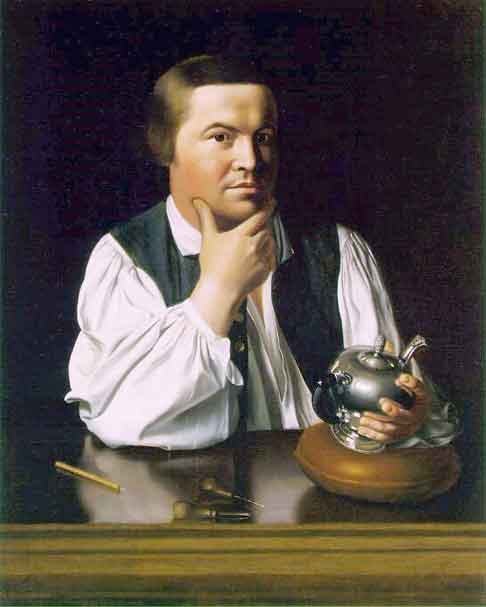
Paul Revere


At 11:00PM on April 18, 1775 Paul Revere set out to warn John Hancock and Samuel Adams that the British were marching on Concord. Today, Revere and his ride is the stuff of legend.

Below are some interesting facts about Paul Revere taken from the Paul Revere Heritage Project:


Paul Revere never shouted "the British are coming".


Paul Revere dressed up as a Mohawk and participated in the Boston Tea Party.

On the night of Paul Revere's ride, not even his wife knew where he had gone. She sent Benjamin Church, another patriot, out to find him.

The Old North church is an Anglican place of worship. Revere was not a member of the congregation.

Besides silver engravings, Paul Revere also produced dental prosthetics in his shop.

In 1775 Revere was one of several fire marshals in Boston.

Shortly after his famous ride, Paul Revere gave an account of the events for that night to the Massachusetts Provincial Congress in a legal deposition. You can read it here.


Wednesday, April 18, 2012

Mid-month recording statistics

Now that we've passed the halfway point for the month of April, we can compare the recording statistics for the first two weeks with the same period last year.  For April 1 thru April 16:  The number of deeds recorded in the two years was nearly the same: 193 in the first two weeks of April 2012 and 191 for the same time in 2011.  Mortgages, however, showed a substantial increase, rising 42% from 385 in 2011 to 548 in 2012.  Foreclosure deeds also had a big spike, rising 50% from 14 in 2011 to 21 in 2012.  Orders of notice on the other hand dropped by a huge amount - 77% - from 60 in 2011 to just 14 in 2012.  Total documents recorded was down slightly (7%), from 2678 in 2011 to 2496 in 2012. 

That's a quick snapshot.  Obviously, the stats for the entire month will be more informative, but there are some interesting trends to watch here: Sales remain sluggish; refinancings are increasing significantly; while foreclosure deeds are up, orders of notice - new foreclosures entering the pipeline - are way down.

Tuesday, April 17, 2012

New Google GBike

Google's main company head-quarters is known as the Googlepex. The Googlepex is just one of Google's forty-six locations throughout the world. Each housing thousands of employees. This main facility, a massive complex, has 20 buildings spanning 506,310 sq ft set on 26 acres in Mountain View, Santa Clara, CA.

Google's free-spirited organization is designed to promote creativity. This loose structure means employees travel from building to building throughout the day.

And that is the topic of this entry...How do Google employees travel to their appointed work locations on the complex?

Since 2008 Google employees have used GBikes or pedal bikes specifically designed for Google and its employees to get around. Recently, after several years of "biking" the campus Google thought it was time to replace its existing fleet. But what would the new two wheelers look like?

For the answer, the meg-company turned to its employees and sponsored a competition. Google received 36 entries from its staff.

The winning design for Google's GBike is pictured below.

Friday, April 13, 2012

Good News on the eBook Front


If you read electronic books, there may be some good news on the horizon. Last Wednesday the Federal Government filed a law suit against Apple Computer and five book publishers.

Here is some historical perspective for you...remember way back, when you first bought your Kindle and you were all excited because Amazon sold eBooks for only $9.99... Remember?

As I understand it, Amazon didn't care if it lost money selling eBooks at $9.99 as long as people were buying its eReader, the Kindle.

Then all of a sudden the electronic book world was tipped upside down when Amazon began charging $14.99 for eBooks. Most of us had no idea what caused the price increase. At the time people blamed Amazon...but now it appears Amazon wasn't the culprit at all. According to the US Justice Department the real bad guys were the publishing companies lead by the late Steve Jobs of Apple Computer.

Read this from the Wall Street Journal:

In a civil antitrust lawsuit, the Justice Department alleged that CEOs of the publishing companies met regularly in private dining rooms of upscale Manhattan restaurants to discuss how to respond to steep discounting of their e-books by Amazon.com Inc., a practice they disliked. The executives also called and emailed each other to craft a solution to what one of them called "the wretched $9.99 price point," the suit said. The five publishers and Apple hatched an arrangement that lifted the price of many best-selling e-books to $12.99 or $14.99, according to the suit. The publishers then banded together to impose that model on Amazon, the government alleged.

Of course, everyone is innocent until proven guilty...but three of the accused publishing companies have already agreed to settled with the Justice Department...hmmmmm, I wonder why???

In typical Apple fashion the computer giant denies the allegations and has decided to fight the Feds....good luck with that one.

At the time of the alleged conspiracy Amazon dominated the eBook and eReader market (Kindle). As you might have expected , when Amazon was forced to abandon the discounted $9.99 price, for whatever reason, it helped Apple's new iBookstore break into the electronic book market and gave the publishers a higher profit... hmmmmm?! Interesting.

The good thing for eBook readers consumers is that experts believe this law suit will result in a decrease in the price of eBooks.

Thursday, April 12, 2012

Dad With His New iPad

A friend of mine sent me this video the other day. It is titled "So Dad how do you like your new iPad?". The characters do not speak English, but that doesn't matter, the message is pretty clear...I think you'll enjoy this.

Wednesday, April 11, 2012

More on mortgage modifications

After writing yesterday about some of the details of mortgage modification agreements we've seen recorded recently, I was interested to read in today's New York Times that the Federal Housing Finance Agency, the entity that now controls Fannie Mae and Freddie Mac and a longtime opponent of principal reductions as a way of assisting underwater homeowners, may now be reconsidering that position.  FHFA has consistently taken the position that the overall cost to taxpayers of principal reductions would exceed the benefits derived from the measure and so has resisted calls to make such reductions.  As the Times story suggests, that might be changing.

I'm not sure if principal reductions will provide much of a boost to the housing market.  But doing nothing will provide no benefit; it will just drag out the sluggish real estate market.

Tuesday, April 10, 2012

Mortgage Modifications

For several years now, the home sales market in Greater Lowell has been sluggish, at best.  One big reason for that is the number of existing homeowners who are underwater on their mortgages.  Most in that position continue to make their monthly payments in the hopes of riding out the price trough and eventually regaining lost equity.  Others have no recourse but to endure foreclosure of the home.  But there's a third group and that's underwater homeowners who succeed in reaching a mortgage modification agreement with their lenders.  Quite a few such agreements get recorded here so I thought I'd scrutinize one and share some of the details.

First, the context: The property in question is a single family residence in a Greater Lowell community that was purchased by a married couple in 1999 for $169,000.  They financed that purchase with a mortgage of $135,200.  Like so many other American homeowners at the beginning of the 21st century, however, they began extracting cash from the rising value of their residence, refinancing four times: in 2001 for $200,000; in 2003 for $247,800; in 2004 for $352,750; and in 2005 for $409,500.  That last loan had an adjustable rate that began with 6.65% but which was permitted to rise in 2008.

That last loan was apparently too much for the home owners and they fell behind on their mortgage payments.  Unlike so many others, they were able to reach a Loan Modification Agreement with their lender earlier this month.  The agreement bundles all amounts owed (excluding late charges which are waived) into a new principal balance of $430,000.  That balance is divided into a "interest bearing principal balance" and a "deferred principal balance."  In our example, the "interest bearing principal balance" is $240,000 which is to be paid in monthly installments with interest at 5% until 2035 (thirty years from the initial loan).  The "deferred principal balance" was set at $190,000.  This amount is due on the maturity date of the loan or when the property is sold, whichever comes first. 

This certainly seems like a reasonable method of keeping underwater borrowers in their homes, but whatever the value of the house now, it seems unlikely that the value will claw back to something that exceeds the total amount owed any time soon.  That means the homeowner is effectively tied to the house for the foreseeable future.  Magnify this situation by everyone else in a like situation and you can better understand why the real estate market remains so sluggish.

Monday, April 09, 2012

Awaiting "Eaton v FNMA"

Over the past few months, several attorneys have mentioned how they're anxiously awaiting the Supreme Judicial Court's decision in the Eaton case.  An article by Ed Bloom, the immediate past president of the Real Estate Bar Association of Massachusetts in the March 2012 edition of REBA News does a good job of explaining why the Eaton decision is so anxiously awaited.  In Eaton, a Superior Court judge invalidated a foreclosure on the grounds that the entity that conducted the foreclosure did not also have possession of the promissory note secured by the mortgage.  This is not to be confused with the issue in Ibanez where the entity conducting the foreclosure did not own the mortgage that was being foreclosed.  In Eaton, the foreclosing entity did own the mortgage, just not the note.

According to Attorney Bloom, if the SJC upholds the Superior Court decision in Eaton and applies it retroactively, "every real estate title in Massachusetts that has a foreclosure in its back title will become unmarketable, because there is no way for anyone examining record title to determine if a foreclosing mortgagee possessed the note at the time of foreclosure."

Because promissory notes have never been recorded, there is no way to tell who owns the note at any given time just by looking at the records at the registry of deeds.  Consequently, I believe Attorney Bloom's concerns are well-founded.  As soon as the SJC issues its decision in Eaton, we'll write about it here.

Friday, April 06, 2012

Statistics for First Quarter 2012

Now that March has drawn to a close, we can compare recording statistics for the first quarter of 2012 with the same period for 2011.  For January thru March 2012, there were 1198 deeds recorded in the Middlesex North District, an 11% increase from the 1076 recorded during the first three months of 2011.  During the same period in 2012, there were 3378 mortgages recorded, a 19% increase from the 2832 recorded in 2011.  During the first quarter of 2012, there were 109 foreclosure deeds recorded, a 38% increase from the 79 recorded in 2011.  Finally, during the first quarter of 2012, there were 201 orders of notice recorded, a 41% increase from the 143 from the first quarter of 2011.

Thursday, April 05, 2012

Record Book Reorg Project

About four years ago we removed all of our paper records book out of public circulation and replaced them with digital images. Several registry employees moved the books to the basement. Some of these books were boxed up and others were stored in plastic bags for protection. Since the initial move we have continued to improve the organization and safe keeping of the books.

Below are pictures of a new, record book reorganization project that we are finishing up. The large books are stored on rolling shelves in plastic bags. We stored the smaller plastic covered record books in cardboard boxes. Each box is labeled with its contents and color coded for ease of retrieval.


Wednesday, April 04, 2012

1940 Census now online

The National Archives launched a website containing the detailed interview sheets from the 1940 census.  While statistical compilations are always released within a few years of the completion of the every-ten-years national census, these detailed sheets which contain a wealth of family information are kept confidential for 72 years after they've been collected.  That particular waiting time - 72 years - is the life expectancy of someone born in that year. 

The 1940 census website is still a bit tricky to navigate.  Users may narrow searches by state, county, city/town and street but not by name (at least not yet, someone is apparently working on that).  Experimenting with the site last night trying to find relatives whose 1940 address I knew for sure, I was able to find both I sought after paging through a dozen or two pages.  My point is that if you are even moderately persistent, you should find what you're looking for.

The following information is available:
  • Whether the family owns or rents the property.  If owns, the value.  If renting, the monthly rent.
  • The names, ages, gender, race, education level and place of birth of all living in the household
  • Whether the person had a job in March 1940 and if not was the person using government programs such as the WPA and the CCC for support
  • For each person who was employed, their occupation, industry worked in, number of hours worked per week in March 1940, the duration of their employment, number of weeks worked in 1939, income in 1939, whether the person had income greater than $850 in 1939 from sources other than salary
So check out the 1940 census website and learn more about your ancestors and others that lived in your neighborhood long before you.

Monday, April 02, 2012

March recording statistics

While the recording statistics for March were not fantastic, there was more good news than bad.  When compared to the same month a year ago, we see the following:

  • The number of deeds recorded in March 2012 was up 17% from the number recorded in March 2011 (471 v 404)
  • The number of mortgages recorded in March 2012 was up 45% from the number recorded in March 2011 (1270 v 873)
  • The number of foreclosure deeds recorded in March 2012 was up 42% from the number recorded in March 2011 (47 v 33)
  • The number of orders of notice recorded in March 2012 was up 22% from the number recorded in March 2011 (77 v 63)
  • The total number of documents recorded in March 2012 was up 14% from the number recorded in March 2011 (5742 v 5030)
Looking at Lowell by itself, we see the following:

  • The number of deeds recorded in March 2012 was up 28% from the number recorded in March 2011 (137 v 107)
  • The number of mortgages recorded in March 2012 was up 26% from the number recorded in March 2011 (240 v 191)
  • The number of foreclosure deeds recorded in March 2012 was up 42% from the number recorded in March 2011 (27 v 19)
  • The number of orders of notice recorded in March 2012 was up 50% from the number recorded in March 2011 (33 v 22)
  • The total number of documents recorded in March 2012 was up 16% from the number recorded in March 2011 (1283 v 1104)

Friday, March 30, 2012

Judge Chernoff retirement ceremony

The Greater Lowell Bar Association held a retirement celebration for the Honorable Paul Chernoff yesterday at the Lowell Superior Court. Judge Chernoff, who has sat at the Lowell courthouse more than perhaps any other Superior Court judge over the past decade, had officially retired several years ago upon reaching age 70 but had been recalled to duty due to a heavy caseload and personnel shortages. Judge Chernoff was presented with proclamations by retired Supreme Judicial Court justice Judith Cowin on behalf of Congresswoman Niki Tsongas and by Superior Court Chief Justice Barbara Rouse on behalf of State Senator Eileen Donoghue. State Representative Kevin Murphy and Lowell City Councilor Kevin Broderick, both practicing attorneys, were present with citations from their respective bodies.

In his farewell remarks, Judge Chernoff spoke eloquently and affectionately about Lowell. He said that with his seniority he could have opted out of sitting in Lowell for at least the last two decades but that he always chose to come here because of the lure of the staff and attorneys who populate the Lowell Superior Courthouse. He always felt like part of a family when he was in Lowell. He called the late Brian Dunigan, Michael Brennan and Joe Mahoney (all of the clerk’s office here) his three Irish brothers and went on to compliment judicial secretary Bonnie Dineen.

Judge Chernoff said that the court staff and the lawyers make Lowell different than anywhere else. He’s not sure why; perhaps people in Lowell “have a better understanding of the human condition.” He also said there is a “higher level of civility here than elsewhere” which was something he learned “at the knee of Elliot Cowdrey, Cornelius Kiernan and David Williams in the Lowell District Court” (where Chernoff frequently sat from his appointment to the District Court in 1976 to his elevation to the Superior Court in 1984).
As his final day of service neared, Judge Chernoff said the court officers frequently said he couldn’t leave because there were still too many cases to be disposed of. To that sentiment, Judge Chernoff turned to Robert Frost for a response, reading the first few lines of Frost’s poem, “After apple picking”:
My long two-pointed ladder’s sticking through a tree
Toward heaven still,
And there’s a barrel that I didn’t fill
Beside it, and there may be two or three
Apples I didn’t pick upon some bough.
But I am done with apple-picking now.
As for his decision to leave now, Judge Chernoff said he had concluded he should leave before he started feeling burned out and before other people thought he was becoming burned out. He closed with a portion of another Frost poem which he said should be in the mind of all judges. The poem was “Fear of God”:
If you should rise from Nowhere up to Somewhere,
From being No one up to being Someone,
Be sure to keep repeating to yourself
You owe it to an arbitrary god
Whose mercy to you rather than to others
Won’t bear to critical examination.

Thursday, March 29, 2012

The Robot Revolution


When I was a kid my father used to say...someday machines will do the work that humans do now and there will be no jobs for any of us. It will be the end of civilization as we know it Anthony (he and my mother always called me Anthony).

Well, with all due respect to my father, society hasn't fallen apart yet...but it seems each day there is a new story about a machine or more specifically a computer-driven robot doing a job once done by a human.

Fortunately, computers weren't around during my father's days or he would have predicted the Milky Way was doomed, not just society. Trust me this guy could have written the scripts to the Terminator movies.

A company called Kiva Systems (no, not Skynet) is a leader in robot development. Kiva recently sold Amazon a machine, excuse me a computer-driven robot, that can maneuver around a warehouse and stock shelves.

Yikes! I can hear my father's voice now...I told you Anthony, it is only a matter of time before we're all jobless, living in caves, eating chickweed because of these things.

First, Roomba (built by iRobot) came along scurrying around, cleaning floors and eating lamp wires. And now professionals utilize robots to assist in medical procedures, dismantle bombs, assembly automobiles and more, more , more.

Where will the robotic revolution end...or will it. Is this really the beginning of the end of civilization as my father predicted?

Not according to Lawrence Summers...
Lawrence H. Summers, the economist, former Treasury secretary and former Harvard president, explained that society has been down this road many times before. The rise of the industrial revolution gave way to fears of extensive job loss, as did the automation of agriculture. But, he said, although these “adjustments were in some cases painful,” people always find new work (New York Times).

See Dad, no need to worry...and besides I like chickweed.

Wednesday, March 28, 2012

Fannie Mae, Freddie Mac & Tax Stamps

Today's email brought a press release from my Essex South colleague John O'Brien in which he asks the Massachusetts Department of Revenue to immediately file suit against mortgage giants Fannie Mae and Freddie Mac to collect unassessed deeds excise taxes on property formerly owned by the two entities. 

Massachusetts imposes an excise tax on the sale of real estate.  The tax is assessed at the rate of $2.28 per $500 in sales price.  Payment of the tax is the responsibility of the person signing the deed (i.e., the seller).  However, property owned or purchased by a governmental entity is exempt from this tax.  A 1991 Department of Revenue ruling (DOR ruling 91-2) held in relevant part:


Freddie Mac, Fannie Mae, and Ginnie Mae are not "agencies" of the United States government, and, thus, do not come within the express exemption from the Deeds Excise as provided by G.L. c. 64D, § 1. Nevertheless, the transfer of realty by written instrument by all three federally sponsored corporations as part of their statutory obligations as secondary market facilities are exempt from the Deeds Excise because of the exemption from state and local taxation provided to each by federal statute. Moreover, the Deeds Excise cannot be imposed on the grantee where the grantor is one of the three federally sponsored corporations mentioned above.
Today's request by Register O'Brien is based on a recent holding in a case from the US District Court of the Eastern District of Michigan (Oakland County v Fannie Mae, et al - Case #11-12666) in which a county in Michigan sued the two federally created mortgage entities on the grounds that they were liable for payment of the deed excise tax.  The Federal Court in Michigan held that even though the federal legislation creating Fannie Mae and Freddie Mac specifically exempted them from "all state and local taxes", such language does not apply to transfer taxes like the deeds excise tax and that Fannie and Freddie were indeed liable.

O'Brien estimates that since the 1991 DOR ruling, Fannie and Freddie have avoided the payment in $4.2 million in deeds excise tax to the Commonwealth.  

Tuesday, March 27, 2012

Need A Recommendation? I Recommend Jybe

Every so often I come across a cool new smartphone App. This morning I found a brand new one called Jybe...how new? Jybe was launched yesterday that's how new.

Jybe gives the user suggestions from other "local" Jybe users on various topics of interest.

OK since Jybe is so new and me being me...I signed up this morning to check it out.

Once I completed the registration process Jybe presented me with three "topics of interest", Dining, Movies and Books. I tapped "Books" just to see what would happened. Twenty eight book categories appeared and I was asked to indicate which of these I liked. I checked off...Biographies, Computers, Cooking and Dining, History, Home and Garden and Literature.

After entering the types of books I liked I clicked "Recommend" and got the following recommendations: Steve Jobs by Walter Isaacson recommended by Bill Jones and 7 other (Bill Jones is a fake name), Good Omens by Neil Gaiman recommended by Mary Jones (fake name again), Bossypants by Tina Fey recommended by Tom Jones (no not the singer, its a fake name too) and six other others.

I love Tina Fey. Her book Bossypants has intrigued me for a while, so after I read it I'll write a Jybe recommendation. Then when you sign up for Jybe and look for book recommendations you'll see Bossypants recommended by Tony Accardi (yes, this is my real name).

I like the Jybe concept. Yes, it reminds me of Yelp (real name) which also offers recommendations... but here is the big difference between Jybe and Yelp. Jybe uses a set of personalized criteria (likes and dislikes) that customize the recommendations for the you the user.

I'd call Jybe a good find...see if you agree.

Give Jybe a try


Monday, March 26, 2012

Stats thru Week 3 of March

We still have another week in March but I thought it might be useful to look at the stats through three weeks of the month and compare them to the same time last year.  I looked at the period from March 1 through March 23 for both 2011 and 2012.  Here is what I found:

Deeds - in 2011 there were 257; in 2012 there were 346; an increase of 35%

Mortgages - in 2011 there were 636; in 2012 there were 903; an increase of 44%

Foreclosure Deeds - in 2011 there were 23; in 2012 there were 38; an increase of 65%

Orders of Notice - in 2011 there were 53; in 2012 there were 70; an increase of 32%.

as for the orders of notice, here's there breakdown by community:

Billerica - 5
Chelmsford - 3
Dracut - 9
Tewksbury - 7
Tyngsborough - 2
Westford - 3
Wilmington - 7
Lowell - 35

Thursday, March 22, 2012

An Act to increase transparency in Massachusetts Land Records

House Bill 3934 , titled "An act to increase transparency in the Massachusetts land record systems to protect the property rights of homeowners and businesses" now resides in the Joint Committee on the Judiciary where a public hearing was held back on February 28, 2012.

The purpose of the bill which was filed by Representative Michael D. Brady of Brockton, will make it a legal requirement for a lender to record an assignment of mortgage within 30 days of the assignment being executed.  Although most assume all real estate document must be recorded, that's not the case.  Our recording system is a voluntary one and if someone with an interest in property chooses not to take advantage of the protections of the recording system, that's their right.  But as a practical matter, almost all documents are recorded relatively promptly. 

The main objective of this bill, it appears, is to curtail the operation of MERS in Massachusetts.  MERS (which stands for Mortgage Electronic Registration Systems Inc) was created in the late 1990s as a central holding facility of mortgages for its member banks.  It was in response to problems that arose during the real estate collapse of the early 1990s when easily negotiated promissory notes often left behind the mortgage of real estate.  MERS was designed to hold the mortgage as a trustee for whichever lender or investor ended up with the note.  The system seemed to work quite well as long as the real estate market was healthy, but in the aftermath of the bubble bursting of 2007-08, many have latched onto MERS as part of the problem.  This bill seeks to remedy that perceived problem.  I'll try to keep track of the measure and report on its progress as it works its way through the legislature.

Wednesday, March 21, 2012

Mass Memories Road Show visits Lowell on Saturday

The Mass Memories Road Show is a statewide community history project sponsored by UMass Boston.  A group of archivists from the university assisted by local volunteers, is in the process of visiting every city and town in the Commonwealth to allow residents to share historic photographs with the project.  Photos are immediately scanned with the original never leaving the custody of its owner who is also asked to complete a photograph information worksheet listing things such as the names of those shown in the picture, its location and the date it was taken.  All of this information and the digital images of the photos will then be made available to all on the Mass Memories website.

This coming Saturday, March 24, from 10 am to 3 pm, the Road Show will be in Lowell at the Tsongas Industrial History Center which is located within the Boott Cotton Mill Museum at 115 John Street.  Those wishing to participate should bring no more than three photos that depict you, your family, your home, your neighborhood - anything about Lowell or its people that you would like to share.  The event is free and open to the public, so even if you don't have any photographs you should stop by and mingle with others interested in the history of this city.   

Tuesday, March 20, 2012

Public access to government records

There's a great story in today's Globe about Jay and DeLene Holbrook, a seventy-something couple from Oxford, Massachusetts who have spent the last 30 year collecting, organizing and microfilming the vital records of every city and town in the Commonwealth.  Mr. Holbrook was a historical demographer who began the project as part of an academic assignment and then continued it as a business with his spouse's assistance.  They would persuade town clerks, one-by-one, to allow them to borrow their books and then take the books to a commercial microfilming service where the records would be photographed.  In return for the loan of the books, the Holbrook's would provide each town with a free copy of that town's microfilm.  Recently, the Holbrooks sold their collection to Ancestry.com which has converted the records from microfilm to digital images and has integrated them into the Ancestry database. 

While it's true that the original version of these records are (or are supposed to be) freely available to the public for review and research at each town hall, having them indexed and available online as digital images adds tremendously to their value. 

Monday, March 19, 2012

Four types of Notarial Acts

A customer came to the registry on Friday wanting to make "a notarized copy of [his] driver's license."  He explained that he was applying for a mortgage and the lender required this.

The most common act by a Notary Public is to take an acknowledgement - that is, after identifying the person and witnessing his signature, then ascertaining whether the signature was a voluntary act.  There are three other acts that can be accomplished by a Notary.  Besides the Acknowledgement, there's the Jurat.  With the Jurat, the person signing the document also swears or affirms that the contents of the document are true and accurate.  The third notarial act is Signature Witnessing.  In this case, the Notary affirms that the person who purports to have signed the document was in fact the person who signed it.  The fourth Notarial Act is Copy Certification.  Here, the Notary makes a copy of a document and then certifies that it is a "true, exact, complete, and unaltered copy" of the original.

For more details about these Notarial Acts and for examples of the verbiage used when affixing them to documents, see THIS pamphlet produced by the Secretary of the Commonwealth.


Friday, March 16, 2012

Mid-month statistics

With March half over, it's time to look at recording statistics for the first two weeks of the month.  Deeds were up 14% when compared to the first two weeks of March 2011, going from 177 to 202.  Mortgages were up nearly twice that, rising from 423 to 539, a 27% jump.   There was no change in foreclosure deeds with 22 in both time periods, but orders of notice, the document that initiates a new foreclosure, doubled, jumping from 27 to 54.

The early March 2012 orders of notice were distributed as follows:
  • Billerica - 3
  • Chelmsford - 3
  • Dracut - 7
  • Lowell - 23
  • Tewksbury - 6
  • Tyngsborough - 2
  • Westford - 3
  • Wilmington - 6