Thursday, July 28, 2005

Lowell Folk Festival


The annual Lowell Folk Festival begins this Friday night and runs through Sunday. All weekend, downtown Lowell will be filled with musical performances, craft demonstrations, and ethnic food stands. The types of music and performers that may be heard include an African/Cuban Ensemble, American Piano Styles, Appalachian Bluegrass, Azerbaijani Music, Blues, Bulgarian Vocals, Cajon Music, a Cape Breton Fiddler, Greek and Near Eastern Music, Irish Music, an Italian-American Brass Bank, Klezmer music, Korean Dance, Drumming and Music, Music of Mali, Mexican Calentiana, Quebecois Music, Rockabilly and a Slovenian Polka band. Craft demonstrations include Abenaki baskets, a blacksmith, a boatbuilder, Byzantine icon painting, duck decoys, hooked rugs, Nantucket lightship baskets, an Oud maker (an Oud is a stringed instrument in the Lute family and is played by Greek, Armenian and Middle Eastern musicians), Penobscot clubs, Portuguese instruments, Portuguese lace, a Puerto Rican Cuatro maker, a steel pan tuner and Ukrainian egg art. Ethnic food will be sold by the African-American Merrimack Valley Branch of the NAACP, the African Cultural Association, the Armenian Relief Society, Iskwelahang Filipino, the Holy Trinity Hellenic Orthodox Church, the Hellenic American School PTA, Jamaican Celebration of Life, Laotian American Community of Massachusetts, the Lao United Church of Christ, the Wat Lao Mixayaram of New England Inc, the Wat Buddhabhavana of Massachusetts, the Lowell Southeast Asian Water Festival, the Lowell Latin Catholic Community of St Patrick’s Parish, the Lowell Polish Cultural Committee and the Portuguese American Veterans Center. As you can plainly see, there is something for everyone, so please come to Lowell this weekend. Detailed information about the festival, a schedule of performances and directions and parking information are available at http://www.lowellfolkfestival.org/

Wednesday, July 27, 2005

National Figures


Once again the national real estate market has set a record for the sale of existing homes. The median sale price in the country rose to $219,900 in June. This is a 6.3% jump, the biggest in history. Housing prices have increased five times the rate of inflation in the country. Incredibly even this is not stopping buyers. Higher family income and lower interest rates are keeping sky-high prices reachable for would-be buyers. These record prices are being fueled by the lowest mortgage rates in fifteen months. The news is the same throughout the country. Prices have increased in all four regions. The West and the Northeast showed the largest gains. In the West the median price went up 17.4% to $317,000 and in the Northeast the median price increased to $250,000 a 13.6% increase from last June. The number of sales also rose in the Northeast by 3.5% but the West (which obviously includes) California out paced even that with a 5.5% increase. The National Association of Realtors is forecasting another increase next year. One thing interesting to note…on a national level yearly housing medians have not dropped since 1950.

Tuesday, July 26, 2005

Condominium Sales

A story in today’s Globe attributed the continued strength of the Massachusetts real estate market to soaring condominium sales. While condo sales are up 24% from the same period last year, sales of single-family homes are slightly down. It’s apparent that buyers at both ends of the market – first time home buyers seeking an affordable place to live and older folks seeking to downsize and cash in on the appreciation of their suburban residences – have made the condominium market very attractive. The story does report, however, that sales of high-end units in Back Bay, Beacon Hill, South Boston and Charlestown are slowing, with less units sold in those areas so far this year as compared to the same period in 2004. This could have significant consequences in Lowell since many of the purchasers of downtown residential condominium units have chosen to live here for economic reasons – a unit in Lowell is affordable while a comparable one closer to Boston is not. With prices in Boston sliding, that dynamic might change. The growth of the condo market here in Lowell is evident from the following statistics: In May and June of 2004, we recorded 742 deeds for the city of Lowell. Of those, 197 (27%) were for condominiums. In May and June of 2005, we recorded 772 deeds, 243 (32%) of which were condominiums. While the number of all deeds recorded for these two months increased by 4% from 2004 to 2005, the number of condominium deeds increased by 23%. Unfortunately, this means that the number of non-condominium deeds decreased by 3%. This transition to a real estate market dominated by condominiums is demonstrated by the number of Master Deeds (the document that creates the condo complex) that have been recorded over the past few years for Lowell. In 2001, there were 7. In 2002, there were 22. In 2003, there were 15. In 2004, there were 41. Up to today in 2005, there have been 25 with many more under construction or in the planning stages. Unfortunately, past experience has shown that when a real estate bubble bursts, condo prices collapse precipitously. If there’s a slow down of the real estate market, this increased dependence on condominiums for housing stock could have dire consequences for the city of Lowell.

Monday, July 25, 2005

Website Woes

Thank you all for your patience with the problems we experienced with our website over this past weekend. As I understand it, a board within the website server which is located in Boston burned out over the weekend. I started receiving emails from customers reporting the problem on Saturday night. In the process, we discovered a flaw in our maintenance procedures: the people who can fix the computer can’t get access to it after hours and the people who can get access to the computer room after hours aren’t the ones who can fix the machine. In the past, the necessary parties have teamed up when confronted with a major outage, but things just didn’t work out this time. On a more optimistic note, we’re formulating plans that will add the rest of our holdings to our computer system which means everything will be available over the Internet, hopefully by the first of the year. All registered land documents have now been scanned and are available electronically. We have just started to experiment with ways of scanning old registered land certificates. Ultimately we want all certificates available electronically, but this must be done carefully and in conjunction with land court. To find the best way of accomplishing this requires some behind the scenes, unofficial, trial and error on our part. As for recorded land, we now have the scanned images of documents recorded in books 1 through 1129 (1855 to 1950) and should have them loaded onto the computer system in early September. Our marginal reference project in which we are entering all pre-computer marginal references in an electronic database is back to book 1100. Once this project is complete, we will switch back to the old grantor and grantee index project in which we’ve made the grantor index from 1950 to 1975 available as an electronic book in the PDF format. We plan to use this same methodology to make all indexes available electronically.

Friday, July 22, 2005

New Courthouse for Lowell

Earlier this week the Lowell Sun reported that the governor formally proposed the construction of a $115 million, 280,000 square-foot judicial center in downtown Lowell, across the street from the Lowell Memorial Auditorium. Plans for such a facility have been discussed for several years, but the actual site has been unclear. While the judicial center is by no means a sure thing, the latest events move it closer to reality. The local legislative delegation has long advocated this proposal, so it should find strong support in the House and the Senate. Presumably the Superior Court and the District Court will find homes in this facility. Hopefully, the additional space will allow for a full-time presence of the Probate Court in the city. While the Juvenile Court should logically be included, that court is in the midst of a long-term lease in a private facility, the former Post Office on Appleton Street. It’s unclear whether that lease could be voided by the state. Of course, the new facility might not even be completed by the time that lease expires. (Plans call for the new court to be occupied in spring 2010). As for the registry of deeds, it’s unclear where we will be located. The state’s master plan does not see courthouses to be the appropriate place for registries of deeds in the future. The primary rationale for that belief is the enormous expense of constructing courthouses. Between security concerns and the legitimate desire to have a formal, imposing setting to lend dignity and respect to court proceedings, judicial facilities are costly to build. A registry of deeds, on the other hand, has needs closer to a library than a court with a much more affordable price tag. And with almost our entire holdings available online and electronic recording about to become a realistic option for many customers, the location and physical structure of the registry are of decreasing importance. So there’s nothing definite, but we’ll certainly keep our readers informed.

Thursday, July 21, 2005

Next!


On Monday we will begin our next scanning project…. The registry has approximately seven hundred unique documents refer to as Miscellaneous Jurisdictions. These are made up of a variety of document types… Judgments, Statements, Petitions etc. They use a numbering system separate from Recorded or Registered Land... it uses both digits and letters…example Misc Jurist 436b. The first phase of the project will involve scanning the “Misc Jurist” into an independent database in “tiff” format. Registry users will be able to view these images using “stand alone” computers that are no connected to the ACS system. During the days of Wang’s proprietary computer system we used a similar system to make images available to the public. If you are a frequent user of the Middlesex North Registry of Deeds you will remember this system… we called it “Image Inquiry”. The Misc Jurist will be made available in much the same way. I know you have hear me say this before…but…these documents are old and many are in bad condition. This means that many will have to be copied before being scanned. Also, when completed the images will be put on CD and copies will be offered to the public.

Wednesday, July 20, 2005

Identity Theft Legislation on Beacon Hill

Today’s Globe reports that a legislative committee is about to report out a bill increasing the penalties for stealing someone’s identity. The full legislature is expected to consider the bill later this summer. One rather controversial provision that has been omitted from this bill deals with “credit freezes.” As I understand it, in a state with a credit freeze law, a consumer can direct credit reporting agencies to freeze that person’s report, preventing the credit agency from issuing a copy of the report to anyone seeking it. Let’s say a wrongdoer applies for a credit card using your name and personal information such as your social security number. Before any company will issue a new credit card, that company will want to see the applicant’s credit report. With a credit freeze in effect, no report may be given and presumably, no new credit card will be issued. When the consumer legitimately wants to obtain a new credit card or a car or home loan, the consumer must request a limited “thaw” of the credit freeze to allow a report to be issued to the new creditor. Sounds like a lot of work which invites the question, who will pay for it. In most states that have such a law, it is the consumer who pays, usually something like $10 to freeze the credit report and $5 each time it has to be thawed. Because there’s a fee involved, not many people utilize this even where it is allowed by law so its effectiveness is questionable. But at least the state legislature is trying to address this problem. All this talk of freezes and thaws seems a little out of place on such a warm, sunny day. On another note, thanks to Assistant Register Tony Accardi for the superb job he did in maintaining the blog while I was vacationing in Canada. It was a great trip although the temperature never made it beyond 33 degrees any day we were there.

Tuesday, July 19, 2005

First Look

Update on the Social Security number project we started last week. A quick review…we assigned an employee to go through record books dated from January 1,1995 to June 30,1995. He is writing down the “book and page” and “document type” of documents that contain a social security number. Today I received a small sample of these to review. As of this morning we have checked 80 record books containing approximately 4,000 documents. We found 375 documents containing Social Security numbers. This is approximately 5 per book or 9% of the documents. As expected the vast majority with SS# are Mass and Federal Tax documents. The list also included a very large number of death certificates. Mortgages and Mass Assistance Liens were also listed, but there were significantly fewer than the other document types. I would like to caution …this is a small sample and the picture may change as more information is collected.

Monday, July 18, 2005

Shorties

We are beginning to replace our older computers…hopeful you will begin to see some new public access terminals in the next week or so. It take a little time to set up both the hardware and the especially the software.

As I mentioned last week we have begun taking inventory of our Registered Land images. Up to this point it appears most of the documents that need to be re-scanned are multiples that we intentional skipped during the back scanning project.

We get between 10 and 20 E-Recordings everyday. Some days a large percentage of these have to be rejected because they out of district. Believe it or not…sometimes we send a “wrong registry” document back to a bank only to receive it again the next day.

Friday we finished quality checking the last of the “plan images”. This was a long, tedious project, but it is behind us now. If you see an image that needs to be re-scanned (plan or any other) please let Customer Service know.

The computer images from 1987 to 1950 were captured from microfilm using an automated system. Some of the older books…especially the 2000 series have problems. If the film had been spliced during its processing it muddled the automated scanner/counter. These books need to be re-scanned. They are very big, seven hundred pages or more. We experimented by making copies using a copy machine, then scanning the copies. This took much too long. The alternate plan (and the better one) is to use our Microdax microfilm scanner. We are going to make hard images then scan them…This should be faster.

Friday, July 15, 2005

One Will Get You Two


In the old days…(you know, before technology guided our lives) the saying was “two heads are better than one”. Well, it looks like Sharp TV has just changed that to “two TV pictures are better than one”. Sharp Corporation has developed a liquid crystal display that shows totally different images depending on the angle from which you view it. Look from the left see CSI Miami…look from the right watch CSI New York. Why would someone want this?…As an example, Sharp says one person can be surfing the Internet while another is watching a movie (I can hear that conversation…Left Side: "Wow, what a price on these tickets to Florida"; Right Side: "Duck Rambo duck!”) This two-way viewing angle LCD is going into mass production this month…and will cost twice as much as a regular TV(sounds fair to me…get twice as many pictures…pay twice as many dollars). I can hear the TV Ad now…"it’s two, two sets in one”. There is one problem with the two-picture TV…if you stand in the middle you see parts of both pictures(seriously)…Just imagine, you might see Ray Ramano being thrown off the Survivor Island…Or Dan Rather on Fox News…or Tom Brady throwing to Alex Rodriguez (today that sounds better than letting Schilling do it). I usually like to try and think of ways new advances in technology can be used to improve the registry…In this case I think I’m stumped.

Thursday, July 14, 2005

Back Scanning Project


We finished back scanning the remainder of our Registered Land documents two weeks ago. Since we finished the project earlier than expected we reassigned the scanners to do an additional 22,500 documents. These documents, which are available on the old Image Inquiry computer program, are not on the ACS system. All 22,500 documents have been prepared for scanning and the majority of these have actually been scanned. Today we began to review the “list” of these documents looking for gaps. The gaps are actually very easy to find…when we bring up the document entries an image flag appears beside documents that have been scanned. Simply put…the gaps are entries without image flags. Once this portion of the project is completed will we deal with special scanning problems. As an example… we found early tax liens with newspaper pages attached proving public notice. These papers are large and fragile. Although there are only about eight of these… they will take time and much work to re-scan.

Wednesday, July 13, 2005

Podcasting


The world of Podcast is growing daily. It is difficult to pick up a magazine or newspaper without seeing some reference to this new entry in the information world. I recently “googled” the phrase “real estate podcast” just to see what would happen. The results were interesting to say the least. Below are a couple of samples of google hits:

Access Realty World: this is a podcast that features news from the real estate world as well as insider hints and tips. It shares information on how to buy and sell and make profits on Foreclosures

Realize the Realty: this podcast, (well it’s actually a BlogPod), is directed toward homeowners, builders and investors. The show’s blurb brags “Know more about the real estate industry using well-researched information through this blog and podcast.

Rich Buckley Show: (do you think this guy is really named…”rich”???... a real estate podcaster named “rich”… sounds very convenient). Anyway…”Rich” talks about hot trends in California real estate. The program also includes interviews with successful real estate entrepreneurs and discussions on hot button issues.

Podcasts and their topics have expanded greatly in the last six months. You can find podcasts on Politics, Arts, Science, Business, Teen Issues, Computers and just about any other imaginable topic. In fact we have discussed the possiblilty of a "registry of deeds" podcast...so stay tuned.

Tuesday, July 12, 2005

Social Security Number Update

As discussed earlier this month we have decided to take a sample of a small group of documents to determine how many contain social security numbers. The work began this morning. One employee has been assigned the task of reviewing record books from January 1, 1995 to June 30, 1995. This span, books "7353-7540" contains 187 books. The “Book, Page and Document Type” of records that contain social security numbers are being recorded on a spreadsheet to be analyzed later. Since each “page” of a book must be checked it will probably take a considerable amount of time to complete the test sample. It is a tedious process, but we have learned that large projects, which seemed insurmountable in the beginning, are managed with diligence. It is expected that the vast majority of these documents will be Massachusetts and Federal tax documents. This information will help us determine if we are dealing with hundreds or thousands of documents containing Social Security numbers. It is worth repeating that effective July 1, 2005 no document containing a social security number will be accepted for recording.

Monday, July 11, 2005

Peter Pan


Have you heard about Google Earth yet?…Well if you haven’t… you’re in for a treat. Google earth is a new satellite imagery based mapping system. It combines buildings and terrain with mapping capability. Google Earth allows you to “fly” around the world zooming in and out of satellite photos. Let me explained my first experience with Google Earth…When I first logged on I saw a map of the world…I picked a location. In this case it was my home. I typed the street name in the search field and hit enter (Wow…it was like a Disney ride)…The earth began to slowly turn …when the program found my home it zoomed in…closer and closer. Before I knew it I was looking at the roof of my house (now I know how Peter Pan felt)… spin the image left…spin the image right…tilt it… zoom even closer…closer (gee, I’ve got to mow the lawn). Let me see…I wonder were the nearest school is…simple, just check the “find school” option…the Dewing School appears…nearest train station…nearest water-way…it’s all right there. You can even combined multiple layers if you want…restaurants, video stores, grocery stores, gas stations, volcanoes (come on, in Tewksbury, I'd know about it...I think)…it all appears. Of course, the next logical step for digital mapping systems like “Google Earth” is to make the information available on your cell phone or PDA. The benefits would be incredible. You can try Google Earth at “earth.google.com”… It’s cheaper than going to Disney World…In fact it’s FREE.

Friday, July 08, 2005

More on Social Security Numbers

Up until yesterday, the social security number of Porter Goss appeared on his local registry of deeds website in Florida. Who is Porter Goss, you ask? He’s the Director of the CIA. Needless to say, now that the press has reported this situation, the social security number has now been blacked out on the records. According to the Associated Press article reporting this, Florida law already has set a deadline of 2007 for all social security numbers to be blacked out from online land records. I understand that there are a number of proposals pending in the Massachusetts legislature to deal with social security numbers in online records. Here in Lowell, we are going to do a sampling of a small group of our existing records to determine how many of them contain social security numbers. This will take some time to allow us to obtain a large enough sample (probably a six month period) and we will identify how many are attributable to federal tax documents, how many to Massachusetts tax documents and how many to other types of documents. Once we get this survey done, we will post the results here on the blog.

Thursday, July 07, 2005

Sales & Foreclosure Reports

I have to apologize for the delay in posting the May sales and foreclosure reports. That just happened yesterday. The reports had been prepared for some time but June turned into such a busy month with meetings, projects and our traditional end-of-June spike in recording activity that I just never loaded them onto the website. As the month dragged on, more and more of you sent emails checking on the status of the reports, so I know you make use of them. If it’s any consolation, the June sales and foreclosure reports went online earlier today and I’ll make an extra effort to post future reports in a timely manner. It’s unfortunate that our computer system is very limited in its ability to perform sophisticated analysis of sales data because the information in our computer has value that far exceeds its traditional use in examining titles. There are ways for us to export the data into other computer applications such as Crystal Reports, but we have no in-house experts on that software and it doesn’t lend itself to self-teaching. We’ll do what we can with what we have. As the summer progresses, we will try to give you more information on sales data and statistics and maybe you will have some ideas on how we can best use or information.

Wednesday, July 06, 2005

Historical Perspective

Yesterday I “revisited” a bar graph I created a number of months ago comparing document totals for the past twenty-five years. No question… 2003 was a record breaker. That year the registry recorded 146,956 documents. As I considered these yearly totals I thought it might be interesting to list some significant registry events with the yearly total:

1986- The Wang computer system wasn’t installed in the registry until September of 1987. This means that in 1986 (the highpoint of the 80’s real estate boom) employees recorded 82,575 documents “by hand”.

1994- The first imaging system was installed in the registry in 1994. 71,427 documents were recorded that year. Interesting fact…with the new imaging system computer responsibilities and document flow were not completely establish in 1994 so the MIS director scanned all documents himself.

1995- Register Howe took office. The registry recorded 60,681 documents that year, less than half of what was recorded in 2003(146,956).

1997- The Massachusetts legislature abolished Middlesex County. That year 70,128 documents were recorded. That July Middlesex North was placed in the office of the Secretary of State.

1999-Thank you Y2K…because of the dreaded “Y2K” bug the Wang computer system was convert to work on a window’s based system called “lightspeed”…and new servers with large memory capacity were installed in the registry. This made it possible for us to scan and store 55 years of images. While "teams" of computer experts upgraded our system, the staff recorded 89,506 documents.

2001- The ACS computer system was installed. That year began the incredible rise in documents... 2001-97,180... 2002-115,890... and finally 2003 a historic 146,6956. The ACS system provided us advantages that allowed us to handled 2003 in stride.

Tuesday, July 05, 2005

Quality Control and Quill Pens

Sometimes it seems that quality control at law offices is going the way of the quill pen. I’m not talking about the content of the documents as much as I am the organization of the documents. Time and again, customers will present themselves at our recording counter and thrust a stack of pages at us with the expectation that we will sort out what pages go with what document, the order in which the documents should be recorded, and even whether the document is recorded land or registered land. Worst of all is the attitude displayed when we ask these customers to put the papers in the proper order and groupings. Surly describes the response of many. While we certainly try to be as helpful as possible, it is not the registry’s responsibility to ensure that registered land goes to the land court section, that the homestead that is stapled to the back of the mortgage be dislodged and recorded separately or that the first mortgage be recorded first and the second mortgage second. We have tried to address this by instituting a rule that all documents should be fastened with either staples or paperclips prior to approaching the recording counter, but all this has done is caused some of these customers to staple entire packages of documents – an MLC, a deed, a mortgage and a homestead – together into a single group. I’m not quite sure how to handle this and would welcome any suggestions. Maybe we will require all multi-page documents to be stapled before reaching the recording counter. Requiring a cover sheet that lists the documents and their order, similar to that in use at the Middlesex South satellite office, might be another option. As always, when you discuss something like this, there’s a risk that the many people that do it right will somehow be hit with the broad brush of criticism. That’s certainly not my intent. We have many customers who are role models of professionalism. But the number who don’t know what they are doing and who are unwilling to acknowledge that they don’t know what they’re doing is rising at a frightening rate.

Friday, July 01, 2005

June Wrap Up

First, some history: June 30 has always been the busiest day of the year at this registry and yesterday was no exception (which is why we didn’t have time to write a blog entry). Often when we cite statistics, we only refer to recorded land documents, primarily because their numbers are the easiest for us to analyze and count, but our total recordings also include registered land documents and documents recorded at the Middlesex South satellite office. So you can get a sense of the proportions involved, yesterday we recorded 716 recorded land documents, 38 registered land documents and 456 Middlesex South documents. As busy as it seemed yesterday, it was actually our slowest June 30 since 1998. Here are some recording totals for other June 30ths: 2005 – 716; 2004 – 756; 2003 – 922; 2002 – 856; 2001 – 826; 2000 – 882; 1999 – 720; and 1998 – 661. This June was a busy month in other ways. We started receiving electronic recordings on a regular basis; the microfilm of documents in books 1 through 1128 are now being scanned off site and will be added to our computer system in website by the end of the summer; almost all registered land have now been scanned; and our marginal reference project – we’re entering into the computer all marginal references made in all (pre-computer) record books – is now back to book 1291. New projects on the horizon include linking our computer system to the Mass GIS mapping site; scanning all registered land certificates, and reformatting this blog so that it includes a subject index that will allow readers to easily and quickly find all entries about a particular topic. That’s it for now. Have an enjoyable Fourth of July.

Wednesday, June 29, 2005

Early Is Better


June 30 is the end of the fiscal year. Traditionally this is one of the busiest days at the registry of deeds. This week is shaping up to be no different. Tuesday we doubled our daily recording average, so we are preparing for heavy volume. Remembering the Boy Scout’s famous motto... “Be prepared”… We have re-assigned staff and issued running sneakers (just kidding). A good tip… we are busier in the afternoon than in the morning. In other words... coming early will probably save you time. This is especially true at the Middlesex South Satellite office which, regardless of the day seems to get busy later… And don’t forget our three set limit. If you have additional sets you will have to get back in line. We will do our best to move people “in and out” as quickly as possible. See you at the recording counter.

Tuesday, June 28, 2005

Two Sets of Books

A consequence of recent legislative interest in new legislation designed to protect privacy and prevent identity theft has shed new light on existing laws that limit access to public records. At last count, we have discovered at least sixty statutes that restrict or limit access to some public records. Thus far, this has not been an issue at the registry of deeds, but as privacy concerns continue to mount, there is a distinct possibility that registries will have to alter their practices in a way that will have an enormous impact on conveyancing. Some cases, such as redacting social security numbers, are relatively benign, but in other instances, we may have to remove entire documents and large portions of indexing information from public view. The target of a stalker who is admitted into the Address Confidentiality Program (ACP), for example, must have all records showing his address removed from public view. It was my understanding that registry of deeds records were initially exempted from this program, but I have heard that this might change. So hypothetically, if someone who owns real estate goes into the Address Confidentiality Program and registry of deeds records are included, we would have to remove all records that identified the address of that person – let’s call him John Doe – from our records. Here’s how I think it would work: we would print the existing index entry and the document to preserve the official record. We would then go into the index and remove the town code and address of the property. This wouldn’t just be for deeds, but would also include mortgages, discharges, MLCs and anything else with the address on it. Then, in place of the document image, we would scan a notice that said something like “The document at this book and page is part of the address confidentiality program: please see the registry staff to view the document.” The customer would then go to a designated place within the registry, fill out a form explaining why he needed to see the document, present personal identification, and only then be allowed to view the document (we’re not yet sure about whether we can provide a copy of the document). As I said, this is only theoretical right now, but the implications of pulling some documents out of our public records and maintaining “two sets of books” are significant and should be thoroughly discussed by the bar.

Monday, June 27, 2005

Is It Really you?


Recently, it was revealed that computer hackers might have jeopardized the security of over 40 million credit cards. The event has put the issue of computer & identity security on front pages across the country. Last week Hewlett Packard began shipping a laptop computer, which attempts to address computer security. The “n6125 notebook” PC comes with a fingerprint reader as standard equipment. Although not the first, HP is certainly the biggest computer maker to use biometrics. Biometrics refers to the identification of a person based on physiological characteristics. This method of identification is superior to PINS and passwords in a number of ways. First, the person must obviously be physically present at the point of identification. Second, it eliminates the need to remember a password. By replacing PINs and passwords, biometrics techniques can potentially prevent unauthorized access to ATMs, networks and other vulnerable computer devices. Various types of biometric systems are in use today. The most popular ones are fingerprint matching, iris matching and face scanning. The n6125 notebook is intended for business use, but you can be sure it will not be long before the same technology is in your home computer.

Friday, June 24, 2005

More on Proposed Standards

First, another reminder that the masslandrecords site will be down all weekend beginning today at 5 p.m. and is scheduled to come back on line Monday morning. This past week at the Registers’ conference, we reviewed the existing Deed Indexing Standards that went into effect on January 1, 2000 and considered some new ones. Aside from the Social Security related standards I wrote about yesterday which go into effect this July 1, the new standards are only in draft form so far. We do want to circulate them as proposals and receive feedback. One proposed rule is that we require that the property address (the number, street and town) be written in a prominent place on the first page of all deeds, mortgages and discharges. We’re confident that the law requires this information already, but specifies that it be in the left margin of the document. Because it’s tough to use a computer to place type vertically in a margin when the text of the document prints horizontally, we’ll allow the address to be oriented the same way as the rest of the text. Another new rule will deal with plans that are attached to documents presented for recording (as opposed to plans that are recorded as plans). When a plan or any other document is recorded as an attachment to another document, the attachment must be on white paper and must be no less than 8.5 inches by 11 inches and no more than 8.5 inches by 14 inches in size. The reason for this rule is that many customers present us with condominium deeds that have floor plans as attachments, but the plans are often on mylar (plastic) or are on 11 inch by 17 inch paper. In both cases, we must reproduce the plan in a way that allows us to scan it. Once this rule goes into effect, that’s a burden the customer will have to bear. There are a few other of these types of rules, but there also will be major sections containing document formatting standards and on electronic recording standards.

Thursday, June 23, 2005

Social Security Numbers

First of all, the www.masslandrecords.com website will be down for equipment repairs this coming weekend from 5 p.m. on Friday, June 24, 2005 to 7 a.m. on Monday, June 27, 2005, so get your work done now and enjoy the weekend. Today’s Globe had a story on the business page about how some social security numbers are present in documents on registry of deeds websites. We’ve been aware of this situation – and its implications for identity theft risks - for some time. We have refused to record documents containing social security numbers, requiring the person doing the recording to cross out the number and, when someone calls our attention to a number that already exists in our system, we have deleted the social security number from it. Of course, we have not applied either of these policies to state and federal tax liens although the full social security numbers shouldn’t be there, either. Some quickly say “who would want to steal the identity of someone who is a tax delinquent” but the tax delinquent of 1985 could easily be the prominent businessman of 2005. His economic situation has changed significantly, but his social security number hasn’t. Over the past two days, the majority of the Commonwealth’s registers and assistant registers of deeds met at our annual meeting. One of our big undertakings was to revise and update our Deed Indexing Standards which have been in effect since January 1, 2000 (more on the updates will appear in this blog over the coming days). But given the legitimate concerns of identity theft, we formally adopted a statewide policy, to be effective July 1, 2005, regarding social security numbers in registry documents. Here it is: (1) No document containing a social security number shall be accepted for recording. This rule shall not apply to state or federal tax liens or to releases of state or federal tax liens and (2) Anytime a social security number is discovered in a previously recorded document, the registry of deeds shall take such steps as are necessary to redact such numbers, however, the registry of deeds shall retain a copy of the original, un-redacted record in a non-public file. This rule shall not apply to state or federal tax liens or releases of state or federal tax liens.

Wednesday, June 22, 2005

The End

We finished the first phase of the Registered Land back scanning project last week. All 230,000+ of Middlesex North’s Registered Land documents are available on the computer system. This project involved the in-house scanning of over one hundred thousand documents. A daunting task to say the least, especially, when you consider that the scanning process includes document preparation, image creation and re-filing, all time consuming jobs. The second phase of the project involves scanning Registered Land documents 1-12,500 and 70,000- 80,000 into the ACS system. These instruments “are” available on the computer but on the registry’s old imaging system called Image Inquiry. We have already begun scanning these and expect to finish the project by the end of August.

Tuesday, June 21, 2005

I'm Not Moving

Mercer Human Resource Consulting released a survey today listing the most expensive cities in the world in which to live. Topping the list for the second year in a row is Tokyo. Japan also boosts the second most expensive city in the world, Osaka. The survey was conducted in March comparing the costs of more than 200 hundred consumer items. As an example… the cost of a cup of coffee in Tokyo is $3.80 compared with $3.40 in New York City (you can get a bagel and coffee for that kind of money in the Merrimack Valley). Interestingly enough, not one US city made the top ten list. In order the ten most expensive cities in the world are: Tokyo, Osaka, London, Moscow, Seoul, Geneva, Zurich, Copenhagen, Hong Kong and Oslo. New York, which is the most expensive city in the United States, placed 13th in the world. In the US, the Big Apple is followed by Los Angeles (44th in the world), San Francisco (50th in the world), Chicago (52nd in the world) and Washington DC (78th in the world). Are you wondering which major US city is the cheapest to live in? It’s Winston Salem, North Carolina. Oh yeah, it is the 119th cheapest in the world.

Monday, June 20, 2005

Foreclosure Rate Soaring - NOT

Saturday’s Boston Globe had a prominent front page story that proclaimed the number of foreclosures were up dramatically this year when compared to 2004. A follow-up story in Sunday’s Northwest Weekly section of the Globe focused specifically on Middlesex County were foreclosures were up 34%. These stories both came as quite a surprise to me since I’ve been tracking these things very closely. When I got to work on Monday we looked up the statistics and, for the Northern Middlesex District at least, the number of foreclosures was actually down in 2005 compared to the same period in 2004. For example, during the period from January 1, 2004 to June 15, 2004, there were 30 foreclosure deeds recorded in Lowell. For the same period in 2005, only 24 foreclosure deeds were recorded. Another indicator of foreclosure activity is the number of Orders of Notice recorded. (The article did a very good job of explaining the Order of Notice process and pointed out that, while the majority of such filings do not ultimately result in foreclosure, they are an indicator of a distressed situation for the home owner). Well in our 5.5 month period of 2004, we recorded 180 Orders of Notice. For the same period in 2005, we only recorded 153. While our statistics don’t corroborate the Globe articles, common sense – or at least my version of it – certainly does. With soaring home prices, interest only adjustable rate mortgages, and an economy that’s never really moved past the “just puttering along” stage, it’s inevitable that the incidence of foreclosure will move up rapidly – just not quite yet.

Friday, June 17, 2005

Bunker Hill Day

One of the less appreciated benefits of state employment is that you learn a lot about some of the more obscure holidays in Massachusetts. Of course this is because some of these days are actually observed as holidays by some state offices, but that’s besides the point. For instance, March 17 is most commonly known as St Patrick’s Day, but it’s also Evacuation Day which celebrates the British evacuation of Boston in March of 1776. (That the British actually left a week or so after March 17th makes the holiday’s observation on St Patrick’s day more than a mere coincidence). Patriot’s Day may be best known now for the Boston Marathon and an 11:00 a.m. Red Sox game, but it’s also the anniversary of the first fighting of the American Revolution on April 19, 1775 at Lexington and Concord. (Historians in Lowell also remember April 19, 1861 as the date that three soldiers from Lowell were killed in Baltimore, making them the first men to die in the American Civil War). And that brings us to Bunker Hill Day – today. On June 17, 1775, more than 3000 British soldiers under the command of General William Howe (no relation) attacked a smaller group of Americans who had entrenched on Breed’s Hill (not the adjacent Bunker Hill). While the Americans were not part of a trained army, they were commanded by many combat veterans of the French and Indian War such as Israel Putnam and John Stark. Before Bunker Hill, those who sought reconciliation between England and the American colonies could rationalize Lexington and Concord as an unfortunate incident that got out of hand. But Bunker Hill was a vicious and costly battle – nearly half the British soldiers involved were casualties – that was the point of no return in America’s war for independence. For more information on the Battle of Bunker Hill, please visit the following websites: http://www.masshist.org/bh/;
http://www.wpi.edu/Academics/Depts/MilSci/BTSI/Hill/ ; http://www.usahistory.info/Revolutionary-War/Bunker-Hill.html

Thursday, June 16, 2005

Clarifying Homestead Law

House Bill 648, now pending before the state legislature, is an attempt to resolve some of the ambiguities that exist in homestead law. The unanswerable question asked most often is “do you have to record a new homestead after you refinance?” The problem is that since a mortgage is technically a deed and a deed dissolves an existing homestead, a new mortgage should dissolve a homestead as well. Many take the opposite view, saying that a mortgage is just a security instrument that does not automatically wipe out an existing homestead. This proposed legislation would end this debate by specifically exempting mortgages from the protection of the homestead. Consequently, lenders would no longer require borrowers to release or subordinate homesteads to new loans. Another area of ambiguity involves property held in trust. This law specifically allows a homestead to be recorded on property owned by a trust where the trustee resides in the property. Now before anyone emails saying “you mean the beneficiary, not the trustee,” the intent of this part of the legislation is to afford the homestead’s protection to those people who, for whatever reason, place their personal residence into a trust but continue living there as if it remains the family home. The final area the new legislation addresses is the rights of spouses and other family members to file a homestead. It says that a homestead filed by one family member also protects the interest of a co-owning family member who also resides in the property. It also allows the combining or stacking of multiple homesteads. In a related matter, we’ve added a new section to www.lowelldeeds.com. It’s called Homestead Forum and we’d like to use it as a place to share thoughts, ideas and interpretations on homestead law and practice. The way the forum works right now, you just send us an email with your thoughts and we cut and paste your thoughts (but not your name) into the forum to create a running dialogue. Please check it out.

Wednesday, June 15, 2005

What is Registered Land?

In anticipation of the expansion of our electronic recording capability, some of our distant document submitters have asked about the distinction between recorded land and registered land. (Of course the most important thing to remember is to never, never send a registered land document by the electronic recording system). The following is from the frequently asked questions portion of www.lowelldeeds.com: Massachusetts has two separate systems of recording documents related to the ownership of land. These two systems are known as recorded land and registered land. Most property is known as recorded land. With recorded land, documents are recorded in record books in the sequence we receive them, so within a book, one document will probably have nothing to do with the documents that come before it or after it within the same book. You must use the Index to find the relevant documents and interpret them for yourself - the registry of deeds does not become involved in the legal effect of these documents. Remember, that's recorded land. Registered land is quite different. With registered land the registry of deeds (operating as an office of the Massachusetts Land Court) issues a property owner a certificate of title. The certificate of title is a decree in which the Land Court declares that a particular person is the owner of a particular parcel of property and any document that effects the ownership of that parcel is annotated on the back of the certificate of title. The Commonwealth of Massachusetts guarantees title to registered land, so if a problem occurs, the state reimburses the property owner for any losses. Big problems occur when a document that effects registered land is recorded at the recorded land section of the registry of deeds and vice versa. So if you are to record a document at the registry of deeds, you must-must-must first determine whether the land in question is registered land or recorded land. Although there is no simple rule that you can follow, in most cases, a registered land document will refer to a certificate number or a certificate of title number. If you see anything like that anywhere on the document, it's probably a registered land document. If you have any questions, please ask a registry employee before you record the document.

Tuesday, June 14, 2005

MassGIS

We’ll shift gears and write about something other than electronic recording. Earlier today I traveled to Waltham to participate in a meeting of the Massachusetts Geographic Information Council (MGIC). The topic of the meeting was “Prospects for Integrating Massachusetts Land Records Information.” The meeting notice is available at http://www.mass.gov/mgis/mgic_ix.htm which is a link on the website of MassGIS, the Commonwealth’s Office of Geographic and Environmental Information (http://www.mass.gov/mgis/). The PowerPoint presentations that were given are supposed to appear on the MassGIS site in a day or two. The concept is to link information at the registry of deeds which is the most up to date record of the property’s ownership with information at the assessor’s office which contains much more detailed information about the property such as how it is used, what’s built on it and how much it’s assessed for. Best of all, the link between the two databases will be the area maps provided by MassGIS. The first stage will be to add a “GIS” button to records that appear on the registry website so when you view a deed, mortgage or other document about a particular property, you simply click on the GIS button and a map with the parcel highlighted in its center appears along with a variety of tools that lets you display assessor’s information about the lot, the overhead photographs of the area and an almost infinite amount of other data. The next step will be to reverse the route so when you start at the map, you can, with a single click of your mouse, display all registry of deeds records pertaining to that parcel. Best of all is that the technological requirements to make all of this happen are quite simple. The challenge will be to find ways to standardize the data that populates the common fields – names, addresses and book and page numbers – that currently populate the two databases.

Monday, June 13, 2005

The Latest on Electronic Recording

The “reject” button on our electronic recording system got a workout today. One customer transmitted nine mortgage discharges to us, but the scanned images left the text of the documents very faded and indistinct, resembling a tenth or eleventh generation photocopy more than the primary permanent image of a land recording office. The variables in these documents – names, addresses, marginal references – all seemed to be in bold print (they were perfectly legible) but I suspect that when these documents were scanned by the submitter, the scanner had some kind of automatic light/dark adjustment activated and the bold print caused the normal print to fade away. Rejecting these documents seemed like a tough call, at first, because the problem wasn’t necessarily a fatal one as would have been the case if the fee was wrong, the document belonged in another registry, or if it was registered land. No, this was a judgment call and it was a close one, but the fact that what we see on the computer screen is the best version of the document we will ever get convinced me that we can only accept high quality scans. As a follow up to last Friday’s post, the ability of a customer to do an up to the minute rundown before submitting time sensitive documents continues to present a challenge. When you come to the registry in person to record, you first stop at a public access computer to do your rundown. Finding nothing of concern, you get in line at the recording counter. At the recording terminal, when the registry clerk enters a name from your document into the grantor index, a pop up box will appear, warning that the same name was entered in the computer within the past hour and identifying the book and page of the document where that name can be found. When this box appears, the registry clerk tells the customer about it and the customer tells us to proceed or to cancel the recording while he investigates further. This works fairly well when the customer is standing across the counter from us (although a disturbingly large number of the people doing recordings don’t have a clue of what we’re talking about). With electronic recording, the same system is in place. The customer can still do a rundown using the Internet rather than our internal public access computers, and the recording terminal will still alert us that the new name was contained in a document recorded within the past hour. The only real difference is that the customer is not standing across the recording counter, but is sitting at his desk hundreds of miles away. Some type of real time chat or instant messaging feature on our computer terminals might allow us to quickly check with the customer, but that doesn’t exist yet and it probably won’t any time soon. Simply rejecting the document won’t work either, since our indexing standards often place common names such as banks and municipalities in the grantor index, thus triggering the pop up warning with some frequency. I’ll keep thinking about this one but, as always, suggestions are welcome.

Friday, June 10, 2005

Will Electronic Recording Harm Conveyancers?

Along with a handful of electronically recorded documents, we also received a thoughtful email today from a local attorney (and avid blog reader) who was surprised to discover that the first documents recorded electronically were mortgages and who speculated about the impact this new technology will have on the local conveyancing attorney and the title examiners who populate registry record halls. My answer will be a long one, so today’s entry will be supplemented on Monday. As for recording mortgages electronically, I don’t consider it to be a revolutionary development. This may come as news to some of you, but many of the big national banks and mortgage companies rely on the U.S. mail to record their mortgages which are often weeks or even months old when they arrive at the registry of deeds. I’ve always assumed that if you mail a document to the registry to be recorded, you’re not unduly concerned with what gets recorded immediately before it or how quickly it gets recorded, as long as it’s within a reasonable period of time. Consequently, I consider documents sent by mail to be “time insensitive.” When a human being actually comes to the registry, does a run down on our public access computers, and stands at the counter until we’re done recording a document, I always consider that document to be “time sensitive.” Where do electronically recorded documents fit in this picture. Right now, the documents being sent to us are “time insensitive” – if they weren’t transmitted electronically they would have been sent through the mail. But the system is certainly capable of handling “time sensitive” documents such as deeds and mortgages. It’s just that we at the registry are not quite ready to deal with them yet – we need to acquire a better feel for the system first, something we can only do by recording things over a multi-week period. I’ll address the implications of that on Monday, but for now, I have to say that electronic recording will not put title examiners and lawyers out of business – as long as they embrace the capabilities of the technology and change their business practices to take advantage of it.

Thursday, June 09, 2005

Indexing Standards

Nothing new to report on electronic recording today. We were supposed to begin receiving a steady flow of electronically submitted documents, but nothing has appeared arrived thus far. On another topic, I’m scheduled to give a presentation on the Deed Indexing Standards at the annual conference of the Massachusetts Registers of Deeds Association the week after next. Two big areas of discussion will be the fees to be charged for so called “multiple documents” and the implementation of document formatting standards that will establish requirements for the appearance and formatting of documents that are to be recorded at the registry. Besides those two items, however, there are a number of other issues with how names are indexed that have arisen since the original Indexing Standards were established in January 2000. If you have a chance, please visit the Indexing section of our website (http://www.lowelldeeds.com/indexing.htm) and read through our Quick Reference Guide. I’d appreciate any comments you might have on the rules set out in this guide. Also send along any suggestions for other names or areas that are particularly problematic so we can address them at the upcoming meeting. Send you comments and suggestions to mailto:lowelldeeds@comcast.net. Thanks in advance for your input.

Wednesday, June 08, 2005

Random Thoughts

When I graduated from college my grade point average was higher than both Senator Kerry's and President Bush's...but I don't think I could run the country.

Our video presentation is working...the video has a few purposes: to remind people to pick up their document box, to inform users about basic registry informationÂ…and to have a little fun. The feedback has been excellent.

Don't worry...Met's ace Pedro Martinez (7-1) will be whining about "something" shortly...and we'll be glad he is gone.

As you know on June 2 we processed the first E-Recording in Massachusetts. Register of Deeds, Dick Howe worked with staff members recording the first document. Shortly after, I searched our database to verify the recording. It may sound corny but watching a document be recorded...then the image and the indexing information immediately appear on the database with simply a few clicks of a mouse was pretty amazing.

Our summer interns are diligently working on our marginal reference and old registered land scanning projects. We've got a nice group of young men and women making real contributions to these projects and others.

With e-mails incredible popularity does anyone put mail in an envelope anymore...unless it a bill? I even send birthday cards electronically.

Tuesday, June 07, 2005

More on Electronic Recording

Now that we have a handful of electronic recordings behind us, here are some observations on the process. The electronic recording reception software seems to work just fine. When a document “payload” arrives to be processed, the screens we see resemble what we see during our verification process. (Verification occurs a day or two after recording when a registry employee re-enters all the data that was previously typed by another registry employee at the recording counter so that any discrepancies – and possible errors – will be identified). When we open up the incoming electronic recording, we confirm that all the pages have been properly scanned and try to ensure that the document is for recorded (not registered) land, that it’s properly signed and that it’s at the correct registry. If all is in order, we press the “record” button and the document including its electronic image is on record. For payment of fees, the company that serves as the recording agent simply makes a bank transfer into our account at the end of each day for the amount of recording fees incurred for that day. After just a few trial recordings, we’ve identified some issues that must be addressed. We will probably develop a “rules and regulations” that very clearly states who is responsible for what – for example, if the customer submits a registered land document to recorded land and we don’t catch it, it’s entirely the customer’s responsibility to correct the problem. But overall, we are extremely optimistic about the usefulness of electronic recording.

Monday, June 06, 2005

Hook, Line and Sinker

A couple of months ago this Blog addressed the deceptive computer practice known as phishing. You may recall that phishing is a form of Internet fraud. Typically hackers or phishers send out large volume emails intending to trick people into sharing personal information such as passwords or user names. These are later sold or used to steal from the innocent victim. Security researchers are reporting that a new type of phishing attack has recently become popular. Phishers are using stolen consumer data to rip off individual account holders at specific banks. According to the Anti-Phishing Work Group (APWG) there has been a large increase in the number of smaller institutions such as credit unions being target by phishers. This trend has evolved into attacks on individuals and their accounts. The phishing emails arrive at bank customer’s in-boxes with partial information, which is accurate. These criminals conducting “personal” phishing attacks have purchased stolen consumer data and are using it to get information that’s even more sensitive. The messages appear as if they originated at the victims bank and ask for information to verify other account information. Of course, an ATM PIN or credit card security code is a main goal. The “server security” company Cyota is advising consumers to avoid giving financial information online unless they have verified the legitimacy of the request.

Thursday, June 02, 2005

Electronic Recording Arrives

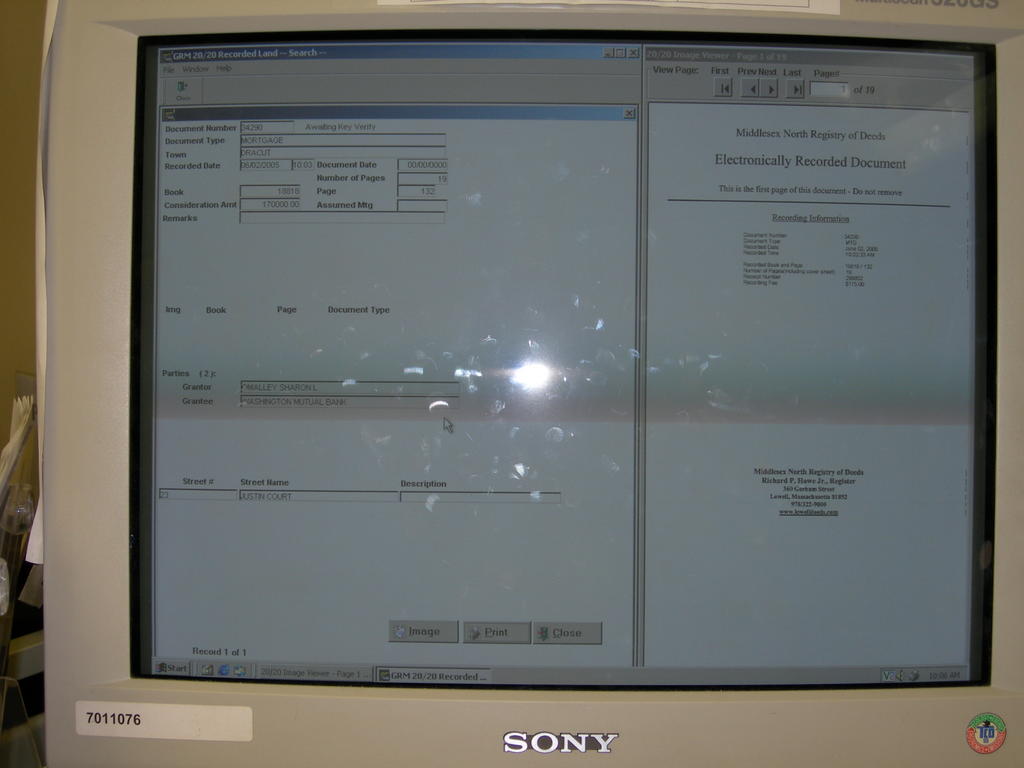
Today was an historic one for the Middlesex North Registry of Deeds. We conducted our first electronic recording of an actual document. About 10 a.m., a Midwestern bank submitted a 20+ page mortgage electronically and we had it recorded within minutes of receipt. Here’s how it works: When the customer submits a “payload” (which is one or more documents that form a single transaction), it zips through the Internet to an electronic queue on our computer system. As soon as something is in the queue, the first cashiering terminal to complete a transaction gets a popup box that says “You have one electronic recording waiting to be processed.” With that, the recording court opens the electronic recording feature on the same terminal. As soon as it opens, the image of the electronically submitted document and the data entered remotely by the submitter appear on the cashiering terminal screen. Our first task is to ensure the document type and the corresponding fee are correct. If they are not, we reject the document. For example, if someone submits a deed (filing fee of $125) but calls it a certificate (filing fee of $75) we must reject it because we have no way to alter the fee. There are some things we can change, such as a party name. For example, say the submitter typed ABC Incorporated as the grantor. Well, our Indexing Standards identify “Incorporated” as a mandatory abbreviation – it must always be changed to “Inc.” In such a case, we would make the correction immediately. We will take a few days to digest today’s experience and will then start posting proposed rules and regulations on our website. Please check back early next week for electronic recording updates.

Wednesday, June 01, 2005

Attack of the Zombies

When I was growing up, a Zombie was “a thing” that hid under my bed when my parents were out. Of course…things have changed…today Zombies are personal computers that are controlled by another. Unlike the Zombies of my youth (which were usually controlled by aliens) today’s Zombies are controlled by computer hackers. The government, (that’s our leaders, not the ones from Mars) believe hackers seize the brains of approximately 175,000 computers each day… turning them into…Zommmbieees. The real Zombies, or should I say the ones I grew up with, usually attacked couples at drive-in’s and obliterated their brains. Today’s Zombies attack web servers… collect personal information… them……… send……SPAM!!!!!…..Oh no, it’s…it’s .…SPAMMM!……In an effort to stop the attacks, the Federal Trade Commission has asked Internet Providers to provide free downloads of Zombie killing software to their customer. In the old days, it was not that easy to kill a Zombie. Bullets couldn’t stop them, fire couldn’t stop them. They seemed to be…well…unstoppable. Of course, after about ninety minutes (not including the intermission) an action hero like Steve McQueen finally destroyed them. Today’s Zombies are out of control. In May the average number of Zombie computers increased by 10% a day. This led the FTC to begin “Operation Spam Zombies”. Since experts seem to have little faith in this operation and Steve McQueen is no longer with us…The Attack of the Zombies will continue… at least until Arnold finds out about them.

Tuesday, May 31, 2005

Time to Buy a Shredder

A front page story in today’s Lowell Sun reminds us that an important provision of the Fair and Accurate Credit Transactions Act (FACTA) goes into effect tomorrow. This law mandates that “any person who maintains or otherwise possesses consumer information for a business purpose” must destroy this information before it is discarded. The proper way to destroy such information is by “burning, pulverizing or shredding.” FACTA says that “consumer information” includes, but is not limited to “social security numbers, driver’s license numbers, phone numbers, physical address, and e-mail address.” The penalty for violating this law is up to $1000 per violation plus liability to the effected person for his actual damages. Alright, I have to confess that prior to reading today’s newspaper, I had never heard of this and, if you’re a regular blog reader, you know that I try to stay up to date on these type of privacy matters. (If I had heard of it before today, I might have bought some stock in a shredder company). What are the practical implications of this law? If a “consumer” sends us a letter at the registry and the envelope bears the consumer’s name and physical address (i.e., his home address), I can no longer just throw that envelope in the trash: I have to “burn, pulverize or shred” it. Same thing with an in-bound e-mail that contains the sender's e-mail address. If I print it, I can’t throw it away without shredding it first. A long, long time ago in a prior career, I was a “top secret document custodian” and it was a tough job. Everything had to be shredded and then the shredded paper had to be burned. It took a significant amount of effort just to throw something away. As of tomorrow, it seems that all of us will have to put a similar amount of effort into destroying papers that we have always just thrown in the trash. For the record, the registry bought its first shredder more than a year ago to handle employee-related paperwork that was to be thrown away. It looks like the usage of this machine will be increasing significantly.

Friday, May 27, 2005

Future Plans

For about an hour early this morning the sky was blue and what we used to know as the sun popped up over the horizon, but that window slammed shut and our normal gray sky has returned. Yesterday’s blog entry listed the top ten milestones in the past decade’s technological evolution of the registry. Change continues and today will take a glimpse at the future. We’re making a major push this summer to convert the remainder of our records to an electronic format. One ongoing project – scanning the 200,000 or so original registered land documents that reach back to 1898 when the Land Court came into existence – will probably be done by the Fourth of July. We have also started to receive CDs with the images of documents contained in record books 1 through 1129 from the company the Secretary of State’s office hired to convert registry microfilm to images. I’m not sure how quickly these images will be integrated into the ACS system, but we’ll find a way to make them available both in the registry and online. The important things is that they now exist in an electronic format. This means all document images from 1855 – the year the Middlesex North Registry opened – to the present will be available electronically. Next, we come to the recorded land indexes. Our searchable index only goes back to 1976, but earlier this year we had a major breakthrough when we were able to present older indexes in an “electronic book” format on CDs. It’s not the perfect solution, but it works and it’s completely affordable. Right now, we have everything from 1950 to 1975 available in this way. After Labor Day, we’ll probably shift back to this project and move back in time, adding additional Grantor Indexes and perhaps starting Grantee Indexes, as well. Then there’s the marginal reference project. You see, when we convert microfilm of documents to electronic images, we’re working with film that was shot right after the record book was created, so anything added to the book – marginal references – would not appear on the film. Consequently, those electronic images are not as useful as the books which do contain the marginal references. To resolve this discrepancy, we’ve been going through our older record books, page by page, and entering all marginal references into a database. Eventually, this data will be imported into the ACS system, but in the short term, we will be producing lists that will work like this: say you’re interested in a mortgage that’s recorded at book 1250, page 5, you’d just look for that book and page number in our marginal reference list and any book and page numbers that were written as marginal references on that particular page will be shown. Again, it’s not perfect, but it will work. Anyway, there are a few other projects on the drawing board – scanning registered land certificates, electronic recording, geographic information systems – but time and space dictate they’ll have to wait until next week. Enjoy Memorial Day.

Thursday, May 26, 2005

Memory Lane

The real estate market may be slipping, but there’s still plenty going on at the registry of deeds. June will be a very busy month behind the scenes with a variety of projects, papers and presentations all coming due. While preparing one of these earlier today I began listing the major events that have shaped the registry during the past ten years. Here’s my list, roughly in chronological order but without any comment or analysis. That will have to come later. (1) creating a Customer Service Department where all incoming calls, mail, and walk-in customers make their first contact with the registry; (2) completing the “10 year index” project, which added grantor index entries from 1976 to 1986 to the Wang computer system; (3) the state legislature abolished insolvent Middlesex County, making the registry of deeds a division of the Secretary of State’s office; (4) with a nearly limitless source of funding for Y2K preparations, we not only made our increasingly obsolete Wang computer system Y2K compliant, but we also added state of the art servers, cabling, and a variety of scanners, printers and computers that formed the backbone of today’s registry, (5) we hired a company to scan microfilm of all documents recorded since 1950, giving us 50 years worth of document images on our computer system; (6) we launched lowelldeeds.com, an interactive website that gave users access to all document images over the Internet at no charge; (7) the Registers of Deeds Association adopted Massachusetts Deed Indexing Standards; (8) we installed the ACS computer system, successfully converting all our old proprietary format Wang data; (9) we established a link to masslandrecords.com, the state’s website for land records which is instantly updated with new recordings and which has revolutionized the way customers use the registry; (10) we converted our Grantor Indexes from 1951 to 1976 into electronic books and distributed them on CDs, giving us 55 years of Grantor Index coverage. There are many more, but ten seems

Wednesday, May 25, 2005

Certificate Scanning

The people at the Suffolk Registry of Deeds have been kind enough to lend us two document scanners for the next few months. The plan is to use these to scan old registered land certificates. The certificates are an unusual size and do not fit in most scanners. The “Suffolk” scanners have an automatic feed which is slightly larger most and duplex capability. The larger feed will physically accept our registered land certificates. Although we have not tested the image “capture size”. Using summer interns we hope to make quick strides on the project. After the first few weeks we will set goals and an estimated completion date. Stay tuned.

Tuesday, May 24, 2005

Housing Market Slippage?

Dodging the incessant rain showers this past weekend, I went for a walk through my Lowell neighborhood and observed that For Sale signs were nearly as common as dandelions on front lawns. My guess is that there’s no great increase in the number of properties that are being placed on the market but that the homes that are for sale are staying on the market for much longer. Just last week, Alan Greenspan, chairman of the Federal Reserve, said that the red-hot housing market is unsustainable. Greenspan hesitated to call it a national bubble (that presumably could burst). Instead, he used the word “froth” to describe the numerous “local bubbles” around the country. He also said that since prices have increased so much, only those who purchase just before the inevitable downslide begins will be harmed. The economist Paul Krugman presented a bleaker picture, however, asserting that the low interest rates that are sustaining such high real estate prices are kept low by the Chinese government which last year bought $200 billion worth of dollars and this year is on track to buy $300 billion – that’s BILLION. Krugman argues that should China take all of its money elsewhere, the ever increasing US budget deficit will cause interest rates to skyrocket with dire consequences for many new homeowners. Sounds ominous. On the other hand, if it would ever stop raining maybe home buyers will venture out and get house sales moving again.

Monday, May 23, 2005

Ah, the Good Old Days

Last week, while preparing old registered land documents for scanning, registry employees found portions of several newspapers from 1937 & 1938 (The Lowell Sun, The Lowell Sunday Telegram, The Lowell Courier Citizen and The Lowell Evening Leader). The newspapers were recorded by Lowell Tax Collector, Albert Blazon as exhibits to documents recorded for non-payment of taxes. Of course, the papers are filled with fascinating news items and advertisements. It would take many blog entries to list them all…so I have selected a few of the more interesting onesto mention:

This week at the Strand Theatre (or should I say June 5, 1937)- Claudette Colbert stars with Robert Young in I Met Him In Paris.

Don’t like the movies? You can go to the “Ward One Bingo Night” at the Memorial Auditorium (that’s if you can afford it)…admission $.40 cents.

Hungry? The Rex is offering a Southern Fried Chicken Dinner…complete… you get corn fed chicken, soup, tomato juice, fresh rolls, potato croquettes and dessert…all for $.50cents…(to tell the truth…I think this is a better deal than the Bingo Night).

The papers have numerous comic strips: “Tarzan”, “Neighborly Neighbors”, “Dickie Dare”, “Big Sister”…(nope, “Charlie Brown” wasn't born yet).

Another article gives the details of a Lowell Commercial College social held at Vesper Country Club. Among those in attendance was the Honorable Mayor Dewey Archambault.

I love this headline from 1938…“Pedestrians Urged To Use More Care”…(hey, what about the drivers?).

On a more serious note… one of the papers contains an article concerning the Mayor of New York City, who apparently said something “hateful about the ruler of Germany”. The remark infuriated the ruler (whose name is never mentioned) and an apology is demanded of the US government, which appears to have been given.

As the weeks go on we will probably re-visit these newspapers…fun stuff. By the way in case you were wondering...June 5, 1937 was a Saturday.

Thursday, May 19, 2005

Registered Land Seminar

Yesterday I traveled to Greenfield to attend a Registered Land Seminar organized by Franklin County Register of Deeds Peter Wood and his staff. The featured speaker was Ed Williams, the Chief Title Examiner of the Land Court. Representatives from each of the 21 registries of deeds in Massachusetts attended. Participants had submitted questions in advance and the program consisted of Attorney Williams addressing each of those questions in detail. Because the participants were almost exclusively registry employees who work in their respective registered land sections, the questions were all involved practical, real world issues. Ed did a fantastic job of responding. He certainly demonstrated incredible physical stamina by staying “on stage for almost five straight hours” which had to be an exhausting experience. And the content of his answers were informative and extremely helpful. The topics discussed are too numerous to mention right here, but we all took extensive notes. In the near future, we plan to compile these notes into a brief document that might serve as a supplement to the current Land Court Guidelines. I’ll certainly be returning to this topic in future postings, so please check back if this area is of interest to you.

Wednesday, May 18, 2005

MLS

The National Association of Realtors is attempting to head off challenges from web-based real estate sale sites. The Realtors want to enact a rule that would allow a brokerage that belongs to the Multiple Listing Service to bar other MLS members from putting their listings on the web. This change would allow a brokerage to decide which realtors could sell their listings on the Internet and which could not. The proposal has been in the works for two years. The United States Justice Department does not agree with the trade organization. The Feds have threatened an antitrust lawsuit to block the rule. Recently, lawyers for the federal government and the NAR meet to try and work out a compromise. According to the Wall Street Journal …Laurie Janik, general counsel for the group said, “it is likely that the Realtors will offer to remove the provision for selective exclusion. In that case an MLS member would have the choice of allowing all other members to display the information or blocking all of them from doing so”. At issue is the rise of discount brokerages that rely heavily on the MLS and the Internet to service customers. Because their costs are lower they charge a lower commission posing a threat for the larger more traditional companies.

Tuesday, May 17, 2005

Proposed Homestead Amendment

I traveled to Beacon Hill today to join Lowell State Representative Kevin Murphy in testifying in favor of a bill he filed that would clarify two glaring ambiguities that exist in the current homestead statue. The first is whether a mortgage automatically terminates an existing homestead. We've been through this before, but for our new readers, here's the issue: an existing homestead is automatically terminated by a deed. In Massachusetts, a mortgage is technically a deed. Therefore, the mortgage might-does-will terminate the homestead. For every lawyer I find who agrees with the foregoing, I find another who reaches the opposite conclusion. Hence the need for legislative clarification. The second ambiguity involves homesteads filed by spouses. Under current law, if the spouses are 62 or older, they both (each?) can file a homestead, but if they are not yet 62, only one spouse may file it. And if they do both file, can they "stack" the coverage provided by the homestead thereby achieving a total equity exemption of $1 million. Although a recent bankruptcy court ruling said you can't stack homesteads, this area is very ambiguous, as well. Rep Murphy's bill would allow all spouses to declare a homestead and would also allow reciprocal spousal homesteads to provide double the exemption amount. Although the Judiciary Committee certainly had much on its plate at today's hearing, they did seem to give this bill their full attention. We will follow it as it moves through the legislative process. On another note, tomorrow I travel to Greenfield to attend a Registered Land seminar sponsored by the Franklin County Registry of Deeds. I'll post a full report on the seminar in this Thursday's post.

Monday, May 16, 2005

MBA

This morning I had the unique opportunity to talk with Robert Cox, President of the Media Bloggers Association. You may remember last week I wrote about a blogger’s convention run by Cox in Nashville. This morning I asked Cox if he envisioned blogs as the next generation of newspapers as some have speculated. Cox said he believes that most major newspapers will actually enter the blogging arena themselves. Cox may be right on with his supposition. Just a couple of days ago reports came out that the New York Times was considering launching a blog. He also felt that blogs would seriously influence hyper-local citizen’s media. Hyper-Local Citizen’s Media (what the heck is that?) These are information websites that are written by “citizens” about local issues. The best restaurants in town, the selection of the new high school principal, discussion about a community’s budget, these are typical topics presented on a hyper-local site. Cox also discussed the audio-blog and its big brother the Podcast. He sees these as competitor of satellite radio. I told him I was overwhelmed with the twists and turns that information mediums were taking…after the conversation I asked my self… I am getting old?

Friday, May 13, 2005

Podcasting Revisited

We’ve written about podcasting before and since it is an emerging technological trend, we’re writing about it again. The word “podcast” emanates from Apple’s iPod music player but it does not require an iPod to participate. The term podcasting describes the act of recording an audio file on your computer and then posting it on the Internet so that others may listen to it. They can download it to an iPod and listen to it as they would music, or they can listen to it right on their computer as it streams from the Internet. The attraction of podcasting is that for very little money and time, anyone can create the equivalent of a radio program about any topic imaginable. While podcasts certainly don’t have the reach of 50,000 watt WBZ radio, they do allow a type of very precise specialization that would never work for commercial radio. We’ve experimented with a type of podcasting with our short audio snippets about the registry, but full scale podcasting may not be far behind. In the meantime, here are some online directories with links to thousands of podcasts. We haven’t screened everyone of them so we’re not attesting to the quality or content, but it might we worth exploring if you have a chance.
Podcast.net (www.podcast.net) - Podcasting News (podcastingnews.com) - Podcast Alley (www.podcastalley.com) and iPodder.org (www.ipodder.org).

Thursday, May 12, 2005

Geographic Information System

Back in 1999 we explored the role that a Geographic Information System might play at the registry of deeds. A Geographic Information System (GIS) is a computer system “capable of storing, manipulating, and displaying geographically referenced information” such as boundary lines, roads, waterways, zoning districts, wetlands and any thing else that can be depicted on a map. As the primary repository of all documents related to land ownership, the registry of deeds certainly has a role to play in any GIS. Six years ago, the technology (fast computers and readily available high speed Internet connections, for example) and the inventory of electronically based data, documents and map images were insufficient to support such a system for anything beyond simple demonstrations. Well as you all know, computer technology changes rapidly and in the tech field, six years is an eternity, so we are revisiting the entire GIS concept. As much by coincidence as by design, we have made contact with MassGIS, the Commonwealth’s office of Geographic and Environmental Information and learned of the tremendous strides that office has made in making a GIS system that other systems – such as a registry of deeds – can plug into to greatly enhance the quality of data we make available to the customers of both the registry and of MassGIS (http://www.mass.gov/mgis/massgis.htm). Imagine using our website to view legal documents about a particular parcel and then, with a simple click of an on-screen link, going directly to an over head photograph of that parcel with the applicable lot lines and road layouts overlaid on the photograph. The easy-to-use MassGIS interface would then permit you to overlay zoning districts, wetlands delineations, the location of schools, police and fire stations and just about any other type of information that can be depicted on the map. For now, we’re experimenting with different concepts to try to decide what works best.

Wednesday, May 11, 2005

Middlesex North Times

The increase in the number and significance of blogs is historic. Categorizing the event as historic is not an exaggeration. Blogs have forever changing the information world, as we know it. According to Jay Rosen, well-known press critic and writer, during the horrific tsunami disaster bloggers actually beat big Journalism at its own game. Last month at a convention of the National Association of Broadcasters, long time news journalist Sam Donaldson made a statement that shocked his audience. “We’re going out of the network news business”, Donaldson told his audience “The old days…are going thanks to changing technology”. At the same convention Jeff Greenfield, a senior analyst with CNN, said blogs are rapidly changing the face of journalism. There is no doubt both print and television news are feeling the awesome effects of the Internet. They offer the public quick, large-scale avenues to read about stories usually covered by traditional news outlets. Last week in New Jersey there was a convention of the “Media Bloggers Association. One of the main topics of discussion was journalistic standards for bloggers. For many, blogging is simply an informal "express yourself" tool, but for others it has become a serious means of communicating news. There are many that believe print news is destined for extinction or evolution into some electronic medium like blogs …but… I won’t my breath waiting for the Middlesex North Times

Tuesday, May 10, 2005

Skimming - A New Type of Crime

Today’s Globe has a fascinating front page story that explains the arrest of a man who allegedly stole more than $400,000 from numerous bank accounts. How did he get the money? By withdrawing it from ATM machines with duplicate ATM cards. According to the police, this scheme is called “skimming.” Here’s how it worked. The criminal obtained a magnetic strip reader, a relatively common device available for less than $1000 on eBay. He would then mount this device at the ATM’s location, either at the entry door that requires users to swipe their cards to gain access or somewhere on top or in front of the real card reader. In either case, unwary bank customers would swipe their ATM cards, allowing the bogus card reader to capture and store the information encoded on the magnetic strip of the real card. The perpetrator would also mount a tiny video camera near the ATM keypad. This would transmit video of the customer poking his PIN number into the ATM’s keypad back to the criminal’s notebook computer screen. As soon as the customer left, the criminal would retrieve the data from the magnetic card reader, use it to format the magnetic strip on a new card with the same information, then write down the PIN number on a paper sticker attached to a card. Then, either he or an accomplice would go to another ATM and withdraw as much cash as possible from the account. When asked how an individual can defend against this kind of operation, the police had two suggestions. Whenever you use an ATM or any kind of card reader, look for anything suspicious or out of place. If something doesn’t look right, it probably isn’t. The other thing you can do is use your free hand and body to block the view of others as you enter your PIN number. I once saw a report by a police officer who was assigned to a major airport. He explained that one day he saw a nice looking family grouped together while the father filmed them with a video camera. The next day, the same family was in the same place shooting the same video. He grew suspicious, but it was only on the third day of seeing this that he realized that the background for this family portrait was a bank of pay telephones and the video camera was being used to record callers entering their phone credit card numbers which would then be used by others for all types of purposes. Here on the registry blog, we’ve often written about identity theft and its consequences. This story is further evidence that this stuff really does happen, so it’s incumbent on all of us to take it very seriously.

Monday, May 09, 2005

Doors Open Lowell

Saturday was the annual “Doors Open Lowell” event. Approximately thirty people visited the Middlesex North Registry of Deeds despite the soggy weather. There were even people who came from Boston and Springfield to visit the historic buildings of Lowell. Register of Deeds Dick Howe gave tours of the Superior Courthouse and Registry. Interesting display panels dealing with various topics related to Middlesex North communities were available for public view as well. Over the years the registry developed these panels to commemorate important events in history. Display panel topics included: the role of the Middlesex North communities in the battle of April 19, 1775; the Irish in Lowell with a recently discovered map of “Paddy Camp Lands”; black history month and various deeds of interest including Lowell’s own Jack Kerouac. In addition visits viewed a video slide show, which included unique pictures of the interior and exterior of the Superior Courthouse. One sequence of frames showed close ups pictures of the clock tower and the clocks works. It’s strange when you work in a building… you never really appreciate it. Participating in “Doors Open Lowell” reminded me of the Superior Courthouse’s historical and architectural significance.

Friday, May 06, 2005

Foreign Language Docusments Part 3

This is the third and hopefully last installment of this discussion of foreign language documents. Here is my attempt at the language of a translator’s certification: “I, Joe Translator, hereby certify that the foregoing English language document is a true and accurate translation of the German language deed from Harry Seller to Mary Buyer dated May 6, 2005 and attached hereto. Signed under the pains and penalties of perjury this 6th day of May, 2005. /s/ Joe Translator.” The ever helpful Corporations Division at the Secretary of the Commonwealth’s office sent me a couple of foreign language documents with English translations that might serves as models of this certification. One, written on the letterhead of “bli translations: a division of The Boston Language Institute” states “I, Joe Translator, certify to the best of my knowledge and belief that the following is a true and accurate translation of a document from Spanish to English done under my supervision this 31st day of March 2005. /s/ Joe Translator.” I think anything resembling these certifications should be sufficient to get on record at the registry of deeds. Of course, the more evidence of the reliability of the translation you can present on this certificate, the less likely you will get a Friday afternoon call five years from now questioning the validity of the deed. For example, the certification on the “Boston Language Institute” letterhead seems more reliable than the same thing printed on plain paper. Any additional facts that help establish the qualifications, training or experience of the translator could also be included in the certificate. On another note, we are working on a master index of our blog that will group our entries by topic, but more on that in the near future.

Thursday, May 05, 2005

More on Foreign Language Documents

Perhaps it’s appropriate on Cinco de Mayo to revisit the issue of documents written in a foreign language. I wrote about our general policy a few days ago but the theoretical very quickly became the practical – a practical problem - when such a document was presented for recording earlier today. Concluding that the document, as presented, could not be recorded was the easy part. When the customer inevitably (and justifiably) asked “What else must be done to get this on record?” we were faced with a case of first impression, at least as far as this office is concerned. Here’s what happened, more or less: A parcel of land in Lowell is owned by a man who lives in Germany. A lawyer in the US drafts a deed in English and mails it to the man in Germany. The German takes it to a notary public in Germany who translates the English language deed into German, has his non-English speaking client sign the German language deed and then notarizes that deed. The German notary also has the client sign the English language deed, but the notary does not execute the acknowledgement section of that deed. The German notary then mails the original English language deed signed by the landowner but not notarized and the signed and notarized German translation of that English language deed to the lawyer in Massachusetts who then tries to record either or both here at the registry. Well, the English language deed could not be recorded because it was not notarized and the German language deed could not be recorded because it wasn’t in English. One option would be to send the English language version back to the German notary and have him complete the acknowledgement clause. To avoid sending it back to Germany, however, I suggested a different approach. Find someone locally who could translate the signed and acknowledged German language deed into English. The translator would then sign a certification attesting to the accuracy of his translation. The German language deed with the original signature and acknowledgement would then be attached to the English language translation and the translator’s certification. Since I have not found anything to serve as a model for the translator’s certification, I composed one myself, but we’ll discuss that tomorrow.

Wednesday, May 04, 2005

iPod?... why not uPod?

A few months ago I briefly blogged about “Podcasting”...the latest phenomenon in audio broadcasting. If you haven't heard yet, a Podcast is an audio file made usually by amateurs that is uploaded to the Internet. It is shared with other listeners through their computers or on portable digital listening devices. The most popular of these devices is an Apple “iPod”. “Podcasting” comes from combining the words iPod and broadcast. Podcasts are delivered on demand…users can listen to Podcast whenever they want. The topics of Podcasts run the gamut. You may hear some would be poet read his works or a focus group talk politics. The possibilities for both amateurs and professional with something to say is immense. This form of “radio” has recently been elevated to a new dimension. Sirius Satellite Radio is launching a new show that will feature a daily selection of do-it-yourself audio Podcasts. Infinity Broadcasting plans to convert one of its AM channels in San Francisco into a all Podcast program format. When I blogged on this topic several months ago, I never imaged that the craze would grow as quickly as it has. You can bet you’ll be hearing more about Podcasting in the near future.

Tuesday, May 03, 2005

Foreign Documents

An attorney called yesterday with an interesting question: he had a deed from a foreign country, acknowledged by a notary in that country, written entirely in the language of that country. His question: would we accept the deed for recording? Probably not, was my response, but not for the reason you might expect. Article 8.4 of the Massachusetts Deed Indexing Standards is directly on point on the notary issue. That article, in subparagraph (1), states that an acknowledgement made outside of the U.S. is valid if made before “a justice of the peace, notary public or magistrate of the country in which the acknowledge is made.” Unfortunately, this rule only applies to recorded land since the Land Court guidelines have the additional requirement that “the identity and office of the notary public or justice of the peace are authenticated by a certificate described in MGL c. 183, sec. 33, sometimes called an ‘apostille,’ issued by the competent authority of the country from which the document emanates.” When formulating the Deed Indexing Standards back in 1999, the Registers of Deeds Association specifically voted to dispense with the “apostille” requirement which is why recorded land and registered land have different standards for recording. The problem with the deed in question, therefore, was not the acknowledgement but the foreign language. Although I can’t find a citation right now (if anyone has one, please send it along), we do have a requirement that any document that is written in a foreign language must have a certified translation attached to it before it can be recorded. The rationale for this is simple: our duty is to create a legible, useful record of land transactions for future generations to use. Allowing a document written in a foreign language to be recorded without a translation attached would tend to frustrate the ability of most future users of our records to make use of such a document. I expect that this issue might be included in the next update to the Deed Indexing Standards (expected release date of January 1, 2006), so if you have any comments, please send them along.

Monday, May 02, 2005

Lights, Camera... Action

Located on the far end of our recording counter is the registry’s latest effort to provide information to the public. Last week we set up a new video presentation with a continuous stream of text and picture slides. The presentation includes pictures of employees during various special events at the registry; text messages explaining our policies for recording documents; an explanation of our documents return policy and many other tidbits related to registry operation. The video presentation is also being used to inform registry users when “pick-up boxes need to be emptied. The video presentation will be changed once a week and will include interesting, informative happening at the registry. On your next registry visit be sure to check it out and…as usual…if you have any suggestions feel free to like us know.